Tasmania is the island state south of mainland Australia, across Bass Strait. People come for its national parks (Cradle Mountain, Freycinet, Mount Field), the Port Arthur convict site, Hobart and its harbour, Bruny Island and the east coast. This Tasmania travel guide recommends going from December to March, during the southern summer; our itineraries cover 10 days to 2 weeks by car.
It brings together the main sights, two itineraries, national park entry rules, Bureau of Meteorology normals and a calculation we have not found elsewhere: day length and sunset time in Hobart, month by month, compared with Paris. For the rest of the country, see our Australia guide.
Our travel deals for Tasmania
Affiliate links: we earn a commission, at no extra cost to you.
FlightsKiwi.comCompare flights and airline combinations to Tasmania.
AirportsHobart and Launceston, by domestic flight (for example from Melbourne or Sydney)
EntryUS citizens: Electronic Travel Authority (ETA); UK citizens: eVisitor or ETA, before you travel
Electricity220–240 V, Type I plugs, according to Tourism Australia: US and UK travelers need an adapter
National parkspass required (Parks and Wildlife Service Tasmania)
Best timeDecember to March
Things to do in Tasmania: the main sights
Hobart and Mount Wellington
The state capital, Hobart, spreads out at the foot of Mount Wellington (kunanyi), whose summit offers a panorama over the Derwent estuary. On the harbour, Salamanca Place lines up old sandstone warehouses turned into galleries and restaurants. North of the city, MONA, a museum of ancient and contemporary art, is reached by ferry.
Port Arthur
On the Tasman Peninsula, east of Hobart, the Port Arthur Historic Site is one of the Australian convict sites on the UNESCO World Heritage list. The penitentiary ruins, church and officers’ houses take a day to visit, often combined with the peninsula’s cliffs.
Bruny Island
Reached by ferry from Kettering, south of Hobart, Bruny Island consists of two islands joined by a narrow isthmus (The Neck), with a lookout. Visitors come for the southern cliffs, the beaches and local produce (oysters, cheese).
Freycinet and Wineglass Bay
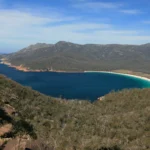
On the east coast, Freycinet National Park is known for Wineglass Bay, a crescent-shaped bay seen from a lookout after a walk uphill, then via a trail down to the beach. The pink granite peaks of the Hazards dominate the peninsula.
Bay of Fires and Maria Island
Further north, the Bay of Fires lines up white sand beaches and rocks covered in orange lichen. The east coast road links Freycinet, Bicheno and St Helens. Offshore, car-free Maria Island is explored on foot or by bike from the Triabunna ferry; you will come across wombats.
Cradle Mountain-Lake St Clair
In the heart of the island, this national park is part of the UNESCO-listed Tasmanian Wilderness. The Dove Lake circuit, at the foot of Cradle Mountain, is a classic walk. The park is also the start of the Overland Track, a multi-day hike to Lake St Clair: check bookings and conditions on the Parks Tasmania website.
Launceston and the north
The island’s second city, Launceston gives access to Cataract Gorge and the Tamar Valley and its vineyards. In the north-west, Stanley and its headland, The Nut, and in the west, Strahan on Macquarie Harbour, complete the tour.
Mount Field and the south-west
West of Hobart, Mount Field National Park is known for Russell Falls, reached by a short trail, and its tree-fern forests. Further on, the south-west is a wilderness region with few roads.
National parks: what you need to know
According to the Parks and Wildlife Service Tasmania (parks.tas.gov.au, checked 26 October 2026), a valid pass is required to enter the island’s national parks. Here are the rules that affect your planning:
Pass
Validity
What it covers
Best for
Daily Pass
24 hours
All parks except Cradle Mountain
A single park in one day
Icon Daily Pass (Cradle Mountain)
24 hours
Cradle Mountain, including the park shuttle bus
A one-off visit to Cradle Mountain
Holiday Pass
Up to 2 months
All parks; Cradle Mountain shuttle not included
A road trip around the island
Annual / Two-Year Pass
1 or 2 years
Vehicles registered to the holder’s address
Residents
Source: Parks and Wildlife Service Tasmania, « Park passes and entry fees », checked 26 October 2026. Fees are reviewed annually: check current prices on the official site.
The Holiday Pass is sold per vehicle (up to 8 people) or per person if you travel by bus, bike or on foot.
If you plan to visit several parks, the Holiday Pass is usually the most suitable option.
At Cradle Mountain, Holiday Pass holders buy shuttle tickets separately (at the Cradle Mountain Visitor Centre); the shuttle is included only in the Cradle Mountain day pass.
Itinerary: suggested routes in Tasmania
10 days: the essential loop
Days 1-2: Hobart, Salamanca, Mount Wellington, MONA
Day 3: Port Arthur and the Tasman Peninsula
Day 4: Bruny Island
Days 5-6: Maria Island and Freycinet
Day 7: Bay of Fires
Day 8: Launceston and Cataract Gorge
Days 9-10: Cradle Mountain, then depart from Launceston
2 weeks: including the west
Days 1-4: Hobart, Port Arthur, Bruny Island
Days 5-7: Maria Island, Freycinet, Bay of Fires
Days 8-9: Launceston and the Tamar Valley
Days 10-11: Stanley and Cradle Mountain
Days 12-13: Strahan and Macquarie Harbour
Day 14: Mount Field and back to Hobart
When to go to Tasmania
Go from December to March: the southern summer, with an average high of 23.1 °C (74 °F) in January in Hobart and days of nearly 15 hours. Hobart gets little rain (about 464 mm / 18.3 in a year at the airport), but the climate is cool: lows stay around 12.6 °C (55 °F) in summer and drop to around 4.4 °C (40 °F) in July. The west of the island and the mountains are wetter and colder. The UK FCDO (GOV.UK, updated 19 March 2026) notes a higher bushfire risk from October to February. To compare with the mainland, see when to go to Australia.
Month
High °C (°F)
Low °C (°F)
Rain mm (in)
Rainy days
Verdict
January
23.1 (74)
12.6 (55)
40.7 (1.6)
9.0
✅ Warmest, long days
February
22.5 (73)
12.4 (54)
35.2 (1.4)
8.8
✅ Warm and dry
March
21.1 (70)
11.0 (52)
34.1 (1.3)
10.3
✅ Still mild
April
18.2 (65)
8.8 (48)
35.6 (1.4)
10.1
⚠️ Autumn, cooler
May
15.6 (60)
6.9 (44)
30.4 (1.2)
10.3
⚠️ Cool, short days
June
13.2 (56)
4.9 (41)
38.9 (1.5)
11.4
❌ Winter, under 9 h of daylight
July
13.0 (55)
4.4 (40)
33.8 (1.3)
13.0
❌ Coldest month
August
13.9 (57)
5.0 (41)
46.0 (1.8)
13.6
❌ Cold, more rainy days
September
15.7 (60)
6.4 (44)
39.8 (1.6)
13.9
⚠️ Cool spring
October
17.7 (64)
7.9 (46)
40.2 (1.6)
13.3
⚠️ Mild but changeable
November
19.5 (67)
9.7 (49)
42.2 (1.7)
12.4
✅ Spring, long days
December
21.4 (71)
11.2 (52)
46.6 (1.8)
11.3
✅ Start of summer
Source: 1991-2020 normals for the Hobart Airport station published by the Bureau of Meteorology (Australia’s weather service). Rainy days: days with at least 0.2 mm.
Hobart and Launceston compared
Month
Hobart high / low °C
Launceston high / low °C
Rain Hobart mm (in)
Rain Launceston mm (in)
January
23.1 / 12.6
24.8 / 12.6
40.7 (1.6)
51.5 (2.0)
April
18.2 / 8.8
18.9 / 7.5
35.6 (1.4)
51.2 (2.0)
July
13.0 / 4.4
12.8 / 2.5
33.8 (1.3)
78.6 (3.1)
October
17.7 / 7.9
18.2 / 7.0
40.2 (1.6)
48.3 (1.9)
Source: Bureau of Meteorology, 1991-2020 normals (Hobart Airport; Launceston).
Launceston, in the north, is slightly warmer in summer but colder at night in winter (2.5 °C / 37 °F in July) and gets about twice as much rain in winter.
Day length and sunset: Hobart vs Paris
At 43° south, Hobart has reversed seasons and large swings in day length. To plan your hikes and drives (driving at dusk and at night means more wildlife on the roads), here is our calculation for the 15th of each month, with Paris as a Northern Hemisphere reference.
Month
Day length in Hobart
Day length in Paris
Sunset in Hobart (local time)
January
14 h 55
8 h 45
20:50
February
13 h 45
10 h 15
20:18
March
12 h 25
11 h 55
19:32
April
10 h 55
13 h 45
17:40
May
9 h 40
15 h 20
16:58
June
9 h 05
16 h 10
16:44
July
9 h 20
15 h 45
16:58
August
10 h 25
14 h 25
17:28
September
11 h 45
12 h 35
18:00
October
13 h 10
10 h 50
19:34
November
14 h 35
9 h 15
20:14
December
15 h 20
8 h 15
20:46
Destination de Voyage calculation: astronomical position of the sun on the 15th of each month in 2026 (Hobart 42.88° S; Paris 48.86° N), Hobart local time including daylight saving. Values rounded to within a few minutes.
In January, about 14 h 55 of daylight in Hobart, 6 h 10 more than in Paris, with sunset around 8:50 pm.
In June, only 9 h 05: the sun sets around 4:44 pm. Plan your drives early in the day.
Budget for a trip to Tasmania
Costs are those of Australia, high for many visitors, and vary a lot with the season: check them when booking rather than relying on a fixed figure. Items to plan for: car rental (almost essential), the national parks pass, ferries (Bruny Island, Maria Island) and accommodation.
Getting there and getting around Tasmania
Arriving: by air to Hobart or Launceston from Melbourne, Sydney or other Australian cities, or on the Spirit of Tasmania ferry from Victoria to Devonport, with your vehicle.
Car: traffic drives on the left (U.S. Department of State). UK visitors can drive with a UK photocard licence as temporary overseas visitors and must carry their licence and passport when driving (GOV.UK); US drivers should check the rules of the state they will drive in.
Rural roads: some are unsealed and wildlife is abundant: avoid driving at night where possible.
Bus: lines link the main towns but serve the parks poorly.
Local ferries: Kettering – Bruny Island, Triabunna – Maria Island.
Where to stay in Tasmania
Base
Best for
Highlights
Hobart (Salamanca, Battery Point)
First stop
Harbour, restaurants, trips to Port Arthur and Bruny
Coles Bay or Bicheno
East coast
Close to Freycinet
Launceston
North
Cataract Gorge, Tamar Valley
Around Cradle Mountain
Hikers
Early starts on the trails
Strahan
West
Macquarie Harbour
Entry requirements, health and safety
US citizens: according to the U.S. Department of State (travel.state.gov, last updated August 13, 2026), you need a valid US passport and a visa or an approved Electronic Travel Authority (ETA). For tourism or business stays of less than 90 days, the ETA, obtained through the Australian ETA app for a small fee, is enough. Overstaying, even briefly, can lead to detention and removal.
UK citizens: according to the UK FCDO (GOV.UK, updated 19 March 2026), you must have a visa to visit Australia: usually an eVisitor visa (no application charge) or an ETA through the ETA app (no visa charge, but there may be a service fee). Your passport must be valid for the length of your planned stay.
Customs and quarantine: you must fill in an Incoming Passenger Card and declare risk goods such as food, animal products and plant material (GOV.UK). For allowances on your return, check your home country’s rules (e.g. CBP in the US, HMRC in the UK).
Beaches: rip currents are the main hazard for swimmers and can occur at any beach (UK FCDO); swim only between the flags where a lifeguard is present, and never alone (U.S. Department of State).
Bushfires and heat: the bushfire risk is higher in spring and summer, from October to February, and extreme heat is a serious risk (UK FCDO, GOV.UK, updated 19 March 2026).
Health: UK visitors get essential and urgent hospital treatment free under a reciprocal agreement, with charges for GP visits and prescriptions (GOV.UK); US travelers should check their insurance covers care abroad.
Emergencies: dial 000 for ambulance, fire and police.
Wildlife: Australia has many dangerous species, including sharks, venomous snakes and spiders (UK FCDO and U.S. Department of State).
Hiking: research the area, prepare for the terrain and weather; it can take hours to get help in an emergency in the bush (UK FCDO).
Entry requirements checked on 26 October 2026; check them again before you travel. See our travel insurance guide.
Practical tips for Tasmania
Packing: even in summer, bring warm layers and a windbreaker; the weather changes quickly in the mountains. See our packing list.
Payment: cards and contactless payment are widespread.
Mobile data: mobile coverage is weak or absent in some parks; see our eSIM guide.
Wildlife: do not feed wild animals (wombats, wallabies, Tasmanian devils).
December to March, during the southern summer: an average high of 23.1 °C (74 °F) in January in Hobart, according to the Bureau of Meteorology.
How many days do you need in Tasmania?
Ten days for an essential loop by car, two weeks to include the west and north-west.
Do you need a pass for Tasmania’s national parks?
Yes, a pass is required. For several parks, the Holiday Pass (up to 2 months) is the most suitable; the Cradle Mountain shuttle is bought separately with it, according to Parks and Wildlife Service Tasmania.
How do you get to Tasmania?
Fly to mainland Australia, then take a domestic flight to Hobart or Launceston, or the Spirit of Tasmania ferry from Victoria.
Do you need a visa for Tasmania?
Tasmania is part of Australia: US citizens need an Electronic Travel Authority (ETA) and UK citizens an eVisitor visa or an ETA, according to the U.S. Department of State and the UK FCDO.
Is Tasmania cold?
The climate is cool: in Hobart, average lows are about 12.6 °C (55 °F) in January and 4.4 °C (40 °F) in July.
Our sources
Bureau of Meteorology: 1991-2020 normals for the Hobart Airport station, via the Wikipedia article « Hobart »
Bureau of Meteorology: 1991-2020 normals for Launceston, via the Wikipedia article « Launceston, Tasmania »


 FlightsKiwi.comCompare flights and airline combinations to Tasmania.Compare flights