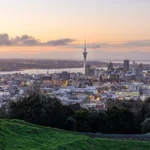
Auckland (Tāmaki Makaurau in Māori), New Zealand’s largest city, is often the gateway to the country. Built on an isthmus between two harbours and on a field of some fifty volcanoes, you visit Auckland for the Sky Tower, volcanic cones such as Mount Eden, the Auckland Museum and the Hauraki Gulf islands of Rangitoto and Waiheke. What to see in Auckland, how many days to allow, when to go based on official NIWA normals and the entry requirements: here are the essentials.
The city stretches between the Hauraki Gulf to the east and the Tasman Sea to the west; its centre faces the Waitematā Harbour, with the Manukau Harbour to the south. Nicknamed the « City of Sails », it hosted three editions of the America’s Cup at the Viaduct Basin (2000, 2003, 2021). After a long-haul flight, it is an ideal stop to recover from jet lag before setting off on the country’s roads.
Our travel deals for Auckland
Affiliate links: we earn a commission, at no extra cost to you.
FlightsKiwi.comCompare flights and airline combinations to Auckland.
Time zoneUTC+12, UTC+13 during the southern summer: 11 to 13 hours ahead of London, 16 to 18 hours ahead of New York depending on the season
AirportsAuckland Airport, south of the city, the country’s main international gateway
Entryno visa for US and UK visitors, but an NZeTA is required before travel; see entry requirements
HighlightsSky Tower, Mount Eden, Auckland Museum, Auckland Domain, Viaduct Harbour, Devonport, Rangitoto, Waiheke, west coast beaches
What to see in Auckland: the highlights
The Sky Tower
Standing 328 m (1,076 ft) to the tip of its mast, the Sky Tower is a telecommunications and observation tower completed in 1997, at the corner of Victoria Street and Federal Street, right in the centre. It was the tallest freestanding structure in the Southern Hemisphere from 1996 to 2022 and is now the second tallest. Several upper levels are open to the public, with views over both harbours and the volcanoes. It is part of the SkyCity complex.
Mount Eden (Maungawhau) and the volcanoes
Auckland is built on a volcanic field of about 53 monogenetic volcanoes: explosion craters, tuff rings, scoria cones and lava flows. Apart from Rangitoto, none has erupted more than once. From the summit of Maungawhau / Mount Eden, the view takes in the Waitematā Harbour and the Hauraki Gulf. Maungakiekie / One Tree Hill, south of the centre, still has the terraces of a former pā (fortified Māori village). Stay on the paths: these cones are protected sites. Further into the South Pacific, our guide to Samoa and its islands presents another destination.
Auckland Museum and the Auckland Domain
The Auckland War Memorial Museum (Tāmaki Paenga Hira) is both one of the country’s leading museums and a war memorial. Its neoclassical building, from the 1920s and 1950s, stands on Observatory Hill, the remains of a dormant volcano, in the heart of the Auckland Domain, one of the city’s largest parks, very close to the centre. The collections cover the history of New Zealand and the Auckland region, natural history and military history.
The centre, Viaduct Harbour and the art gallery
The city centre is easy to explore on foot around Queen Street and Britomart. On the water, the Viaduct Basin, which hosted the America’s Cup, is the waterfront district; nearby, the Ferry Building is the departure point for ferries. The Auckland Art Gallery, whose modern wing was completed in 2011, is the city’s main art gallery; the city also has the New Zealand Maritime Museum.
Devonport
Across the Waitematā Harbour, on the North Shore, Devonport is a district with heritage charm, known for its waterfront cafés and restaurants. It is home to the main base of the Royal New Zealand Navy and its museum. North Head, the headland guarding the harbour entrance, and Mount Victoria offer views of the city and Rangitoto. You get there by ferry from the centre.
Rangitoto Island
Facing the city, Rangitoto is a shield volcano 5.5 km (3 mi) wide, rising to 260 m (853 ft). It is the youngest and largest volcano in the Auckland field: it formed in two eruptive phases, around 1450 and 1500, about 600 years ago. A causeway links it to the much older island of Motutapu. Ferries serve the island from the centre; take water and walking shoes, as the lava ground is rough.
Waiheke Island
The second-largest island in the Hauraki Gulf, Waiheke is the most populated and the most accessible, with passenger and car ferries. Ferries arrive at the Matiatia terminal. People come for its beaches, vineyards and villages, for the day or overnight.
The west coast: Piha and the Waitākere Ranges
West of the city, the Waitākere Ranges Regional Park protects a relatively intact native forest (bush). The west coast is lined with surf beaches such as Piha, Muriwai and Te Henga (Bethells Beach). Many Auckland beaches, including Piha, are patrolled by surf lifesaving clubs: swim in the areas they mark out.
Itinerary: how many days in Auckland? A 3-day plan
Day
Morning
Afternoon
Evening
1: centre and volcanoes
Auckland Museum and Auckland Domain
Mount Eden (Maungawhau)
Viaduct Harbour, Sky Tower
2: Hauraki Gulf
Ferry to Rangitoto, climb to the summit
Back, then ferry to Devonport, North Head
Dinner in Devonport or the centre
3: island or west coast
Waiheke (beaches, vineyards)
or the Waitākere Ranges and Piha beach
Back to the centre
Suggested itinerary by Destination de Voyage. Check ferry and site timetables on the official websites.
One day is enough for the centre, the museum and Mount Eden; three days let you add the islands and the west coast. Auckland is then the natural starting point for a road trip in New Zealand, towards Northland or the centre of the North Island.
When to go to Auckland
From December to March, during the southern summer. The seasons are the reverse of the Northern Hemisphere: in January and February, maximums reach 23.9 to 24.4 °C (75 to 76 °F) at Auckland Airport, nights stay mild (above 16 °C (61 °F)) and it is the least rainy period (58 mm (2.3 in) in January). Winter (June to August) is mild but damp: 14.6 °C (58 °F) in the afternoon in July, 7.7 °C (46 °F) at night, and the most rain (137 mm (5.4 in) in July), more than double January’s. It rains a little in every season: always bring a waterproof jacket. April, October and November are reasonable shoulder seasons.
Month
Max
Min
Rain
Rainy days
Rainy days out of 7
Sunshine / day
Verdict
January
23.9 °C (75 °F)
16.1 °C (61 °F)
58 mm (2.3 in)
6.8
1.5
7.8 h
✅ Sunniest, summer
February
24.4 °C (76 °F)
16.6 °C (62 °F)
63 mm (2.5 in)
6.5
1.6
7.3 h
✅ Warmest
March
22.9 °C (73 °F)
14.9 °C (59 °F)
75 mm (3.0 in)
7.7
1.7
6.5 h
✅ End of summer, mild
April
20.4 °C (69 °F)
12.8 °C (55 °F)
87 mm (3.4 in)
9.6
2.2
5.6 h
✅ Mild autumn
May
17.7 °C (64 °F)
10.8 °C (51 °F)
120 mm (4.7 in)
13.0
2.9
4.8 h
⚠️ Cool, more rain
June
15.5 °C (60 °F)
8.7 °C (48 °F)
119 mm (4.7 in)
14.3
3.3
4.2 h
⚠️ Cool and rainy
July
14.6 °C (58 °F)
7.7 °C (46 °F)
137 mm (5.4 in)
15.2
3.4
4.3 h
❌ Wettest and coolest
August
15.2 °C (59 °F)
8.3 °C (47 °F)
117 mm (4.6 in)
14.7
3.3
5.0 h
⚠️ Cool and rainy
September
16.5 °C (62 °F)
9.7 °C (49 °F)
100 mm (3.9 in)
12.5
2.9
5.3 h
⚠️ Spring, still damp
October
17.9 °C (64 °F)
11.3 °C (52 °F)
92 mm (3.6 in)
11.5
2.6
5.8 h
✅ Mild spring
November
19.6 °C (67 °F)
12.8 °C (55 °F)
69 mm (2.7 in)
9.3
2.2
6.8 h
✅ Mild, sunny
December
22.0 °C (72 °F)
15.0 °C (59 °F)
82 mm (3.2 in)
9.0
2.0
6.5 h
✅ Early summer
Temperatures, precipitation, rainy days (≥ 1 mm) and sunshine: 1991-2020 normals from NIWA (National Institute of Water and Atmospheric Research) for the Auckland Airport station, 7 m (23 ft) above sea level, via the Wikipedia climate box (article « Auckland »). Sunshine per day and rainy days out of 7: Destination de Voyage calculation.
The reference station is at the airport, south of the city, on the Manukau Harbour. These figures are the same as on our page about the best time to visit New Zealand, which compares Auckland with Rotorua, Wellington, Christchurch and Queenstown.
A week in Auckland: how many rainy days?
Scaling each month’s average number of rainy days (at least 1 mm) to a 7-day stay, you can expect about 1.5 rainy days in January, compared with 3.4 in July. In other words, a summer week has on average a day and a half of rain, a winter week more than three. Destination de Voyage calculation: rainy days in the month × 7 / number of days in the month, based on the NIWA 1991-2020 normals.
How sunny is Auckland?
Auckland Airport receives an average of 2,122 hours of sunshine a year. Because the seasons are reversed, a trip from December to February takes you from the northern winter to the southern summer: 7.8 hours of sunshine a day in January, against 4.3 hours in July (Destination de Voyage calculation based on the NIWA normals).
If you… then…: planning your stay
If you…
Then…
arrive from a long-haul flight
stay one or two nights in the centre before getting behind the wheel: museum, Mount Eden and harbour on foot or by bus
have only one day
Auckland Museum and the Domain in the morning, Mount Eden, then Viaduct Harbour and the Sky Tower
love volcanoes
Mount Eden, One Tree Hill and the climb up Rangitoto
want a beach
Waiheke on the gulf side, or Piha on the west side, in patrolled areas
travel in June-August
focus on museums and bring rain gear: it is the wettest season
rent a camper van in Auckland
leave nothing valuable in the vehicle: thefts from vehicles, especially hire cars and camper vans, are common (GOV.UK; travel.state.gov)
Destination de Voyage summary based on the NIWA normals and the UK and US government travel advice.
Getting there and getting around
By air: Auckland Airport, south of the city, is the country’s main airport (18.5 million passengers in 2024), served by long-haul flights from Asia, Australia and North America.
On arrival: follow the biosecurity rules strictly (see below): airport checks are rigorous.
In the city: the centre is walkable; buses and suburban trains serve the metropolitan area from Britomart. To have data as soon as you leave the airport, see our page on eSIMs for New Zealand.
By ferry: ferries leave the centre for Devonport, Waiheke, Rangitoto and Tiritiri Matangi.
By car: useful for the west coast and the rest of your trip; traffic drives on the left.
Where to stay in Auckland
The centre (CBD, Viaduct, Britomart) puts you within walking distance of the harbour, the ferries and the Sky Tower: the most practical choice for a short stay. Ponsonby, Parnell and Newmarket are other neighbourhoods close to the centre. Devonport, across the harbour, offers a quieter setting a ferry ride from the centre. For an early departure or a late arrival, hotels near the airport save crossing the city.
Entry requirements, health and safety
US citizens: US citizens traveling under the visa waiver program, including in transit and on cruise ships, need an NZeTA, which can take up to 72 hours to process and is valid for multiple visits for up to two years; the International Visitor Conservation and Tourism Levy (IVL) is paid when you apply (U.S. Department of State, travel.state.gov, last updated May 7, 2026).
UK citizens: you can visit without a visa for up to 6 months, but you need an NZeTA (plus the levy), valid for up to 2 years. Your passport must be valid at least 3 months after the day you plan to leave, and you must show a return or onward ticket and proof of enough money for your stay. Everyone must also complete the free New Zealand Traveller Declaration (NZTD) before travelling (UK FCDO, GOV.UK, updated 19 March 2026).
Biosecurity: rules are very strict: failing to declare goods could lead to a fine of up to NZ$100,000 or prison, and prescription medicines must be declared (GOV.UK, updated 19 March 2026). Do not keep food served on board. Customs officers may examine phones, laptops and cameras (travel.state.gov).
Safety: crime levels are generally low, but street crime happens in major towns and thefts from vehicles are common (GOV.UK; travel.state.gov). New Zealand is in a major earthquake zone and tsunamis can occur along the coasts (GOV.UK).
Health: the public ACC scheme helps pay for care if you are injured, but travel insurance remains essential (GOV.UK). Emergencies: 111 (police, fire and ambulance).
Frequently asked questions
How many days do you need to visit Auckland?
One day for the centre, the museum and Mount Eden; two to three days to add Rangitoto, Devonport, Waiheke or the west coast.
What is the best time to visit Auckland?
From December to March, during the southern summer: an average afternoon temperature of 24.4 °C (76 °F) in February and the least rainy months, according to the NIWA 1991-2020 normals for Auckland Airport. July is the coolest and wettest month.
Do you need a visa to visit Auckland?
No for US and UK visitors, but an NZeTA electronic travel authority is required, including in transit (travel.state.gov, last updated May 7, 2026; GOV.UK, updated 19 March 2026). UK visitors can stay up to 6 months.
How do you fly to Auckland?
Auckland Airport, south of the city, is the country’s main international gateway, with long-haul flights from Asia, Australia and North America; from Europe, the trip involves at least one connection.
What is the time difference with Auckland?
Auckland is on UTC+12, or UTC+13 during the southern summer: 11 to 13 hours ahead of London and 16 to 18 hours ahead of New York, depending on the time of year.
Our sources
NIWA, 1991-2020 normals for the Auckland Airport station (CliFlo), via the Wikipedia climate box (article « Auckland »), checked on 23 October 2026
Wikipedia (English): « Auckland », « Sky Tower (Auckland) », « Auckland volcanic field », « Rangitoto Island », « Waiheke Island », « Auckland War Memorial Museum », « Devonport, New Zealand », « Auckland Airport », checked on 23 October 2026
Destination de Voyage calculations: sunshine per day, rainy days over a 7-day stay


 FlightsKiwi.comCompare flights and airline combinations to Auckland.Compare flights