Chennai, the former Madras renamed in 1996, is the capital of Tamil Nadu on the Bay of Bengal coast: founded in 1639 around Fort St George, it combines great Dravidian temples, colonial memories and one of the longest sand beaches in India, Marina Beach. This guide covers what to see in Chennai, when to go according to India Meteorological Department normals, how to get organised and what the US and UK governments say about entry and safety.
Chennai has its own calendar: its rainy season peaks from October to December, when northern India is dry. To compare, see our India travel guide, the best time to visit India calendar and the map of India.

Our travel deals for Chennai
Affiliate links: we earn a commission, at no extra cost to you.
 Learn the languageTargumiLearn a few words of Tamil before you go — 30% off via our link.See the course
- FlightsKiwi.comCompare flights and airline combinations to Chennai.Compare flights
- eSIMAiraloData plan to install before you leave (eSIM-compatible phone).See plans



Chennai at a glance
- State Tamil Nadu, of which Chennai is the capital
- Language(s) at Union level, Hindi and English (Article 343 of the Constitution, Official Languages Act 1963); in Tamil Nadu, Tamil is the official language and English an additional official language. To learn a few words before you go, try Targumi’s online Tamil lessons with native teachers (30% off via our link).
- Currency Indian rupee (INR)
- Time zone UTC+5:30 all year (no daylight saving): 5 h 30 min ahead of London in winter (4 h 30 min in summer) and 10 h 30 min ahead of New York in winter (9 h 30 min in summer)
- Entry US and UK citizens need a visa or e-visa (or an OCI card); UK travellers need a passport valid at least 6 months beyond arrival and 2 blank pages (UK FCDO, updated 7 October 2026); an online e-arrival card is required for all foreign nationals
- Climate 856 mm (33.7 in) of rain from October to December, 62% of the annual total (IMD 1991-2020 normals)
- Swimming the U.S. State Department advises avoiding ocean swimming during the monsoon season
What to see in Chennai: the highlights
Fort St George
Built by the English, Fort St George is the first British fortress in India and the historic core of the city, founded in 1639 when the English East India Company chose the small fishing village of Madraspattinam. Today it houses the legislative and administrative seat of Tamil Nadu: some parts cannot be visited, so check access on the spot.
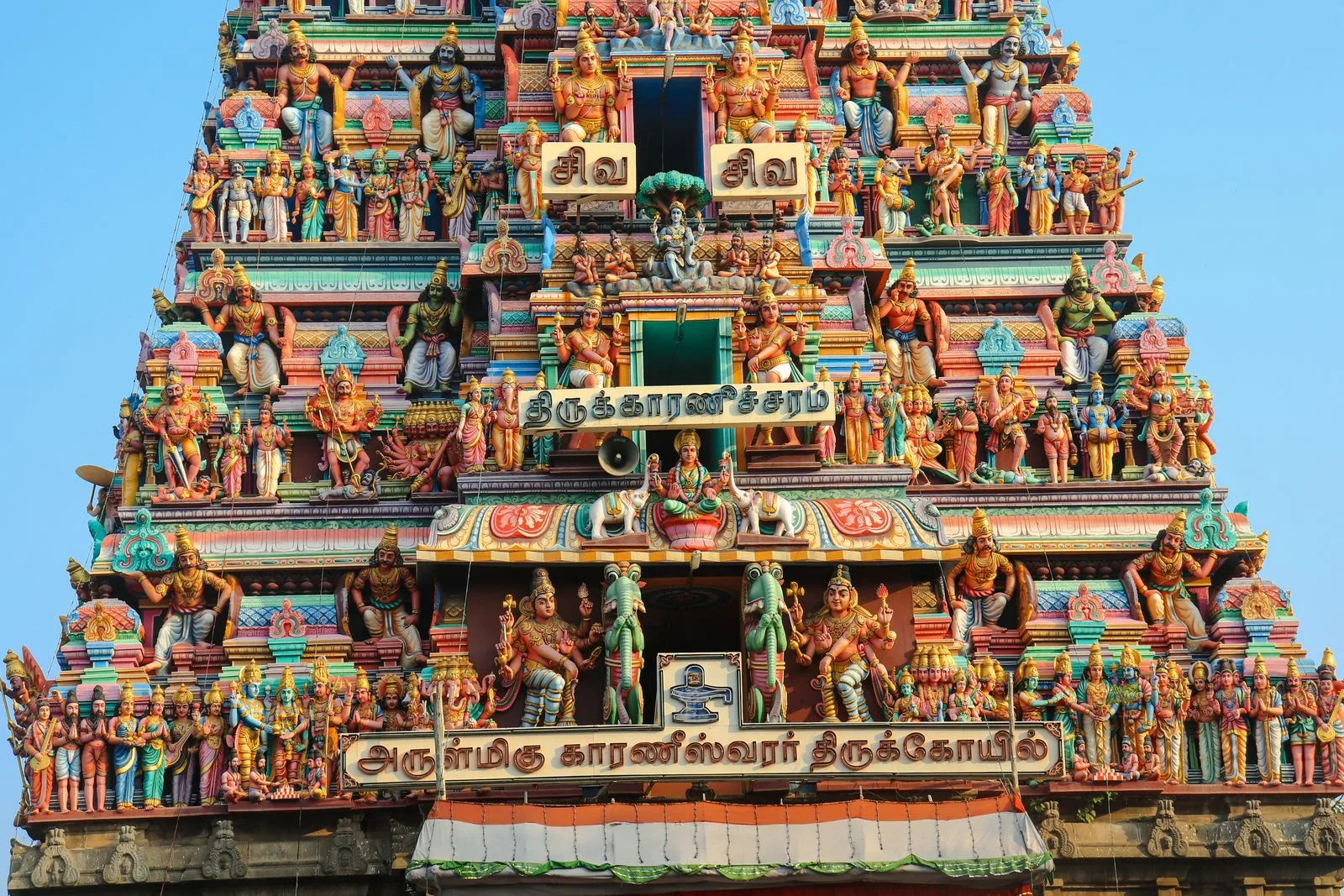
Kapaleeshwarar Temple in Mylapore
In the old district of Mylapore, the Kapaleeshwarar Temple, dedicated to Shiva, is recognisable by its tall carved entrance tower (gopuram). It is a living temple, busy from morning to evening: remove your shoes, cover shoulders and legs, and respect the areas reserved for worshippers. The streets around it, with their flower and ritual-object stalls, are part of the visit.
San Thome Basilica
Built at the end of the 19th century by the sea, San Thome Basilica stands over the supposed tomb of the apostle Thomas. It combines easily with Mylapore and the south end of Marina Beach.
Marina Beach
This long urban beach is a place for walks, especially early in the morning and at the end of the day, when families gather. It is not a swimming beach: the U.S. State Department advises avoiding swimming in the ocean during the monsoon season and warns that strong currents cause drowning every year along the Bay of Bengal.
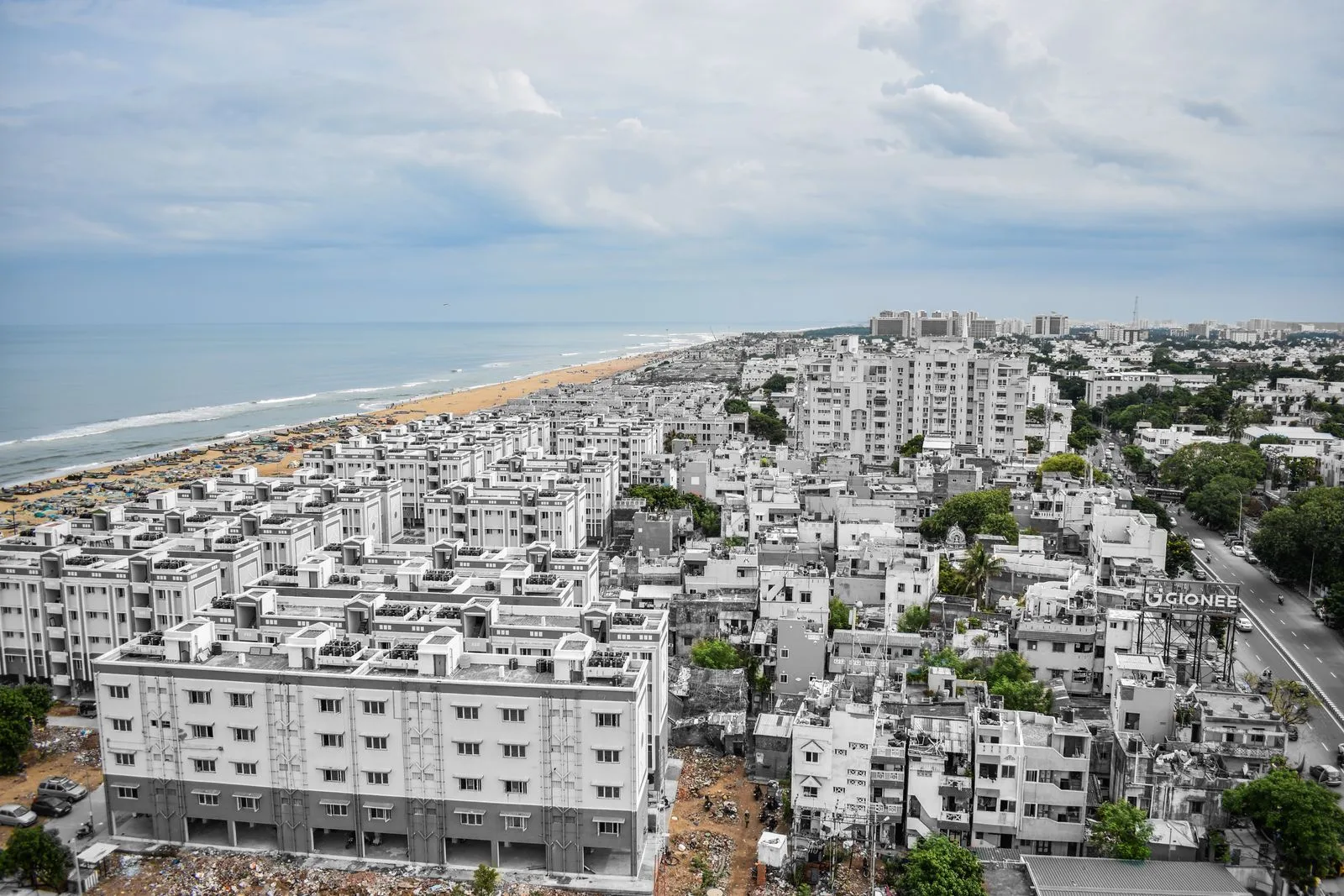
The Government Museum
On Pantheon Road, the Government Museum has an important collection of Chola bronzes, one of the high points of South Indian art. Allow half a day, ideal in the hot hours; check closing days on the official site.
Triplicane and the Parthasarathy Temple
The Parthasarathy Temple, dedicated to Vishnu, is the city’s other great historic shrine, in the Triplicane district near Marina Beach. The same dress rules apply as at Kapaleeshwarar.
Music and dance
Chennai is associated with bharatanatyam, the classical dance of Tamil Nadu, and with Carnatic music. For the « Madras Music Season », check the programmes of the halls and organisers for the exact dates of the current edition.
Day trips: Mahabalipuram and Kanchipuram
Mahabalipuram and Kanchipuram are linked to the Pallava dynasty, which shaped the medieval history of the region; they are the two classic day trips from Chennai. If you go to the seaside at Mahabalipuram, the same advice on currents applies, and note the restricted area near Kalpakkam mentioned in the safety section below.
Chennai in 2 or 3 days
- Day 1: Mylapore and the Kapaleeshwarar Temple in the morning, San Thome Basilica, then the Government Museum in the hot hours; sunset on Marina Beach.
- Day 2: Fort St George, Triplicane and the Parthasarathy Temple; an evening concert or dance performance if one is advertised.
- Day 3: day trip to Mahabalipuram or Kanchipuram, leaving early.
When to go to Chennai: month-by-month climate
Chennai is hot all year: the average minimum never falls below 21.5 °C (71 °F). Its particularity is the rain: the south-west monsoon is modest here, and most of the rainfall arrives from October to December (856 mm out of 1,377 mm a year, or 33.7 in out of 54.2 in). From January to March almost nothing falls. The table combines the official normals with our calculations.
| Month | Max °C (°F) | Min °C (°F) | Rain mm (in) | Rain days (≥ 2.5 mm) | Day/night range °C (°F) | Sunrise / sunset on the 15th | Day length |
|---|---|---|---|---|---|---|---|
| January | 29.7 (85) | 21.5 (71) | 16 (0.6) | 0.9 | 8.2 (14.8) | 06:35 / 18:01 | 11 h 26 min |
| February | 31.2 (88) | 22.4 (72) | 6 (0.2) | 0.5 | 8.8 (15.8) | 06:31 / 18:14 | 11 h 43 min |
| March | 33.1 (92) | 24.5 (76) | 2 (0.1) | 0.2 | 8.6 (15.5) | 06:16 / 18:19 | 12 h 03 min |
| April | 34.7 (94) | 26.9 (80) | 14 (0.6) | 0.9 | 7.8 (14.0) | 05:56 / 18:21 | 12 h 25 min |
| May | 37.3 (99) | 28.2 (83) | 43 (1.7) | 1.6 | 9.1 (16.4) | 05:43 / 18:27 | 12 h 44 min |
| June | 37.2 (99) | 27.9 (82) | 59 (2.3) | 4.2 | 9.3 (16.7) | 05:42 / 18:36 | 12 h 54 min |
| July | 35.7 (96) | 26.8 (80) | 102 (4.0) | 6.6 | 8.9 (16.0) | 05:50 / 18:39 | 12 h 50 min |
| August | 34.9 (95) | 26.2 (79) | 133 (5.2) | 8.1 | 8.7 (15.7) | 05:56 / 18:30 | 12 h 34 min |
| September | 34.3 (94) | 25.8 (78) | 146 (5.7) | 7.0 | 8.5 (15.3) | 05:58 / 18:10 | 12 h 12 min |
| October | 32.6 (91) | 25.0 (77) | 300 (11.8) | 10.5 | 7.6 (13.7) | 05:59 / 17:50 | 11 h 51 min |
| November | 30.3 (87) | 23.5 (74) | 374 (14.7) | 11.3 | 6.8 (12.2) | 06:07 / 17:39 | 11 h 32 min |
| December | 29.4 (85) | 22.2 (72) | 182 (7.2) | 5.5 | 7.2 (13.0) | 06:22 / 17:44 | 11 h 22 min |
Reading the table: November is the wettest month (374 mm, 14.7 in, 11.3 days of significant rain) and March the driest (2.2 mm, 0.1 in). May and June are the hottest (37.3 and 37.2 °C, 99 °F, average maximum). Destination de Voyage calculation: the gap between the longest and shortest day is only 1 h 32 min at this latitude, and the sun sets all year between 18:01 and 17:44 (on the 15th of each month).
According to the U.S. State Department, typhoons and cyclones are common along the Indian coasts, especially in Tamil Nadu; GOV.UK gives south India as at risk from June to November. Follow the weather bulletins and stay away from the coast during an alert.
If you… then…
| If you… | Then… |
|---|---|
| Want dry weather and bearable temperatures | Aim for January to March (less than 17 mm, 0.7 in, a month; highs of 29.7 to 33.1 °C, 85 to 92 °F) |
| Are combining it with northern India in November | Expect frequent rain in Chennai: 11.3 days of significant rain in November |
| Love Carnatic music | Target December-January, the Madras music season, and check the programmes |
| Dream of swimming | Not at Marina Beach: the U.S. State Department advises avoiding swimming in the ocean during the monsoon season and warns of strong currents on the Bay of Bengal coast |
Getting to Chennai and getting around
Chennai has an international airport; compare itineraries from the major international hubs, with connections where needed. The central station links the city to the rest of the country; tickets are sold on the official Indian Railways booking site (IRCTC) or at the station.
In the city, the metro serves part of the city; taxis, ride-hailing apps and rickshaws complete the picture. For Mahabalipuram or Kanchipuram, a car with a driver avoids driving yourself in a country where, according to GOV.UK, the death rate from road accidents is high.
Transfers and excursions
Compare a prepaid taxi, a ride-hailing app and a booked transfer: check the meeting point, whether a delay is taken into account and the cancellation terms. For a day excursion, check the departure time, the entrance fees included and the guide’s language.
Where to stay in Chennai
Mylapore suits the temples and San Thome Basilica; the area around the central station is practical before a train; districts near Marina Beach allow an evening stroll. From April to September, air conditioning is not a luxury.
Entry requirements, health and safety
US citizens
- According to the U.S. Department of State (travel.state.gov, last updated August 11, 2025), you need a valid US passport and either a valid Indian visa or an Overseas Citizen of India (OCI) card to enter and exit. For short tourist stays of less than 60 days you can apply for an eVisa at least 4 days before arriving; eVisas are not valid at land border crossings. For longer tourist stays, apply for a visa at an Indian embassy or consulate. Use official government websites only: the State Department warns that many fake webpages seek to collect personal information. Visa rules change often and with little warning.
UK citizens
- According to the UK FCDO (GOV.UK foreign travel advice, updated 7 October 2026), you must have a visa unless you hold an OCI card; depending on your plans you may be able to apply for an e-visa (check the website’s FAQs for restrictions on airports, land borders and seaports of entry). Your passport must have an expiry date at least 6 months after the day you arrive and at least 2 blank pages.
- All foreign nationals must complete an e-arrival card online before reaching immigration, up to 72 hours before arrival; it is not a visa. Make sure the border officer stamps your passport on arrival.
- GOV.UK also notes health screening measures linked to Ebola, including a Self-Declaration Form for all international passengers, to be completed up to 24 hours before arrival through the Air Suvidha portal.
Health and safety
- Swimming: the U.S. State Department advises avoiding swimming in the ocean during the monsoon season and notes that strong currents cause drowning every year along the Bay of Bengal; GOV.UK adds that most beaches have no warning signs, flags or lifesaving equipment.
- Cyclones: the U.S. State Department names Tamil Nadu among the states where typhoons and cyclones are common along the coast; GOV.UK gives the east coast (September to December) and south India (June to November) as risk areas. Monitor weather bulletins and follow municipal warnings.
- Mahabalipuram: the U.S. State Department notes that the Indira Gandhi Atomic Research Center at Kalpakkam, near Mamallapuram (Mahabalipuram), is a restricted area that is not clearly marked.
- Consulate: the U.S. Consulate General in Chennai can be reached on +91 44 2857-4000 (travel.state.gov).
- Emergencies: dial 112 for police, ambulance and fire from a mobile phone (GOV.UK; travel.state.gov also lists 100 for police from a landline).
- Terrorism: GOV.UK states that terrorists are very likely to try to carry out attacks in India, including in places visited by foreign nationals; stay alert in crowded places and keep up with local media.
- Road safety: India has a high death rate from road accidents (GOV.UK). Avoid travelling at night and in fog, and try to use taxis that have seatbelts.
- Women travellers: GOV.UK reports that female travellers often experience verbal and physical harassment and advises avoiding isolated areas; the U.S. State Department recommends conservative clothing that covers legs and shoulders.
- Health: GOV.UK advises checking vaccine recommendations with TravelHealthPro at least 8 weeks before you travel and lists dengue, malaria and chikungunya among the health risks; it also notes that severe air pollution is a major health hazard from October to February.
- Customs and cash: you must declare anything that may be prohibited or subject to duty; GOV.UK says you must declare more than 5,000 US dollars in notes (or 10,000 US dollars in notes and travellers cheques combined).
Our travel documents guide summarises the formalities, and the step-by-step process is in our India visa guide.
Staying connected
India is outside the European Union, so EU roaming does not apply. Check your plan or see our travel eSIM guide.
Tamil: a few pointers
Tamil is the mother tongue of most residents and the official language of Tamil Nadu; English is an additional official language and widely used in tourism. Hindi is far less present than in the north: a few words of Tamil open more doors.
For western India, see Goa and Mumbai; for the north, Jaipur and the Taj Mahal.
Frequently asked questions
What should I see in Chennai in two days?
Mylapore and the Kapaleeshwarar Temple, San Thome Basilica, the Government Museum and its Chola bronzes, Marina Beach at sunset, Fort St George and the Parthasarathy Temple.
What is the best time to go to Chennai?
January to March: less than 17 mm (0.7 in) of rain a month and highs of 29.7 to 33.1 °C (85 to 92 °F) (IMD 1991-2020 normals, Nungambakkam station).
When does it rain most in Chennai?
From October to December, with an average of 373.6 mm (14.7 in) in November, the wettest month.
Can you swim at Marina Beach?
The U.S. State Department advises avoiding swimming in the ocean during the monsoon season and warns that strong currents cause drowning every year along the Bay of Bengal; GOV.UK notes that most beaches have no warning signs, flags or lifesaving equipment.
Madras or Chennai?
It is the same city: it officially became Chennai in 1996.
Our sources
- India Meteorological Department, WMO 1991-2020 climate normals, Chennai Nungambakkam station (43278), NOAA/NCEI archive
- Astronomical calculations: NOAA solar algorithm, applied by Destination de Voyage to the coordinates of Chennai (15th of each month)
- Wikipedia, article « Chennai » (history, monuments), consulted on 11 November 2026
- Wikipedia (official languages of the Union and of the Indian states: Article 343 of the Constitution, Official Languages Act 1963)
- Entry requirements, health and safety checked between 26 October and 12 November 2026: U.S. Department of State, India country information (last updated August 11, 2025) and UK FCDO, GOV.UK foreign travel advice for India (updated 7 October 2026)
- Our methodology
Updated November 2026.