Hyderabad, the capital of Telangana, was founded in 1590 by Sultan Muhammad Quli Qutb Shah on the banks of the Musi: the Charminar, Golconda Fort, the Qutb Shahi tombs and the palaces of the nizams make it one of the great history cities of South India. This guide covers what to see in Hyderabad, when to go according to India Meteorological Department normals, how to get organised and what the US and UK governments say about entry and safety.
To place Hyderabad in a wider trip, see our India travel guide, the best time to visit India calendar and the map of India.

Our travel deals for Hyderabad
Affiliate links: we earn a commission, at no extra cost to you.
 Learn the languageTargumiLearn a few words of Telugu before you go — 30% off via our link.See the course
- FlightsKiwi.comCompare flights and airline combinations to Hyderabad.Compare flights
- eSIMAiraloData plan to install before you leave (eSIM-compatible phone).See plans



Hyderabad at a glance
- State Telangana, created on 2 June 2014, of which Hyderabad is the capital and largest city
- Language(s) at Union level, Hindi and English (Article 343 of the Constitution, Official Languages Act 1963); in Telangana, Telugu is the official language and Urdu an additional official language. To learn a few words before you go, try Targumi’s online Telugu lessons with native teachers (30% off via our link).
- Currency Indian rupee (INR)
- Time zone UTC+5:30 all year (no daylight saving): 5 h 30 min ahead of London in winter (4 h 30 min in summer) and 10 h 30 min ahead of New York in winter (9 h 30 min in summer)
- Entry US and UK citizens need a visa or e-visa (or an OCI card); UK travellers need a passport valid at least 6 months beyond arrival and 2 blank pages (UK FCDO, updated 7 October 2026); an online e-arrival card is required for all foreign nationals
- Climate plateau city (station at 530 m / 1,739 ft); 15.3 °C (60 °F) average minimum in December, 39.7 °C (103 °F) average maximum in May (IMD 1991-2020 normals)
- Speciality Hyderabadi biryani has a protected geographical indication in India
What to see in Hyderabad: the highlights
The Charminar and the old city
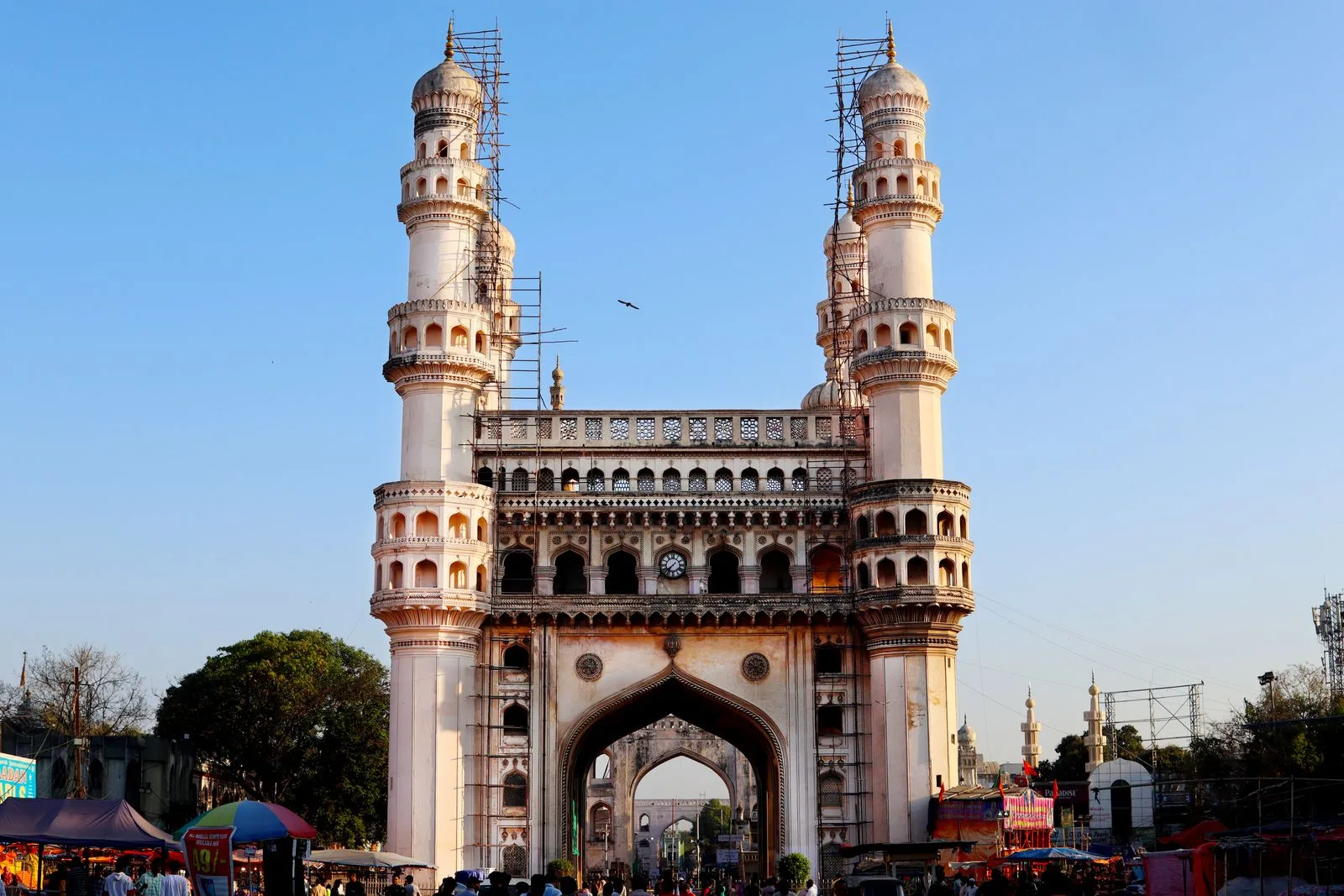
Built in 1591 by Muhammad Quli Qutb Shah, the Charminar, 56 metres (184 ft) high, is the symbol of the city: four minarets frame a monumental arch in the heart of the old city. All around, the shopping lanes stay busy until evening; the nearby Laad Bazaar is known for its pearl trade. Keep your belongings close in the crowd.
The Mecca Masjid
A few steps from the Charminar, the Mecca Masjid was begun in 1614 and completed in 1687; it can hold 10,000 worshippers. It is an active place of worship: cover up, remove your shoes and visit outside prayer times.
Golconda Fort
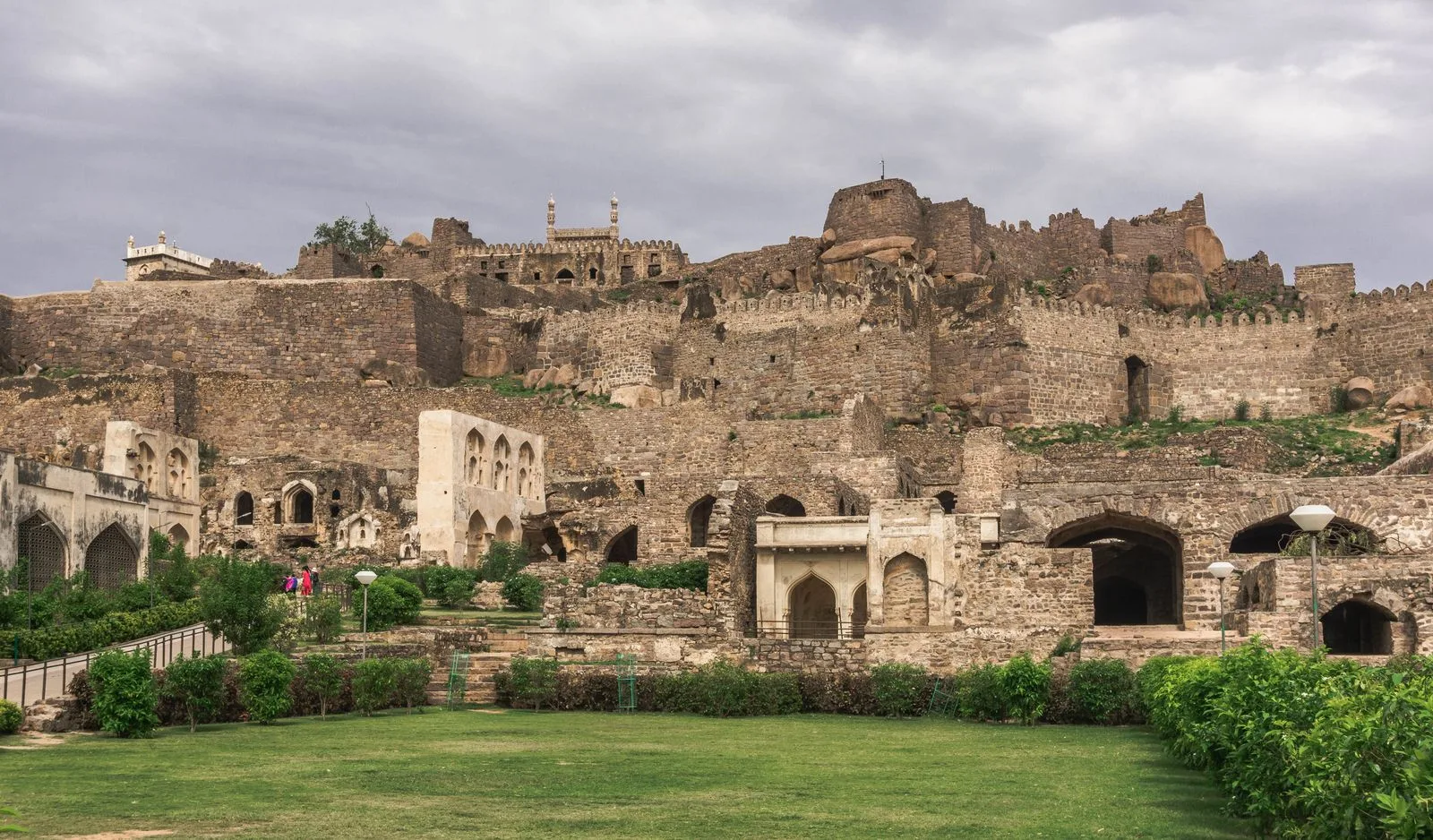
Before Hyderabad was founded, Golconda (Golkonda) was the capital of the Qutb Shahi sultans; it was a lack of water that led Muhammad Quli Qutb Shah to leave the fort in 1590. Its ramparts and the ruins on the hill are visited on foot: start early from April to June, when average highs exceed 38 °C (100 °F), and bring water and good shoes.
The Qutb Shahi tombs
Near Golconda, the tombs of the Qutb Shahi sultans form a necropolis of domed mausoleums; the oldest, that of Sultan Quli, dates from 1543. The site combines naturally with the fort in the same half day.
Hussain Sagar Lake and the Birla Mandir
Dug in 1562 under Ibrahim Qutb Shah, Hussain Sagar Lake separates Hyderabad from its twin city, Secunderabad; a large statue of the Buddha stands in the middle. On a nearby hill, the Birla Mandir, a temple of white Rajasthan marble built in 1976 and dedicated to Venkateswara, offers a view over the city; respect the dress and photography rules.
Museums and the palaces of the nizams
The nizams, rulers of the state of Hyderabad, left palaces such as Chowmahalla, and the city is home to the Salar Jung Museum, with very varied collections. Check opening hours and closing days on the official sites before you go: these are good visits for the hot hours or a monsoon afternoon.
Hyderabad in 2 or 3 days
- Day 1: Charminar and Mecca Masjid in the morning, Laad Bazaar, then Chowmahalla; evening in the old city.
- Day 2: Golconda at opening time, the Qutb Shahi tombs; end of the day at Hussain Sagar Lake.
- Day 3: Salar Jung Museum, the Birla Mandir at sunset, dinner built around a Hyderabadi biryani.
When to go to Hyderabad: month-by-month climate
On its plateau, Hyderabad has dry, mild winters, cool nights in December and January, a hot season from April to May and a monsoon from June to September (628 mm out of 860 mm a year, or 24.7 in out of 33.9 in). The table combines the official normals with our calculations.
| Month | Max °C (°F) | Min °C (°F) | Rain mm (in) | Rain days (≥ 2.5 mm) | Day/night range °C (°F) | Sunrise / sunset on the 15th | Day length |
|---|---|---|---|---|---|---|---|
| January | 29.7 (85) | 15.9 (61) | 9 (0.4) | 0.6 | 13.8 (24.8) | 06:49 / 18:01 | 11 h 12 min |
| February | 32.5 (90) | 18.3 (65) | 10 (0.4) | 0.6 | 14.2 (25.6) | 06:43 / 18:17 | 11 h 35 min |
| March | 36.1 (97) | 21.5 (71) | 12 (0.5) | 0.9 | 14.6 (26.3) | 06:24 / 18:25 | 12 h 01 min |
| April | 38.2 (101) | 24.5 (76) | 27 (1.1) | 2.0 | 13.7 (24.7) | 06:00 / 18:32 | 12 h 32 min |
| May | 39.7 (103) | 26.6 (80) | 34 (1.3) | 2.5 | 13.1 (23.6) | 05:44 / 18:40 | 12 h 57 min |
| June | 35.1 (95) | 24.4 (76) | 114 (4.5) | 6.8 | 10.7 (19.3) | 05:41 / 18:51 | 13 h 10 min |
| July | 31.5 (89) | 22.9 (73) | 162 (6.4) | 9.5 | 8.6 (15.5) | 05:49 / 18:54 | 13 h 05 min |
| August | 30.5 (87) | 22.5 (72) | 204 (8.0) | 11.3 | 8.0 (14.4) | 05:58 / 18:42 | 12 h 43 min |
| September | 31.2 (88) | 22.3 (72) | 148 (5.8) | 8.4 | 8.9 (16.0) | 06:04 / 18:18 | 12 h 15 min |
| October | 31.4 (89) | 20.9 (70) | 114 (4.5) | 5.6 | 10.5 (18.9) | 06:09 / 17:54 | 11 h 46 min |
| November | 30.2 (86) | 17.8 (64) | 19 (0.7) | 1.3 | 12.4 (22.3) | 06:20 / 17:40 | 11 h 19 min |
| December | 29.2 (85) | 15.3 (60) | 5 (0.2) | 0.3 | 13.9 (25.0) | 06:38 / 17:43 | 11 h 06 min |
Reading the table: May is the hottest month (39.7 °C, 103 °F average maximum), August the wettest (204 mm, 8.0 in, 11.3 days of significant rain), December the driest (5.0 mm, 0.2 in). Destination de Voyage calculation: the widest day/night range falls in March (14.6 °C, 26 °F): pack a layer for winter evenings, even if afternoons exceed 29 °C (84 °F).
If you… then…
| If you… | Then… |
|---|---|
| Want to see Golconda while it is cool | Aim for November to February (highs of 29.2 to 32.5 °C, 85 to 90 °F, and less than 20 mm, 0.8 in, a month) |
| Go in April or May | Visit at opening time and keep museums and palaces for the afternoon |
| Go during the monsoon | August is the wettest month: plan covered visits and some flexibility |
| Are combining it with Chennai | Hyderabad is dry in December (5 mm, 0.2 in) when Chennai is coming out of its rainy season |
Getting to Hyderabad and getting around
Hyderabad has an international airport; compare itineraries from the major international hubs, with connections where needed. For trains, buy tickets on the official Indian Railways booking site (IRCTC) or at the station; check whether your train leaves from Hyderabad or Secunderabad.
In the city, the metro, taxis, ride-hailing apps and rickshaws cover most needs. For Golconda and the tombs, a taxi or a driver for half a day is simplest; GOV.UK notes that India has a high death rate from road accidents and advises avoiding travel at night.
Transfers and guided visits
Compare a prepaid taxi, a ride-hailing app and a transfer booked from the airport: check the meeting point, whether a delay is taken into account and the cancellation terms. For a guided visit of the old city or Golconda, check the guide’s language and the entrance fees included.
Where to stay in Hyderabad
Staying near Hussain Sagar Lake or in the central districts makes it easy to reach both the old city and Golconda. If you arrive or leave by train, look at the distance to your station (Hyderabad or Secunderabad). Check recent reviews and air conditioning for April-May.
Entry requirements, health and safety
US citizens
- According to the U.S. Department of State (travel.state.gov, last updated August 11, 2025), you need a valid US passport and either a valid Indian visa or an Overseas Citizen of India (OCI) card to enter and exit. For short tourist stays of less than 60 days you can apply for an eVisa at least 4 days before arriving; eVisas are not valid at land border crossings. For longer tourist stays, apply for a visa at an Indian embassy or consulate. Use official government websites only: the State Department warns that many fake webpages seek to collect personal information. Visa rules change often and with little warning.
UK citizens
- According to the UK FCDO (GOV.UK foreign travel advice, updated 7 October 2026), you must have a visa unless you hold an OCI card; depending on your plans you may be able to apply for an e-visa (check the website’s FAQs for restrictions on airports, land borders and seaports of entry). Your passport must have an expiry date at least 6 months after the day you arrive and at least 2 blank pages.
- All foreign nationals must complete an e-arrival card online before reaching immigration, up to 72 hours before arrival; it is not a visa. Make sure the border officer stamps your passport on arrival.
- GOV.UK also notes health screening measures linked to Ebola, including a Self-Declaration Form for all international passengers, to be completed up to 24 hours before arrival through the Air Suvidha portal.
Health and safety
- Monsoon: according to GOV.UK, the monsoon season usually runs from June to November and can cause flash floods and disruption in big cities; Hyderabad’s wettest month is August.
- Registration: the U.S. State Department lists a Foreigners Regional Registration Office (FRRO) in Hyderabad; foreign visitors staying more than 180 days must register within 14 days of arrival, and GOV.UK adds that hotels and other accommodation must register foreign guests using the online C-form.
- Naxalite activity: the U.S. State Department places Naxalite (Maoist) activity in rural parts of eastern India, including northern Telangana and the borders of Telangana with neighbouring states, and says it rarely occurs in places frequented by foreigners.
- Consulate: the U.S. Consulate General in Hyderabad can be reached on +91 40 6932 8000 (travel.state.gov). The U.S. State Department lists the Hyderabad women’s helpline as 1098.
- Emergencies: dial 112 for police, ambulance and fire from a mobile phone (GOV.UK; travel.state.gov also lists 100 for police from a landline).
- Terrorism: GOV.UK states that terrorists are very likely to try to carry out attacks in India, including in places visited by foreign nationals; stay alert in crowded places and keep up with local media.
- Road safety: India has a high death rate from road accidents (GOV.UK). Avoid travelling at night and in fog, and try to use taxis that have seatbelts.
- Women travellers: GOV.UK reports that female travellers often experience verbal and physical harassment and advises avoiding isolated areas; the U.S. State Department recommends conservative clothing that covers legs and shoulders.
- Health: GOV.UK advises checking vaccine recommendations with TravelHealthPro at least 8 weeks before you travel and lists dengue, malaria and chikungunya among the health risks; it also notes that severe air pollution is a major health hazard from October to February.
- Customs and cash: you must declare anything that may be prohibited or subject to duty; GOV.UK says you must declare more than 5,000 US dollars in notes (or 10,000 US dollars in notes and travellers cheques combined).
Our travel documents guide summarises the formalities, and the step-by-step process is in our India visa guide.
Staying connected
India is outside the European Union, so EU roaming does not apply. Check your plan or see our travel eSIM guide.
Telugu and Urdu: a few pointers
Telugu is the official language of Telangana and Urdu is an additional official language there, a legacy of the history of the sultans and nizams; Hindi and English are also widely understood in the city. In the old city you will often hear Urdu; elsewhere, a few words of Telugu are well received.
For the west coast, see Mumbai and Goa; for the north, Jaipur and the Taj Mahal.
Frequently asked questions
What should I see in Hyderabad in two days?
The Charminar, the Mecca Masjid and the Laad Bazaar, Chowmahalla Palace, Golconda Fort, the Qutb Shahi tombs and Hussain Sagar Lake.
What is the best time to go to Hyderabad?
November to February: less than 20 mm (0.8 in) of rain a month and highs of 29.2 to 32.5 °C (85 to 90 °F) (IMD 1991-2020 normals, Hyderabad station).
When is Hyderabad hottest?
In May, with a 39.7 °C (103 °F) average maximum; April follows with 38.2 °C (101 °F).
What language is spoken in Hyderabad?
Telugu, the official language of Telangana, and Urdu, an additional official language; Hindi and English are also common.
When was the Charminar built?
In 1591, under Sultan Muhammad Quli Qutb Shah, the founder of the city.
Our sources
- India Meteorological Department, WMO 1991-2020 climate normals, Hyderabad station (43128), NOAA/NCEI archive
- Astronomical calculations: NOAA solar algorithm, applied by Destination de Voyage to the coordinates of Hyderabad (15th of each month)
- Wikipedia, article « Hyderabad » (history, monuments), consulted on 11 November 2026
- Wikipedia (official languages of the Union and of the Indian states: Article 343 of the Constitution, Official Languages Act 1963)
- Entry requirements, health and safety checked between 26 October and 12 November 2026: U.S. Department of State, India country information (last updated August 11, 2025) and UK FCDO, GOV.UK foreign travel advice for India (updated 7 October 2026)
- Our methodology
Updated November 2026.