Kolkata, officially the name of the city since 2001 and still widely known as Calcutta, is the capital of West Bengal on the east bank of the Hooghly: the capital of British India from 1773 to 1912, it combines colonial monuments, temples, markets and bookshops. This guide covers what to see in Kolkata, when to go according to India Meteorological Department normals, how to get organised on the ground, and what the US and UK governments say about entry and safety.
To place Kolkata in a wider trip, see our India travel guide, the best time to visit India calendar, the map of India and our guide to Varanasi, often combined with Kolkata by train.

Our travel deals for Kolkata
Affiliate links: we earn a commission, at no extra cost to you.
 Learn the languageTargumiLearn a few words of Bengali before you go — 30% off via our link.See the course
- FlightsKiwi.comCompare flights and airline combinations to Kolkata.Compare flights
- eSIMAiraloData plan to install before you leave (eSIM-compatible phone).See plans



Kolkata at a glance
- State West Bengal, of which Kolkata is the capital
- Language(s) at Union level, Hindi and English (Article 343 of the Constitution, Official Languages Act 1963); in West Bengal, Bengali and English are official languages. To learn a few words before you go, try Targumi’s online Bengali lessons with native teachers (30% off via our link).
- Currency Indian rupee (INR)
- Time zone UTC+5:30 all year (no daylight saving): 5 h 30 min ahead of London in winter (4 h 30 min in summer) and 10 h 30 min ahead of New York in winter (9 h 30 min in summer)
- Entry US and UK citizens need a visa or e-visa (or an OCI card) and a passport valid at least 6 months beyond arrival for UK travellers (UK FCDO, updated 7 October 2026); an online e-arrival card is required for all foreign nationals
- Climate 1,345 mm (53.0 in) of rain from June to September out of 1,814 mm (71.4 in) a year (IMD 1991-2020 normals)
- Consulate U.S. Consulate General in Kolkata (travel.state.gov)
What to see in Kolkata: the highlights
The Victoria Memorial and the Maidan
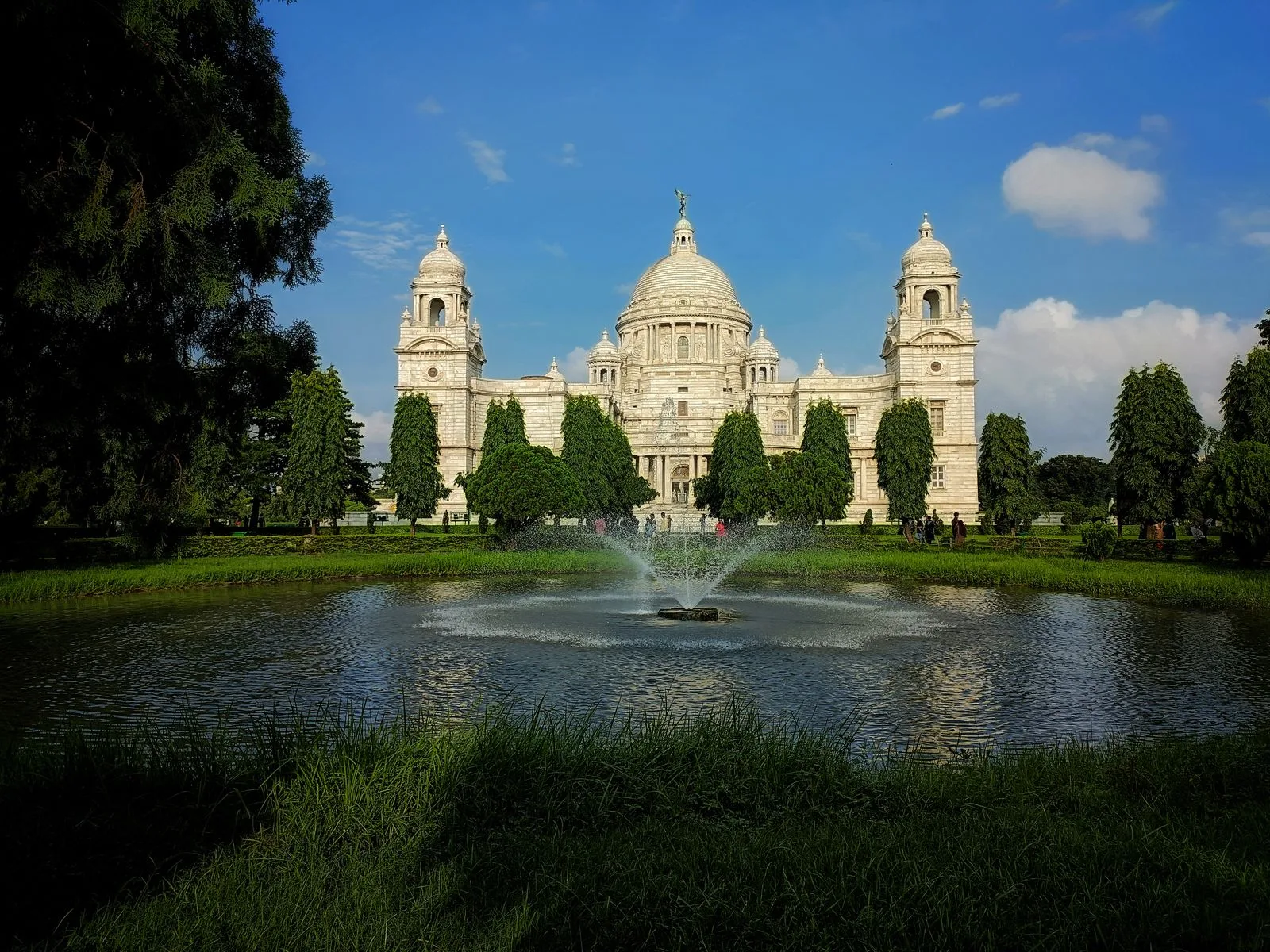
Built between 1906 and 1921 in memory of Queen Victoria, this white marble monument designed by the architect William Emerson mixes a European-inspired plan with Mughal elements. It stands in the southern part of the Maidan, the big green space in the centre, and houses a museum of paintings and documents from the British period. Plan for early morning: average highs exceed 32 °C (90 °F) from March to October.
Kalighat Temple
The Kalighat Temple, dedicated to the goddess Kali, dates from 1809 in its present form. It is a heavily visited place of worship: remove your shoes, cover shoulders and legs, and ask before taking photos. Intermediaries offering « quick access » for a fee are not a necessary part of the visit.
The Indian Museum
Housed in a building dating from 1878, the Indian Museum is one of the oldest museums in the country. Its archaeology, art and natural history collections justify half a day, ideal in the hottest hours or on a monsoon rainy day. Check closing days on the official site before you go.
Mother Teresa and the Mother House
Mother Teresa founded the Missionaries of Charity in Kolkata in 1950 and died there in 1997. The congregation’s Mother House welcomes visitors who want to see her tomb and the exhibition devoted to her; it is a place of prayer, so dress modestly and keep quiet.
College Street and the city of books
Around the University of Calcutta, founded in 1857, College Street is lined with second-hand book stalls and bookshops. It is the neighbourhood in which to feel Bengali intellectual life, in the city of Rabindranath Tagore. Go on a weekday, when the stalls are open.
Howrah Bridge and the banks of the Hooghly
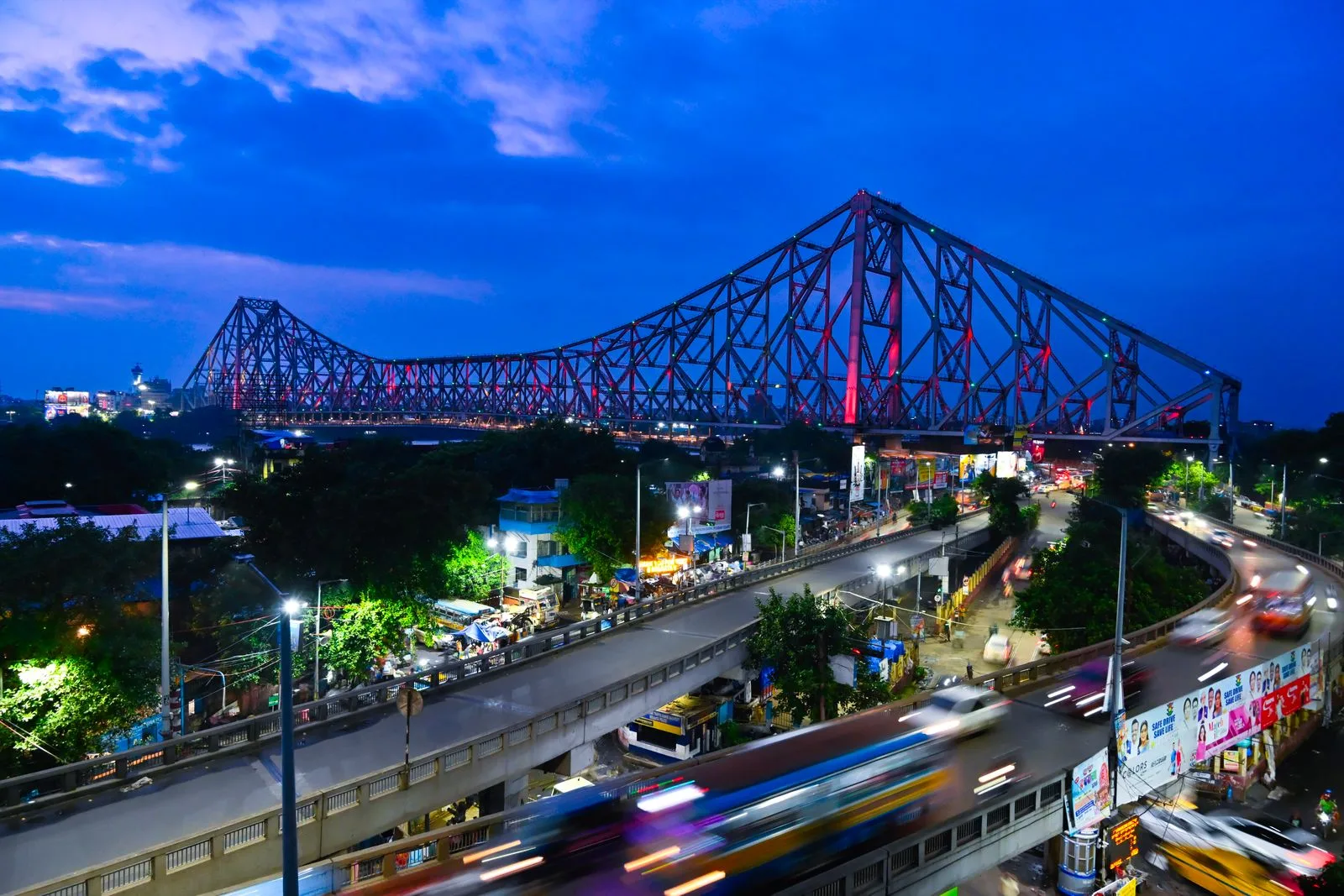
Howrah Bridge links Kolkata to Howrah, where the big railway station stands. The ghats and markets along the Hooghly come alive at dawn; the flower market near the bridge is best visited early in the morning. Keep an eye on your belongings in the crowd.
Kolkata in 2 or 3 days
- Day 1: Victoria Memorial early in the morning, the Maidan, then the Indian Museum in the hot hours; evening around Park Street.
- Day 2: flower market and the banks of the Hooghly at dawn, Howrah Bridge, College Street, then the Mother House.
- Day 3: Kalighat Temple in the morning and the southern districts; free time for Bengali food and its milk-based desserts.
When to go to Kolkata: month-by-month climate
Kolkata has a humid tropical climate shaped by the south-west monsoon: from June to September 1,345 mm (53.0 in) fall, or 74% of the annual rainfall, with 12 to 18 days of significant rain per month. From November to February the weather is dry and milder. The table combines the official normals with our own calculations.
| Month | Max °C (°F) | Min °C (°F) | Rain mm (in) | Rain days (≥ 2.5 mm) | Day/night range °C (°F) | Sunrise / sunset on the 15th | Day length |
|---|---|---|---|---|---|---|---|
| January | 25.5 (78) | 14.3 (58) | 15 (0.6) | 1.1 | 11.2 (20.2) | 06:18 / 17:13 | 10 h 54 min |
| February | 29.4 (85) | 18.1 (65) | 25 (1.0) | 1.5 | 11.3 (20.3) | 06:08 / 17:33 | 11 h 24 min |
| March | 33.7 (93) | 22.9 (73) | 37 (1.5) | 2.1 | 10.8 (19.4) | 05:45 / 17:45 | 12 h 00 min |
| April | 35.4 (96) | 25.7 (78) | 55 (2.2) | 3.2 | 9.7 (17.5) | 05:17 / 17:56 | 12 h 40 min |
| May | 35.5 (96) | 26.8 (80) | 118 (4.6) | 6.2 | 8.7 (15.7) | 04:56 / 18:09 | 13 h 13 min |
| June | 34.1 (93) | 27.1 (81) | 277 (10.9) | 12.6 | 7.0 (12.6) | 04:51 / 18:22 | 13 h 30 min |
| July | 32.5 (90) | 26.7 (80) | 372 (14.6) | 17.5 | 5.8 (10.4) | 05:00 / 18:24 | 13 h 23 min |
| August | 32.3 (90) | 26.6 (80) | 372 (14.6) | 16.8 | 5.7 (10.3) | 05:13 / 18:08 | 12 h 55 min |
| September | 32.6 (91) | 26.3 (79) | 325 (12.8) | 13.6 | 6.3 (11.3) | 05:23 / 17:40 | 12 h 17 min |
| October | 32.3 (90) | 24.4 (76) | 180 (7.1) | 7.4 | 7.9 (14.2) | 05:32 / 17:11 | 11 h 39 min |
| November | 30.2 (86) | 20.1 (68) | 33 (1.3) | 1.4 | 10.1 (18.2) | 05:48 / 16:53 | 11 h 04 min |
| December | 26.7 (80) | 15.5 (60) | 6 (0.2) | 0.7 | 11.2 (20.2) | 06:08 / 16:54 | 10 h 46 min |
Reading the table: December is the driest month (5.6 mm, 0.2 in) and January the coolest (14.3 °C, 58 °F average minimum). May is the hottest (35.5 °C, 96 °F average maximum) just before the monsoon; August is the wettest (372 mm, 14.6 in). Destination de Voyage calculation: over a 7-day stay in July, the normals give an average of about 4 days of significant rain, against fewer than one in December.
GOV.UK lists the east coast of India and the Bay of Bengal among the areas at risk from tropical cyclones, with the risk periods given above (April to June and September to December for the Bay of Bengal): follow weather bulletins during your stay.
If you… then…
| If you… | Then… |
|---|---|
| Want to walk without rain or extreme heat | Aim for November to February (less than 33 mm, 1.3 in, a month; highs of 25.5 to 30.2 °C, 78 to 86 °F) |
| Can only travel in the monsoon | Keep covered visits (Indian Museum, Victoria Memorial) and slack in your journeys |
| Arrive or leave by train | Look after your bags and valuables: GOV.UK says thefts are common on trains |
| Travel in cyclone season | Check the official weather bulletins and follow local instructions |
Getting to Kolkata and getting around
Kolkata is served by its international airport; compare itineraries from the major international hubs, with connections where needed. By train, the city is linked to the rest of the country through Howrah and Sealdah stations; tickets are sold on the official Indian Railways booking site (IRCTC) or at the station.
In the city, the metro serves part of the central districts; taxis and ride-hailing apps complete the picture (GOV.UK notes that Uber and Ola are widely available, and advises against hailing taxis on the street, especially at night). Given India’s road accident rate, prefer public transport, taxis or a driver to driving yourself.
Transfers and excursions
For the airport transfer, compare a prepaid taxi, a ride-hailing app and a transfer booked in advance: check the meeting point, whether a flight delay is taken into account and the cancellation terms. For guided visits, check the guide’s language and what is included.
Where to stay in Kolkata
The Park Street area and its surroundings are practical for the Maidan, the Victoria Memorial and the Indian Museum. The streets around Sudder Street have more basic accommodation. If you leave early by train, look at the distance to Howrah or Sealdah station. In every case, check recent reviews and air conditioning from April to October.
Entry requirements, health and safety
US citizens
- According to the U.S. Department of State (travel.state.gov, last updated August 11, 2025), you need a valid US passport and either a valid Indian visa or an Overseas Citizen of India (OCI) card to enter and exit. For short tourist stays of less than 60 days you can apply for an eVisa at least 4 days before arriving; eVisas are not valid at land border crossings. For longer tourist stays, apply for a visa at an Indian embassy or consulate. Use official government websites only: the State Department warns that many fake webpages seek to collect personal information. Visa rules change often and with little warning.
UK citizens
- According to the UK FCDO (GOV.UK foreign travel advice, updated 7 October 2026), you must have a visa unless you hold an OCI card; depending on your plans you may be able to apply for an e-visa (check the website’s FAQs for restrictions on airports, land borders and seaports of entry). Your passport must have an expiry date at least 6 months after the day you arrive and at least 2 blank pages.
- All foreign nationals must complete an e-arrival card online before reaching immigration, up to 72 hours before arrival; it is not a visa. Make sure the border officer stamps your passport on arrival.
- GOV.UK also notes health screening measures linked to Ebola, including a Self-Declaration Form for all international passengers, to be completed up to 24 hours before arrival through the Air Suvidha portal.
Health and safety
- Cyclones: GOV.UK lists the east coast of India (September to December) and the Bay of Bengal (April to June and September to December) among the cyclone-risk areas; the U.S. State Department names West Bengal among the states where cyclones are common. Monitor weather bulletins and follow local warnings.
- Monsoon: according to GOV.UK, the monsoon season usually runs from June to November and can cause flash floods and disruption in big cities.
- Trains and stations: GOV.UK advises not to accept food or drinks from strangers, to look after your passport and valuables because thefts are common, and to avoid people at railway stations offering tickets and tours.
- Naxalite activity: the U.S. State Department describes Naxalite (Maoist) activity from eastern Maharashtra and northern Telangana through western West Bengal, mostly in rural areas and rarely in places frequented by foreigners; ask your hotel or a local operator before leaving the city.
- Consulate: the U.S. Consulate General in Kolkata can be reached on +91 33 3984-2400 (travel.state.gov). The U.S. State Department lists the Kolkata women’s helpline as 1090.
- Emergencies: dial 112 for police, ambulance and fire from a mobile phone (GOV.UK; travel.state.gov also lists 100 for police from a landline).
- Terrorism: GOV.UK states that terrorists are very likely to try to carry out attacks in India, including in places visited by foreign nationals; stay alert in crowded places and keep up with local media.
- Road safety: India has a high death rate from road accidents (GOV.UK). Avoid travelling at night and in fog, and try to use taxis that have seatbelts.
- Women travellers: GOV.UK reports that female travellers often experience verbal and physical harassment and advises avoiding isolated areas; the U.S. State Department recommends conservative clothing that covers legs and shoulders.
- Health: GOV.UK advises checking vaccine recommendations with TravelHealthPro at least 8 weeks before you travel and lists dengue among the health risks; it also notes that severe air pollution is a major health hazard from October to February.
- Customs and cash: you must declare anything that may be prohibited or subject to duty; GOV.UK says you must declare more than 5,000 US dollars in notes (or 10,000 US dollars in notes and travellers cheques combined).
Our travel documents guide summarises the formalities, and the step-by-step process is in our India visa guide.
Staying connected
India is outside the European Union, so EU roaming does not apply. Check your plan or see our travel eSIM guide.
Bengali: a few pointers
Bengali is the official language of West Bengal, alongside English. English is common in hotels and for paperwork; a few words of Bengali (greetings, thanks) are well received in markets and small restaurants.
Kolkata combines well with Varanasi to the north-west; for the west coast, see Mumbai and Goa.
Frequently asked questions
What should I see in Kolkata in two days?
The Victoria Memorial and the Maidan, the Indian Museum, the flower market and Howrah Bridge at dawn, College Street and Mother Teresa’s Mother House; add Kalighat Temple with a third day.
What is the best time to go to Kolkata?
November to February: less than 33 mm (1.3 in) of rain a month and highs of 25.5 to 30.2 °C (78 to 86 °F) (IMD 1991-2020 normals, Alipore station).
Do I need a visa for Kolkata?
Yes. According to the U.S. State Department (last updated August 11, 2025) US citizens need a valid Indian visa (or an OCI card), and according to the UK FCDO (updated 7 October 2026) UK citizens must have a visa unless they hold an OCI card; an e-visa may be available. Check the official Indian immigration sites before you book.
Kolkata or Calcutta?
It is the same city: Kolkata has been the official name since 2001, and Calcutta remains common in English.
When does the monsoon fall in Kolkata?
From June to September: each of these months receives between 276.7 and 372.1 mm (10.9 to 14.6 in) of rain on average (IMD 1991-2020 normals).
Our sources
- India Meteorological Department, WMO 1991-2020 climate normals, Kolkata Alipore station (42807), NOAA/NCEI archive
- Astronomical calculations: NOAA solar algorithm, applied by Destination de Voyage to the coordinates of Kolkata (15th of each month)
- Wikipedia, article « Kolkata » (history, monuments), consulted on 11 November 2026
- Wikipedia (official languages of the Union and of the Indian states: Article 343 of the Constitution, Official Languages Act 1963)
- Entry requirements, health and safety checked between 26 October and 12 November 2026: U.S. Department of State, India country information (last updated August 11, 2025) and UK FCDO, GOV.UK foreign travel advice for India (updated 7 October 2026)
- Our methodology
Updated November 2026.