Varanasi, also called Benares or Kashi, is the holiest city of Hinduism: on the left bank of the Ganges, dozens of ghats, the stone steps leading down to the river, host ritual bathing, prayers and cremations every day. People come for the boat ride at dawn, the evening ceremony at Dashashwamedh Ghat, the lanes of the old city and Sarnath, where the Buddha gave his first sermon. This guide covers what to see in Varanasi, when to go according to India Meteorological Department normals, how to get there and what the US and UK governments say about entry and safety.
Time zoneUTC+5:30 all year (India does not change its clocks): 5 h 30 min ahead of London in winter (4 h 30 min in summer) and 10 h 30 min ahead of New York in winter (9 h 30 min in summer)
Climate21.9 °C (71 °F) average maximum in January, 40.4 °C (105 °F) in May, monsoon from June to September (IMD 1991-2020 normals)
Best timeOctober to March, with frequent morning fog in December and January
EntryUS and UK citizens need a visa or e-visa (or an OCI card) and must fill in the online e-arrival card (travel.state.gov; UK FCDO)
SafetyGOV.UK advises against travel only to specific border and regional areas, not to Varanasi; take care on trains and at stations (GOV.UK)
What to see in Varanasi: the highlights
The ghats, from Assi Ghat to Panchganga
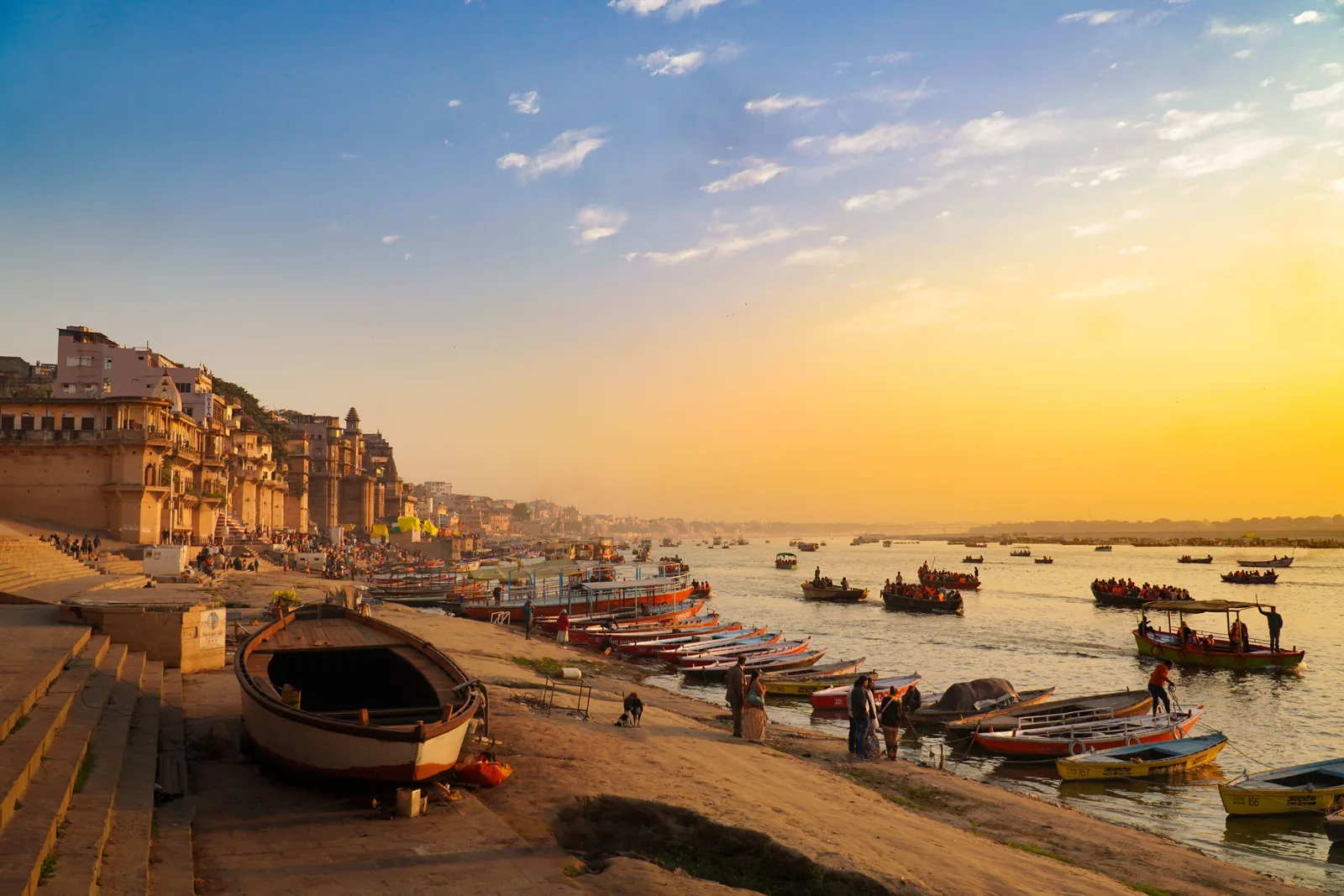
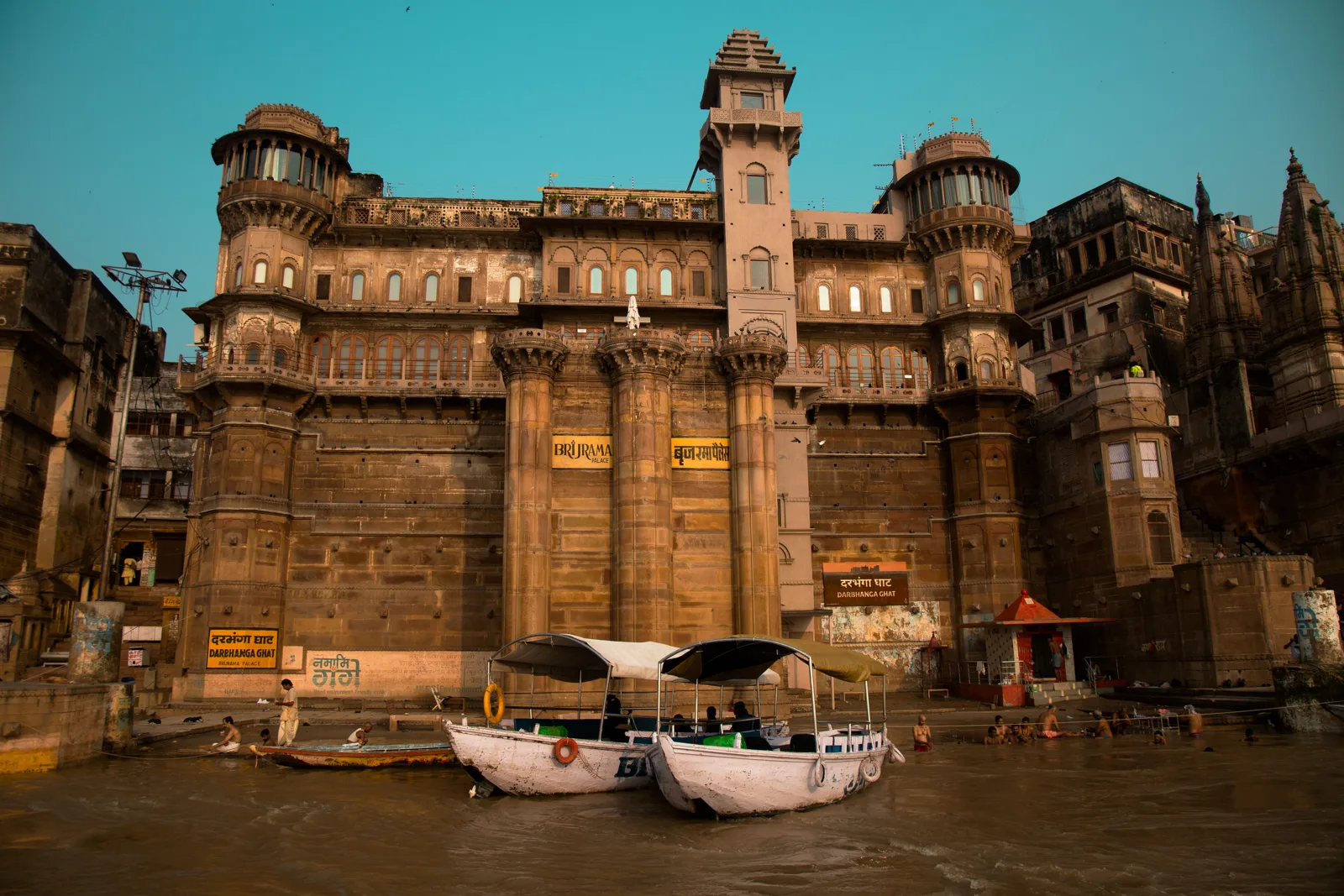
The city has at least 84 ghats lined up along the left bank of the Ganges, which forms a crescent here. Most are used for ritual bathing and prayers; many were built under the patronage of the great Maratha families. To the south, Assi Ghat marks one of the traditional limits of the old city, near the Assi river, now a mere stream; to the north, the Varuna closes the crescent. The name Varanasi is said to come from these two watercourses. Walking along the ghats lets you move from one district to another while staying at the water’s edge.
Dashashwamedh Ghat is the main ghat and probably the oldest, right next to the Kashi Vishwanath Temple. Every evening a group of priests performs a fire ceremony there dedicated to Shiva, the Ganges, the Sun and fire, and special aartis are held on Tuesdays and feast days. Arrive early to find a place on the steps or on a boat; sunset (see our table below) gives the timing reference, which varies by about an hour and a half between December and June.
Manikarnika: the cremation ghat
Manikarnika Ghat is the city’s main cremation ground; Harishchandra Ghat is a second one. Dying in Varanasi is said to free a person from the cycle of rebirth, which explains the presence of many elderly pilgrims. Cremations take place in public: stay at a distance, do not photograph families and decline the improvised « guides » who offer a paid tour of the pyres.
The boat ride at dawn
A morning boat ride along the ghats is the most popular activity: at dawn you see the ritual bathing and the facades of palaces and temples rising above the water. In December and January morning fog is frequent (see the climate section): it can hide the opposite bank and shift the best light. Agree the price and duration before boarding.
Dedicated to Shiva, the Kashi Vishwanath Temple, known as the « Golden Temple », is the most important in the city. The present building was rebuilt in the 18th century on the initiative of Queen Ahilyabai Holkar of Indore, and a landscaped corridor, inaugurated in December 2021, links it to the ghats. Access conditions to the sanctuary (prohibited items, security checks) should be checked on the spot. Around it, the lanes of the old city are narrow and lively; you will also pass silk shops, a Varanasi speciality.
Sarnath
About ten kilometres (6 mi) north-east, Sarnath is where, according to Buddhist tradition, the Buddha gave his first teaching after enlightenment, in the Deer Park. It is a Buddhist pilgrimage centre with archaeological remains; the Ashoka lion capital found there commemorates that sermon. Allow half a day.
Ramnagar Fort and Banaras Hindu University
On the opposite bank, facing Tulsi Ghat, Ramnagar Fort was built in the 18th century by the Maharaja of Benares; it houses a museum on the history of the dynasty. South of the city, the vast campus of Banaras Hindu University, founded in 1916, includes a Vishwanath temple and the Bharat Kala Bhavan art museum.
Varanasi in 2 or 3 days
Day 1: arrival, a walk along the ghats from Assi to Dashashwamedh, evening ceremony.
Day 2: boat ride at dawn, old city and Kashi Vishwanath, then Manikarnika from a respectful distance.
Day 3: Sarnath in the morning, Banaras Hindu University or Ramnagar Fort in the afternoon.
When to go to Varanasi: month-by-month climate
Varanasi has three clear seasons: a dry, mild winter from October to March, a hot season from April to June, then the monsoon. The table combines the official normals with our calculations: day/night range, sunrise and sunset, day length.
Month
Max °C (°F)
Min °C (°F)
Rain mm (in)
Rain days (≥ 2.5 mm)
Day/night range °C (°F)
Sunrise / sunset on the 15th
Day length
January
21.9 (71)
9.0 (48)
16 (0.6)
1.5
12.9 (23.2)
06:45 / 17:29
10 h 44 min
February
26.7 (80)
12.4 (54)
22 (0.9)
1.7
14.3 (25.7)
06:33 / 17:51
11 h 18 min
March
32.8 (91)
16.7 (62)
11 (0.4)
1.2
16.1 (29.0)
06:07 / 18:06
11 h 59 min
April
38.9 (102)
22.1 (72)
7 (0.3)
0.8
16.8 (30.2)
05:36 / 18:20
12 h 45 min
May
40.4 (105)
25.9 (79)
14 (0.6)
1.4
14.5 (26.1)
05:13 / 18:35
13 h 22 min
June
38.5 (101)
27.8 (82)
101 (4.0)
5.2
10.7 (19.3)
05:07 / 18:49
13 h 42 min
July
33.9 (93)
26.6 (80)
265 (10.4)
12.3
7.3 (13.1)
05:16 / 18:50
13 h 34 min
August
33.1 (92)
26.2 (79)
283 (11.1)
12.9
6.9 (12.4)
05:31 / 18:33
13 h 02 min
September
33.1 (92)
25.3 (78)
224 (8.8)
8.6
7.8 (14.0)
05:43 / 18:02
12 h 19 min
October
32.5 (90)
20.9 (70)
33 (1.3)
1.9
11.6 (20.9)
05:56 / 17:31
11 h 35 min
November
29.2 (85)
14.5 (58)
6 (0.2)
0.3
14.7 (26.5)
06:14 / 17:09
10 h 55 min
December
24.1 (75)
10.1 (50)
4 (0.2)
0.3
14.0 (25.2)
06:35 / 17:10
10 h 35 min
Temperatures, rainfall and rain days (≥ 2.5 mm, the IMD threshold): 1991-2020 normals for the Varanasi station (42483), India Meteorological Department, published by the World Meteorological Organization (NOAA/NCEI archive). Day/night range, sunrise, sunset and day length: Destination de Voyage calculations (NOAA solar algorithm, 15th of each month, Indian time).
Reading the table: from October to March less than 35 mm (1.4 in) falls each month and the average maximum stays between 21.9 and 32.8 °C (71 to 91 °F). Nights are cool in January (9.0 °C, 48 °F). May is the hottest month (40.4 °C, 105 °F average maximum). From July to September more than 220 mm (8.7 in) falls each month, with 12.9 rain days in August: the lowest ghats can be submerged during floods.
Winter fog: a figure rarely quoted
IMD normals count an average of 13 days of fog in January and 11.2 in December at Varanasi, against 2 in February and in November and none from March to October. For the boat at dawn and photos of the river, February and November therefore combine dry weather, moderate temperatures and rare fog. In December and January fog can also disrupt morning trains and flights: leave a margin for any connection.
Month
Fog days (IMD)
Sunrise on the 15th (calculated)
Max / min °C (°F)
October
0.0
05:56
32.5 (90) / 20.9 (70)
November
2.1
06:14
29.2 (85) / 14.5 (58)
December
11.2
06:35
24.1 (75) / 10.1 (50)
January
13.0
06:45
21.9 (71) / 9.0 (48)
February
2.0
06:33
26.7 (80) / 12.4 (54)
March
0.0
06:07
32.8 (91) / 16.7 (62)
Fog days: 1991-2020 normals for the Varanasi station (42483), IMD / WMO. Sunrise: Destination de Voyage calculation (NOAA algorithm).
Varanasi is served by Lal Bahadur Shastri International Airport, at Babatpur, north-west of the city, linked to the major Indian cities; from abroad you will usually arrive with at least one connection. Varanasi Junction station is linked to Delhi, Agra and Kolkata. In the old city the lanes are too narrow for cars: you get around on foot, by rickshaw or by boat along the river.
Transfers, trains and bookings
For the transfer from the airport or station, prefer a prepaid taxi or a transfer booked by your hotel. GOV.UK advises avoiding people at railway stations who offer tickets and tours, because you may be scammed, and notes that you must carry valid ID on trains. Before booking a transfer or an excursion to Sarnath, compare the operator’s official site and resellers: cancellation terms, meeting point, what is included.
Where to stay in Varanasi
There are two main options: hotels and guesthouses on the ghats, to wake up facing the river and walk to the boat, but in lanes that can be hard to reach with luggage; or the newer districts of the city, quieter and accessible by car, but away from the ghats. Around Assi Ghat the atmosphere is a little less dense than at Dashashwamedh. During the big religious festivals of October-November, book early.
Entry requirements, health and safety
US citizens
According to the U.S. Department of State (travel.state.gov, last updated August 11, 2025), you need a valid US passport and either a valid Indian visa or an Overseas Citizen of India (OCI) card to enter and exit. For short tourist stays of less than 60 days you can apply for an eVisa at least 4 days before arriving; eVisas are not valid at land border crossings. For longer tourist stays, apply for a visa at an Indian embassy or consulate. Use official government websites only: the State Department warns that many fake webpages seek to collect personal information. Visa rules change often and with little warning.
UK citizens
According to the UK FCDO (GOV.UK foreign travel advice, updated 7 October 2026), you must have a visa unless you hold an OCI card; depending on your plans you may be able to apply for an e-visa (check the website’s FAQs for restrictions on airports, land borders and seaports of entry). Your passport must have an expiry date at least 6 months after the day you arrive and at least 2 blank pages.
All foreign nationals must complete an e-arrival card online before reaching immigration, up to 72 hours before arrival; it is not a visa. Make sure the border officer stamps your passport on arrival.
GOV.UK also notes health screening measures linked to Ebola, including a Self-Declaration Form for all international passengers, to be completed up to 24 hours before arrival through the Air Suvidha portal.
Health and safety
Trains and stations: GOV.UK advises not accepting food or drinks from strangers on trains, looking after your passport and valuables because thefts are common, and avoiding people at railway stations offering tickets and tours; the U.S. State Department adds that you should lock sleeping compartments and keep valuables with you.
River and boats: GOV.UK warns of strong currents in rivers and says tourist boats and other small craft rarely carry life-saving equipment. Agree the price and duration before boarding, and do not swim in the river.
Scams and spiking: GOV.UK reports spiked drinks and food, with British nationals robbed or assaulted, and warns of confidence scams; the U.S. State Department notes that some vendors sell expensive items such as carpets, jewellery and gemstones that are not as promised.
Monsoon: according to GOV.UK, the monsoon season usually runs from June to November and can cause flash floods and disruption to transport and services.
Large gatherings: GOV.UK advises avoiding large gatherings, including at religious sites, and notes that stampedes have occurred at events with large crowds.
Emergencies: dial 112 for police, ambulance and fire from a mobile phone (GOV.UK; travel.state.gov also lists 100 for police from a landline).
Terrorism: GOV.UK states that terrorists are very likely to try to carry out attacks in India, including in places visited by foreign nationals; stay alert in crowded places and keep up with local media.
Road safety: India has a high death rate from road accidents (GOV.UK). Avoid travelling at night and in fog, and try to use taxis that have seatbelts.
Women travellers: GOV.UK reports that female travellers often experience verbal and physical harassment and advises avoiding isolated areas; the U.S. State Department recommends conservative clothing that covers legs and shoulders.
Health: GOV.UK advises checking vaccine recommendations with TravelHealthPro at least 8 weeks before you travel and lists dengue, malaria and chikungunya among the health risks; it also notes that severe air pollution is a major health hazard from October to February.
Customs and cash: you must declare anything that may be prohibited or subject to duty; GOV.UK says you must declare more than 5,000 US dollars in notes (or 10,000 US dollars in notes and travellers cheques combined).
An eSIM installed before departure saves you from looking for a SIM card on arrival and lets you use maps and train-booking apps from the airport. Check that your phone is compatible and unlocked: see our travel eSIM guide.
If you… then…
If you…
Then…
Want sharp photos of the river at dawn
Aim for February or November: dry weather and little fog (IMD)
Struggle with heat
Avoid April to June: highs of 38 to 40 °C (100 to 104 °F)
Arrive by train from Delhi or Kolkata
Look after your bags and valuables and do not accept food or drinks from strangers (GOV.UK)
Have only one evening
Walk from Assi Ghat to Dashashwamedh and watch the evening ceremony
Travel in the monsoon
Expect partly flooded ghats and limited boat trips
Are interested in Buddhism
Keep half a day for Sarnath
Frequently asked questions
What is the best time to visit Varanasi?
October to March: less than 35 mm (1.4 in) of rain a month and highs between 22 and 33 °C (72 to 91 °F) (IMD 1991-2020 normals). February and November also limit morning fog.
How many days should I stay in Varanasi?
Two days for the ghats, the boat at dawn and the evening ceremony; a third for Sarnath and Banaras Hindu University.
Can you watch the cremations?
They take place in public at Manikarnika Ghat. Stay at a distance, do not photograph families and ignore the paid tours offered on the spot.
What time is the evening ceremony?
At Dashashwamedh Ghat, every evening after sunset, which falls around 17:10 in mid-December and around 18:50 in mid-June (calculated). Check the time on the spot.
Do I need a visa for Varanasi?
Yes. According to the U.S. State Department (last updated August 11, 2025) US citizens need a valid Indian visa or OCI card, and according to the UK FCDO (updated 7 October 2026) UK citizens must have a visa unless they hold an OCI card; an e-visa may be available. All foreign nationals must also complete the online e-arrival card.
Is Varanasi safe?
GOV.UK’s areas of advised against travel are the India-Pakistan border area, Jammu and Kashmir and (all but essential travel) Manipur, not Varanasi. GOV.UK highlights thefts on trains, spiked food and drinks and scams, and advises avoiding large gatherings.
Our sources
World Meteorological Organization, 1991-2020 climate normals, Varanasi station (42483), India Meteorological Department (NOAA/NCEI archive)
Wikipedia articles « Bénarès » (French) and « Varanasi » (English)
Astronomical calculations: NOAA solar algorithm, applied by Destination de Voyage to the coordinates of Varanasi (15th of each month, year 2027)


 FlightsKiwi.comCompare flights and airline combinations to Varanasi.Compare flights