Ticino is the Italian-speaking canton of Switzerland, the only one lying entirely south of the Alps, between the St Gotthard Pass and the Lombardy border. Palm-fringed lakes, arcaded towns, granite valleys and medieval castles: people come for Lugano, Locarno, Bellinzona and its UNESCO-listed castles, the Verzasca Valley and Lake Maggiore. This guide covers what to see in Ticino, how to get there, where to stay and what weather to expect month by month, based on MeteoSwiss normals.
Time zoneCentral European Time (UTC+1; UTC+2 in summer), usually 1 hour ahead of London and 6 hours ahead of New York
LanguageItalian; currency: Swiss franc
Climate in Luganoaverage high of 7.1 °C (45 °F) in January, 27.3 °C (81 °F) in July (MeteoSwiss, 1991-2020)
EntryUS citizens: Schengen rules, see the State Department; UK citizens: up to 90 days visa-free in any 180 days (GOV.UK); details below
What to seeLugano, Morcote, Locarno, Brissago Islands, Bellinzona, Verzasca Valley, Monte San Giorgio
Ticino in brief
The canton takes its name from the Ticino river, a tributary of the Po. Long attached to Como and the Duchy of Milan, the territory was conquered by the Swiss Confederates from the 15th century, then administered as bailiwicks until 1798; the canton of Ticino was born in 1803 from the merger of the cantons of Lugano and Bellinzona. It peaks at the Adula (3,402 m / 11,161 ft) and drops to the shores of Lake Maggiore at 193 m (633 ft), the lowest point in Switzerland. A curiosity: Campione d’Italia, on Lake Lugano, is an Italian enclave in Swiss territory.
What to see in Ticino: the highlights
Lugano and its lake
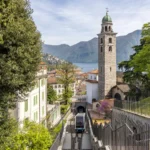
The largest town in the canton, Lugano stretches along the north shore of the lake of the same name (Ceresio). You can stroll along the quays and through the arcaded pedestrian streets of the centre. Two peaks frame the bay: Monte Brè, the panoramic viewpoint of Italian-speaking Switzerland, and Monte San Salvatore, both reached by funicular. Boats of the lake navigation company serve the lakeside villages.
Morcote and Gandria
South of Lugano, Morcote stacks its houses and church at the water’s edge; it is one of the most photographed villages in Ticino. To the east, Gandria, clinging to the slope, is reached on foot by a lakeside path or by boat. Right next to Morcote, at Melide, the Swissminiatur park displays models of Swiss monuments.
Monte San Giorgio
Between the two southern arms of Lake Lugano, Monte San Giorgio is a UNESCO World Heritage Site for its Triassic marine fossil beds, among the richest in the world. A fossil museum at Meride presents the finds, and trails cross the mountain.
Locarno, Ascona and Lake Maggiore
On the north of Lake Maggiore, Locarno is built around the Piazza Grande, which hosts the open-air film festival every summer; above the town, the Madonna del Sasso sanctuary overlooks the lake. Neighbouring Ascona lines its colourful facades along the promenade. Offshore, the Brissago Islands can be visited by boat: the largest holds a botanical garden. Check festival dates and boat timetables on the official sites.
Bellinzona and its castles
The canton’s capital since 1878, Bellinzona guards the Ticino valley at the foot of the great Alpine passes. Its three castles, Castelgrande, Montebello and Sasso Corbaro, linked by walls, have been a UNESCO World Heritage Site since 2000. It is one of the finest ensembles of medieval fortifications in the Alpine arc, and an easy stop by train.
The Verzasca Valley and the Maggia Valley
Above Locarno, the Verzasca Valley is known for its clear green water, its stone villages and the medieval double-arched bridge at Lavertezzo. Further west, the Maggia Valley leads to granite villages and waterfalls. Swimming in the torrents is dangerous: floods are sudden, especially when dams release water upstream. Respect the signs and never swim after a storm.
Mendrisiotto and Monte Generoso
In the far south, the Mendrisiotto is Ticino’s wine region, known for its merlot. Above it, Monte Generoso, reached by rack railway from Capolago, offers a view over the lakes and the Po plain. Mendrisio is also known for its Holy Week processions, an old tradition.
Ticino in 4 or 5 days
Day 1: Lugano, its quays and Monte Brè; in the evening, Gandria by the lake path.
Day 2: Morcote by boat, Monte San Giorgio or Monte Generoso.
Day 3: Bellinzona and its three castles.
Day 4: Locarno, Madonna del Sasso, Ascona and the Brissago Islands.
Day 5: Verzasca Valley and Lavertezzo, or the Maggia Valley.
Where to stay in Ticino
Two bases share most stays. Lugano, for Lake Lugano, Morcote, Monte San Giorgio and the south of the canton. Locarno or Ascona, for Lake Maggiore and the valleys (Verzasca, Maggia). Bellinzona, between the two, is well connected by train and also works as a stopover. Valley villages suit hikers, with less frequent transport.
Getting to Ticino and getting around
From northern Switzerland, the train passes under the St Gotthard massif through the base tunnel, opened in 2016, then through the Ceneri tunnel; by road, access is through the Gotthard road tunnel or over the San Bernardino pass. From Italy, the Chiasso border opens onto Lombardy. Many visitors fly into Milan or Zurich and continue by train.
On the spot, the rail network links Bellinzona, Lugano, Locarno and Mendrisio; PostBuses climb into the valleys and boats serve the two lakes. A car is useful for the most remote valleys.
Train, car or pass?
A stay between lakes and towns can be done without a car. If you drive, you must buy and display a vignette (sticker) for Swiss motorways, and without one you could get a large fine (UK FCDO (GOV.UK, updated 11 August 2026); the U.S. Department of State (travel.state.gov, last updated January 15, 2026) says rental cars usually already have one: check with the rental agency). In alpine areas roads can become dangerous because of snowfall, ice or avalanches, and some mountain roads may close for extended periods; snow chains are required in some mountain areas in winter (U.S. Department of State). The UK FCDO says you can use a UK photocard driving licence in Switzerland. Before buying a pass or a rental, compare the official site (SBB, the navigation company, the rental company) with resellers: validity, zones covered, cancellation.
When to go to Ticino: climate month by month
Sheltered from the north winds by the Alps, southern Ticino is milder than the rest of Switzerland, which allows palm trees and Mediterranean vegetation to grow beside the lakes. But it is also wetter, with heavy, short downpours. The table combines the official normals with our own calculations: day-night gap, sunrise and sunset, day length.
Month
High °C (°F)
Low °C (°F)
Rain mm (in)
Rain days (≥ 1 mm)
Day-night gap °C (°F)
Sunrise / sunset on the 15th
Day length
January
7.1 (45)
1.2 (34)
66 (2.6)
5.3
5.9 (11)
8:02 am / 5:05 pm
9 h 03 min
February
9 (48)
1.9 (35)
61 (2.4)
5
7.1 (13)
7:27 am / 5:49 pm
10 h 22 min
March
13.5 (56)
5.2 (41)
76 (3.0)
6.3
8.3 (15)
6:37 am / 6:29 pm
11 h 52 min
April
16.7 (62)
8.5 (47)
138 (5.4)
9.9
8.2 (15)
6:38 am / 8:10 pm
13 h 32 min
May
20.8 (69)
12.4 (54)
178 (7.0)
11.6
8.4 (15)
5:52 am / 8:49 pm
14 h 57 min
June
24.9 (77)
16.1 (61)
172 (6.8)
10.1
8.8 (16)
5:32 am / 9:16 pm
15 h 44 min
July
27.3 (81)
18 (64)
158 (6.2)
8.2
9.3 (17)
5:47 am / 9:11 pm
15 h 24 min
August
26.8 (80)
17.8 (64)
158 (6.2)
9.6
9 (16)
6:23 am / 8:33 pm
14 h 10 min
September
22.1 (72)
14.2 (58)
165 (6.5)
8.7
7.9 (14)
7:01 am / 7:36 pm
12 h 34 min
October
16.9 (62)
10.2 (50)
150 (5.9)
9.2
6.7 (12)
7:40 am / 6:38 pm
10 h 58 min
November
11.6 (53)
5.7 (42)
167 (6.6)
9.3
5.9 (11)
7:24 am / 4:52 pm
9 h 29 min
December
7.7 (46)
2 (36)
80 (3.1)
6.3
5.7 (10)
7:59 am / 4:39 pm
8 h 40 min
Temperature, precipitation and days with precipitation (≥ 1 mm): 1991-2020 normals for the Lugano station (06770), MeteoSwiss, published by the World Meteorological Organization (NOAA/NCEI archive). Day-night gap, sunrise, sunset and day length: Destination de Voyage calculations (NOAA solar algorithm, 15th of each month, Swiss time).
Reading the table: winter is dry and often sunny (5 to 6 days with precipitation a month from December to February), with highs of 7 to 9 °C (45 to 48 °F). From April to November, totals exceed 135 mm (5.3 in) a month, with a peak in May (178 mm / 7.0 in), but they fall as showers and thunderstorms: the number of rainy days stays at 8 to 12 a month. July is the hottest month (27.3 °C / 81 °F) and the sunniest (260 hours of sunshine, MeteoSwiss). Lugano gets 2,120 hours of sunshine a year. September (22.1 °C / 72 °F) is a good compromise for walking and swimming in the lakes.
US citizens: according to the U.S. Department of State (travel.state.gov, last updated January 15, 2026), visit the website of the Embassy of Switzerland in Washington, D.C. for the most current visa information. For the Schengen area, your passport should be valid for at least three months beyond the period of stay, and you will need sufficient proof of funds and a return plane ticket. The State Department rates Switzerland Level 1, Exercise Normal Precautions (travel advisory dated August 13, 2026).
UK citizens: according to the UK FCDO (GOV.UK, updated 11 August 2026), you can travel without a visa to the Schengen area, which includes Switzerland, for up to 90 days in any 180-day period as a tourist. Your passport must have been issued less than 10 years before you arrive and be valid for at least 3 months after the day you plan to leave the Schengen area. At Swiss border control you may be asked to show proof of accommodation, proof of insurance, a return or onward ticket and proof of enough money (around 100 Swiss francs a day). The EU Entry/Exit System (EES) is being implemented across the Schengen area: you may need to register fingerprints and a photo, at no cost. The two governments’ pages are consistent; check with the Swiss Embassy if in doubt. See entry requirements for Switzerland.
Local rules and safety: in Ticino and St Gallen it is illegal to cover your face in public, including for tourists, with fines of 100 to 10,000 Swiss francs (UK FCDO (GOV.UK, updated 11 August 2026)). For hiking and other mountain sports, the FCDO advises insurance that includes mountain rescue, helicopter costs and repatriation. The U.S. Department of State warns that alpine hazards (avalanches, landslides, flooding, falling rocks, sudden weather changes) are common and that mountain rescues can be extremely expensive. Emergencies: dial 112; 144 for an ambulance, 117 for the police and 118 for the fire department (U.S. Department of State).
Staying connected
Check your own provider’s roaming terms for Switzerland before you leave, or see our Switzerland eSIM page. Close to the border, your phone may also pick up an Italian network. Payments: the State Department says most major credit cards are widely accepted but many vendors will only accept chip-and-PIN cards.
If you… then…
If you…
Then…
Want winter sun
Ticino is dry from December to February, with highs of 7 to 9 °C (45 to 48 °F) in Lugano
Want to swim in the lakes
Aim for July-September, but not in the torrents after a storm
Like castles
Bellinzona: three UNESCO-listed castles
Travel without a car
Trains, PostBuses and boats cover most of it
Combine with Italy
Lake Como and Lake Maggiore on the Italian side are very close
Have only two days
Lugano and Morcote, then Locarno and the Verzasca Valley
Frequently asked questions
What is there to see in Ticino?
Lugano and its lake, Morcote, Monte San Giorgio, Locarno and Ascona, the Brissago Islands, the castles of Bellinzona, the Verzasca and Maggia valleys, Monte Generoso.
What language is spoken in Ticino?
Italian. Ticino makes up most of Italian-speaking Switzerland.
What is the capital of Ticino?
Bellinzona, the canton’s capital by a decree of 1878. Lugano is the largest town.
When is the best time to go to Ticino?
June to September for the lakes; winter is dry and mild by Swiss standards. May is the wettest month in Lugano (MeteoSwiss 1991-2020 normals).
How do you get to Ticino?
Many visitors fly into Milan or Zurich and continue by train, or drive through the Gotthard or San Bernardino tunnels and passes.
Do US and UK citizens need a visa for Ticino?
UK citizens can travel to Switzerland without a visa for up to 90 days in any 180-day period (UK FCDO, GOV.UK, updated 11 August 2026). For US citizens, the State Department (updated January 15, 2026) refers to the Swiss Embassy for visa information and lists Schengen requirements: a passport valid at least three months beyond your stay, proof of funds and a return ticket.
Our sources
UK FCDO, foreign travel advice for Switzerland (GOV.UK, updated 11 August 2026), read on 26 October 2026
U.S. Department of State, Switzerland country information (travel.state.gov, last updated January 15, 2026) and Travel Advisory (Level 1, August 13, 2026)
World Meteorological Organization, 1991-2020 climate normals, Lugano station (06770), MeteoSwiss (NOAA/NCEI archive)
Wikipedia article “Canton of Ticino” (geography, history)
UNESCO World Heritage List: Three Castles, Defensive Wall and Ramparts of the Market-Town of Bellinzona (2000); Monte San Giorgio (2003)
Astronomical calculations: NOAA solar algorithm, applied by Destination de Voyage to the coordinates of Lugano (15th of each month, year 2027)
Time zone: IANA tz database (Europe/Zurich); UK and US clock-change rules: GOV.UK “When do the clocks change” and NIST


 FlightsKiwi.comCompare flights and airline combinations to Ticino.Compare flights