Mendoza, the capital of the province of the same name, lies at the foot of the Andes in western Argentina, not far from the Chilean border. It is the capital of Argentine wine: the city is surrounded by vineyards, and the wineries of Maipú, Luján de Cuyo and the Uco Valley draw malbec lovers. People also come for its wide, shaded avenues, irrigated by canals, and as a base for Aconcagua, the highest peak in the Americas. This guide to visiting Mendoza covers what to see, how to get there, where to stay and the weather month by month, based on the Servicio Meteorológico Nacional normals.
To prepare your trip: our Argentina travel guide, the calendar when to go to Argentina, our Buenos Aires guide and the map of Argentina.

Our travel deals for Mendoza
Affiliate links: we earn a commission, at no extra cost to you.
 FlightsKiwi.comCompare flights and airline combinations to Mendoza.Compare flights
- Airport transferKiwitaxiPrivate driver booked in advance at a fixed price.Book a transfer
- eSIMSailyAnother eSIM plan to compare: data, validity, network.See Saily plans



Mendoza at a glance
- Time zone UTC−3 all year: 3 hours behind London in winter (4 hours during UK summer time), 2 hours ahead of New York in winter (see time difference in Argentina)
- Climate average high of 32.8 °C (91 °F) in January and 15.3 °C (60 °F) in July; 238 mm (9.4 in) of rain a year (SMN, 1991–2020)
- Entry visa-free for up to 90 days for US and UK citizens, passport valid for the length of your stay (travel.state.gov, GOV.UK)
- Airport Francisco Gabrielli International Airport (El Plumerillo)
- Highlights Independencia Square, General San Martín Park, Cerro de la Gloria, Maipú and Luján de Cuyo wineries, Aconcagua
Mendoza in brief: a city rebuilt after the earthquake
Mendoza was founded on March 2, 1561 by Pedro del Castillo. It was here that General José de San Martín prepared the army that crossed the Andes to liberate Chile in 1817–1818. On March 20, 1861, a magnitude 7.2 earthquake destroyed the city and killed more than 4,000 people. It was rebuilt on another site, following a plan drawn in 1863 by the Frenchman Jules Balloffet: wide avenues, squares and parks. The acequias, irrigation canals inherited from the Huarpes, still run along the streets and feed the trees that make Mendoza an oasis in an arid region. The urban area, Greater Mendoza, extends across the neighboring departments: Godoy Cruz, Guaymallén, Las Heras, Maipú and Luján de Cuyo.
What to see in Mendoza: the highlights
Independencia Square and the central squares
At the heart of Balloffet’s plan, Independencia Square covers several blocks; it houses the municipal museum of modern art. Four smaller squares surround it, each with its own style: Plaza España, decorated with ceramics and given by the Spanish government, is the most photographed. In the center, the terraces of Avenida Arístides Villanueva gather bars and restaurants in the evening.
General San Martín Park and Cerro de la Gloria
West of the center, the vast General San Martín Park brings together a lake, tree-lined paths and several museums, including the Juan Cornelio Moyano natural sciences and anthropology museum. At the back of the park, Cerro de la Gloria carries a monument to San Martín’s Army of the Andes and offers a view of the city and the cordillera. On its slopes, the Frank Romero Day Greek Theatre hosts the central event of the grape harvest festival.
Museums of Mendoza’s history
The Museum of the Cuyan Past, in a house dating from 1873, tells the story of life in the region in the nineteenth century. The General San Martín Historical Museum recalls the Andes campaign. The ruins of the old city, destroyed in 1861, can be visited in the historic district. Check the opening hours on the official sites before going.
The wineries and the wine route
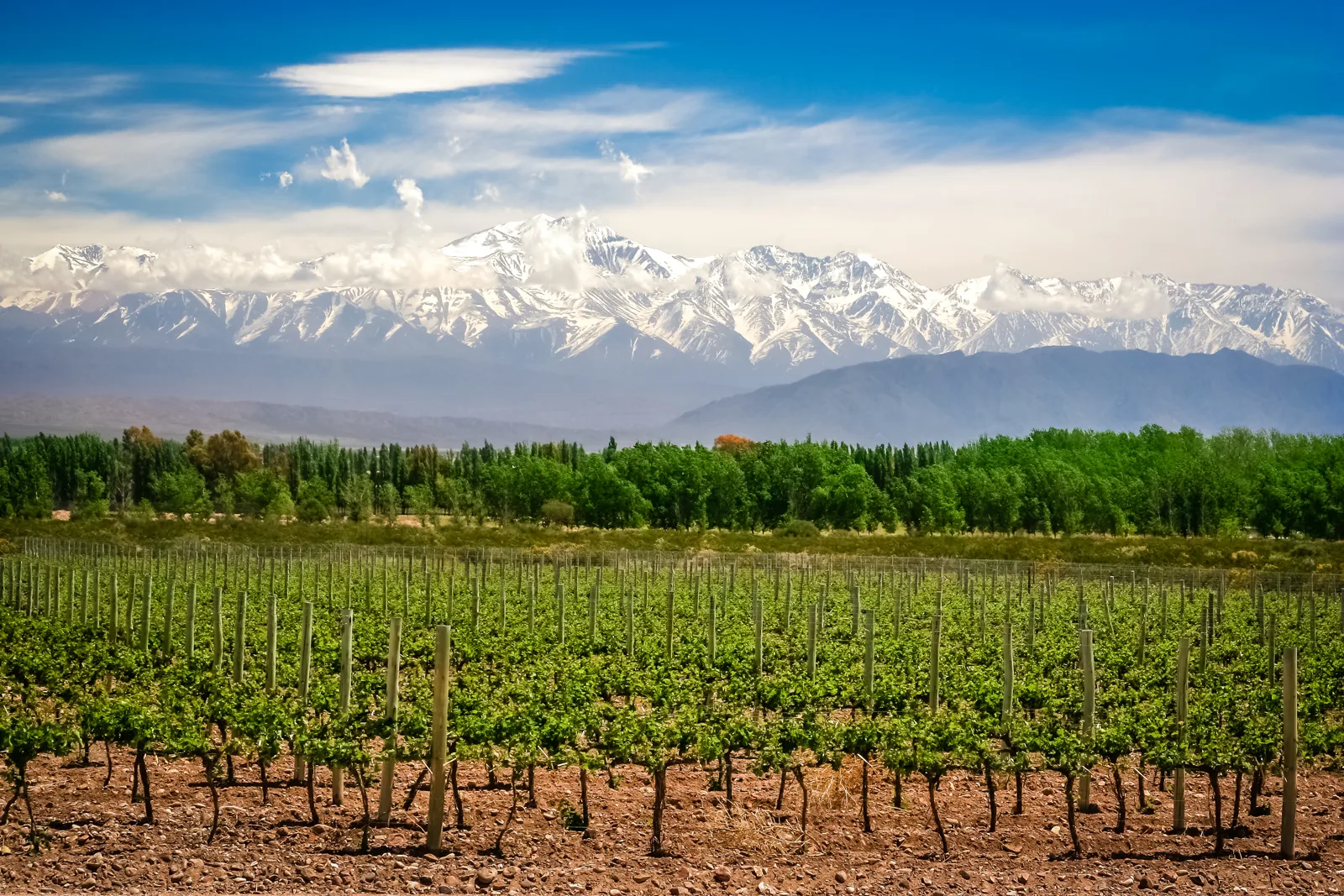
Mendoza is Argentina’s leading wine-producing center, and the vines begin at the edge of the city. Maipú and Luján de Cuyo, in the urban area, have many wineries (bodegas) offering tours and tastings, often by reservation. Farther south, the Uco Valley, at the foot of the Andes, is the province’s other major wine zone. Note: the U.S. Department of State (travel.state.gov) reports frequent robberies at the bus station in Mendoza, and the UK FCDO advises extra caution downtown. Prefer group or guided visits, and do not drink and drive.
The road to Aconcagua
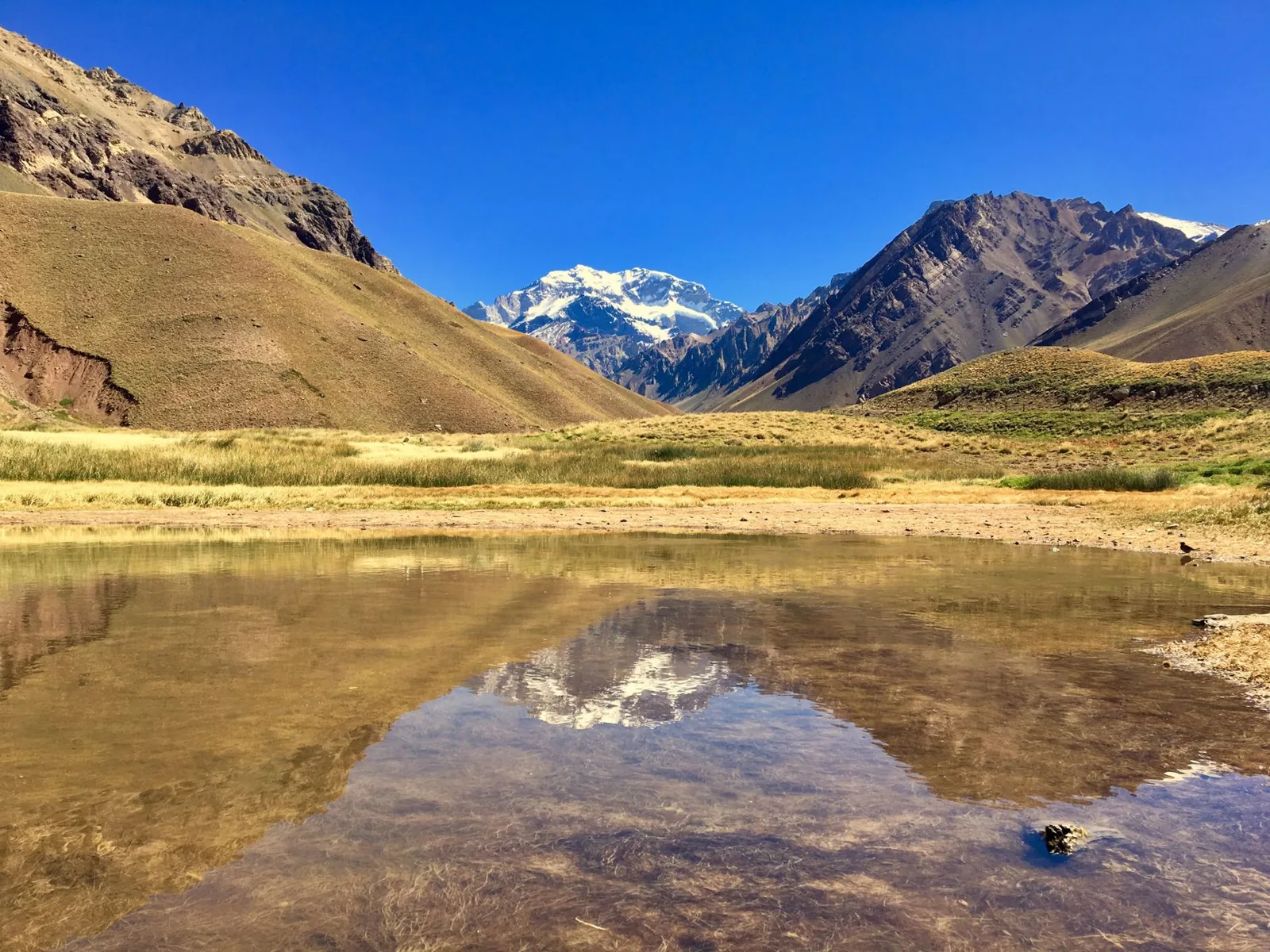
To the west, the national highway to Chile climbs the Mendoza valley through the Precordillera. It leads toward Aconcagua, the highest peak in the Americas. Climbing it is a high-mountain expedition: acclimatization and experienced guides are essential. Ask the provincial authorities about access conditions.
Mendoza in three or four days
- Day 1: the center on foot, Independencia Square and Plaza España, General San Martín Park and Cerro de la Gloria at sunset.
- Day 2: winery visits in Maipú or Luján de Cuyo, on a guided excursion.
- Day 3: excursion along the Aconcagua road, in the Precordillera.
- Day 4: Uco Valley or a relaxed day, then the museums in the center.
Where to stay in Mendoza
The center, around Independencia Square and the neighboring squares, lets you do everything on foot and enjoy the restaurants. The area near General San Martín Park is quieter. For a wine-focused stay, lodging is set among the vineyards in Luján de Cuyo, Maipú or the Uco Valley, but you then need a vehicle or excursions.
Getting to Mendoza and getting around
Mendoza has an international airport, Francisco Gabrielli, known as El Plumerillo, northeast of the city. International visitors generally arrive via Buenos Aires or Santiago de Chile: check routes on the airport and airline websites. Mendoza is also linked by coach to the rest of Argentina and to Santiago through the Andes road, whose border crossing can be closed in winter by snow; check before you go. The FCDO (GOV.UK) advises being particularly cautious downtown and the State Department reports frequent bag thefts at the Mendoza bus station.
In town, the center is walkable, and buses and a metrotram complete the network. For the wineries and the mountains, you use excursions or a rental car.
Transfers, excursions and car rental
Taxis, ride-hailing and buses link the airport and the center. For winery visits, organized excursions spare you from driving after tastings. A rental car is useful for the Aconcagua road and the Uco Valley; in winter, check the condition of mountain roads. Before booking, compare the provider’s official site and resellers: insurance, excess, cancellation terms, and permission to cross into Chile.
When to go to Mendoza: climate month by month
Mendoza has an arid climate: very sunny, with little rain, hot summers and cool winters with cold nights. The seasons are the opposite of those in the Northern Hemisphere. The table combines the official normals with our calculations: day/night gap, sunrise and sunset, day length.
| Month | Avg. max | Avg. min | Rain | Days with precipitation (at least 1 mm) | Day/night gap | Sunrise / sunset on the 15th | Day length |
|---|---|---|---|---|---|---|---|
| January | 32.8 °C (91 °F) | 19.3 °C (67 °F) | 47 mm (1.9 in) | 4.5 | 13.5 °C (24 °F) | 6:42 am / 8:46 pm | 14 h 04 min |
| February | 31.0 °C (88 °F) | 17.8 °C (64 °F) | 41 mm (1.6 in) | 4.0 | 13.2 °C (24 °F) | 7:11 am / 8:26 pm | 13 h 15 min |
| March | 28.1 °C (83 °F) | 15.7 °C (60 °F) | 32 mm (1.3 in) | 3.4 | 12.4 °C (22 °F) | 7:34 am / 7:53 pm | 12 h 18 min |
| April | 23.3 °C (74 °F) | 10.8 °C (51 °F) | 18 mm (0.7 in) | 2.4 | 12.5 °C (22 °F) | 7:56 am / 7:13 pm | 11 h 16 min |
| May | 18.7 °C (66 °F) | 6.8 °C (44 °F) | 11 mm (0.4 in) | 2.0 | 11.9 °C (21 °F) | 8:18 am / 6:44 pm | 10 h 26 min |
| June | 15.9 °C (61 °F) | 2.9 °C (37 °F) | 6 mm (0.2 in) | 1.0 | 13.0 °C (23 °F) | 8:36 am / 6:35 pm | 10 h 00 min |
| July | 15.3 °C (60 °F) | 2.0 °C (36 °F) | 5 mm (0.2 in) | 1.3 | 13.3 °C (24 °F) | 8:36 am / 6:46 pm | 10 h 11 min |
| August | 18.6 °C (65 °F) | 4.3 °C (40 °F) | 8 mm (0.3 in) | 1.3 | 14.3 °C (26 °F) | 8:12 am / 7:07 pm | 10 h 54 min |
| September | 21.8 °C (71 °F) | 7.8 °C (46 °F) | 12 mm (0.5 in) | 2.1 | 14.0 °C (25 °F) | 7:34 am / 7:27 pm | 11 h 53 min |
| October | 25.7 °C (78 °F) | 11.9 °C (53 °F) | 11 mm (0.4 in) | 2.0 | 13.8 °C (25 °F) | 6:54 am / 7:47 pm | 12 h 53 min |
| November | 29.2 °C (85 °F) | 15.4 °C (60 °F) | 22 mm (0.9 in) | 3.0 | 13.8 °C (25 °F) | 6:25 am / 8:14 pm | 13 h 49 min |
| December | 32.0 °C (90 °F) | 18.1 °C (65 °F) | 25 mm (1.0 in) | 3.2 | 13.9 °C (25 °F) | 6:21 am / 8:39 pm | 14 h 19 min |
Reading the table: only 238 mm (9.4 in) of precipitation falls a year, over about thirty days, mostly in the southern summer as thunderstorms. From December to February the average high exceeds 31 °C (88 °F) (32.8 °C (91 °F) in January); this is also the sunniest period (more than 300 hours in December and January, SMN). In June and July the high falls to 15–16 °C (59–61 °F) and the low to 2–3 °C (36–37 °F), with on average 8.7 frost days in July. March–April, the grape-harvest season, and October–November, in spring, have the most pleasant temperatures (23.3 °C (74 °F) in April, 25.7 °C (78 °F) in October). The day/night gap stays between 12 and 15 °C (22 to 27 °F) all year: bring a jacket for the evening.
To compare with Buenos Aires, Patagonia or the northwest, see when to go to Argentina.
Entry requirements, health and safety
- US citizens: according to the U.S. Department of State (travel.state.gov, Argentina page last updated July 16, 2026), you need a valid passport, and US citizens do not need a visa for visits of up to 90 days for tourism or business. Expired or damaged passports may mean you are refused entry. The Department rates Argentina Level 1, « Exercise normal precautions » (advisory updated July 9, 2026).
- UK citizens: according to the UK FCDO (GOV.UK, updated 7 May 2026), your passport must be valid for the proposed length of your stay, and you can visit Argentina without a visa for tourism for up to 90 days. Immigration authorities no longer stamp passports on entry: if you need proof of entry or exit, contact the Argentine Migration Office. You must declare cash or traveller’s cheques worth more than 10,000 US dollars.
- Street crime: the State Department says street crime is a problem in most urban areas, including Mendoza, and that frequent robberies of luggage and handbags occur at the Mendoza bus station; the FCDO advises being particularly cautious downtown in Mendoza.
- Tourist Police: according to the FCDO (GOV.UK), the Mendoza Tourist Police (Comisaría del Turista) can be reached 24 hours a day on +54 261 413 2135.
- Earthquakes: the FCDO (GOV.UK, updated 7 May 2026) says there is a risk of earthquakes in Argentina, particularly in the provinces of Mendoza, San Juan, Salta and Jujuy: monitor media reports and follow the advice of local authorities.
- Altitude and adventure sports: the FCDO says altitude sickness is a risk when hiking in parts of Argentina, and that you will have to pay for most helicopter rescues, including on Mount Aconcagua; make sure your travel insurance covers helicopter rescue and medical evacuation. The State Department notes that several US citizens, including expert climbers, have died on Aconcagua and that rescue missions are often impossible.
- Health: the FCDO lists yellow fever, Zika virus and dengue among the diseases to be aware of in Argentina, and says hantavirus is present; the State Department notes that mosquitoes are prevalent from December to March (see TravelHealthPro and the CDC for vaccine advice).
- If you cross into Chile on the Andes road, also check Chile’s entry rules. See our travel formalities guide.
Staying connected
An eSIM installed before departure lets you use maps and ride-hailing on arrival. In the mountains the network is often absent, so download offline maps. See our travel eSIM guide.
If you… then…
| If you… | Then… |
|---|---|
| Come for the wine | March–April (harvest); visit the wineries on a guided excursion rather than cycling alone |
| Dislike the heat | Avoid December–February (highs above 31 °C (88 °F)) |
| Want to see Aconcagua | Take the Aconcagua road for a day trip; climbing it demands acclimatization and an experienced guide (FCDO and State Department advice) |
| Travel in the southern winter | Mild days, nights close to 0 °C (32 °F); check that the pass to Chile is open |
| Arrive by coach | Watch your belongings at the bus station |
| Have only one day | Downtown, Plaza España, San Martín Park and Cerro de la Gloria, then a winery in Maipú |
Frequently asked questions
What is there to see in Mendoza?
Independencia Square and Plaza España, General San Martín Park and Cerro de la Gloria, the history museums, the Maipú and Luján de Cuyo wineries, the Uco Valley and the Aconcagua road.
What is the best time to visit Mendoza?
March–April and October–November, with highs of 23 to 29 °C (73 to 84 °F). The southern summer (December–February) exceeds 31 °C (88 °F) and winter is cool with cold nights (SMN 1991–2020 normals).
How many days should you spend in Mendoza?
Three or four days: one for the city, one or two for the wineries, one for the Aconcagua road.
Is Mendoza a safe city?
The State Department rates Argentina Level 1, but warns that street crime is a problem in Mendoza and that bag thefts are frequent at the bus station; the FCDO advises caution downtown. The Tourist Police can be reached on +54 261 413 2135 (FCDO).
Do you need a visa for Mendoza and Argentina?
No visa is needed for US or UK citizens for tourist stays of up to 90 days; your passport must be valid for your stay (U.S. Department of State, last updated July 16, 2026; UK FCDO, GOV.UK, updated 7 May 2026).
Can you see Aconcagua from Mendoza?
You approach it on the national highway to Chile, on a day excursion or by car.
Our sources
- U.S. Department of State, Argentina country information (travel.state.gov, last updated July 16, 2026) and Argentina travel advisory (Level 1, updated July 9, 2026), read on 26 October 2026
- UK FCDO, foreign travel advice for Argentina (GOV.UK, updated 7 May 2026), read on 26 October 2026
- World Meteorological Organization, 1991–2020 climate normals, Mendoza Aero station (87418), Servicio Meteorológico Nacional (NOAA/NCEI archive)
- Wikipedia article « Mendoza (Argentina) » (history, urban planning, museums, harvest festival, airport)
- Astronomical calculations: NOAA solar algorithm, applied by Destination de Voyage to the coordinates of Mendoza (15th of each month, year 2027)
- Our methodology
Updated October 2026.