The best time to visit Bali is the dry season, from April to October, and more precisely from May to September: Denpasar gets less than 100 mm (3.9 in) of rain a month, the air is a little less heavy and the sea is generally calm on the east coast. The rainy season, from November to March, stays hot (about 33 °C, or 91 °F, in the afternoon) but is very wet, with a peak in January. Bali has a tropical climate: it is hot all year, and it is rain, more than temperature, that sets the seasons apart. That January rain peak then drops sharply: our page on Bali in April describes this transition month into the dry season.
Because Bali lies just south of the equator, temperatures barely change through the year: what makes the difference is rain, crowds and prices. July–August is the busiest period, with European and Australian school holidays. Here is how to choose, based on the official climate normals for the Denpasar station (BMKG, 1961–1990). For that busiest period, our guide to the weather in Bali in July covers the climate, crowds and how far ahead to book.

Our travel deals for Bali
Affiliate links: we earn a commission, at no extra cost to you.
 FlightsKiwi.comCompare flights and airline combinations to Bali.Compare flights
- eSIMAiraloData plan to install before you leave (eSIM-compatible phone).See plans


When to go to Bali at a glance
- Best time May to September (dry season)
- Best balance of weather, prices and crowds May–June and September
- Driest months August (25 mm (1.0 in) of rain in Denpasar), then September, June and July (47 to 55 mm, or 1.9 to 2.2 in)
- Rainy season November to March, peaking in January (345 mm (13.6 in))
- Temperatures 29.6 °C (85 °F) to 34.4 °C (94 °F) in the afternoon depending on the month on the coast, noticeably cooler at altitude (Ubud, Munduk, Kintamani)
- High season July–August and the year-end holidays
- Good to know Nyepi, the Day of Silence, usually in March: the whole island shuts down for 24 hours, airport included
When to go to Bali by priority
- Best weather: May to September, in the dry season (25 mm (1.0 in) of rain in August in Denpasar)
- Cheapest: February–March and November, outside the year-end holidays
- Fewest crowds: February, March and November; May–June and September offer the best balance of weather, prices and crowds
- Events: Nyepi, the Day of Silence, usually in March (island and airport closed for 24 hours); Galungan every 210 days; Bali Arts Festival in June–July
Bali: the calendar at a glance
🔎 Month by month: Bali in January · Bali in February · Bali in April · Bali in may · Bali in June · Bali in July · Bali in August · Bali in September · Bali in October · Bali in November · Bali in December
✅ Best months: April, may, June, July, August, September, October
❌ Period to avoid: January
Climate and weather in Bali month by month
The table below gives the normals for Denpasar, in the south of the island. They are representative of the coastal areas where most travelers stay (Kuta, Seminyak, Canggu, Sanur, Uluwatu, Nusa Dua). The mountainous center and the north are covered further down.
| Month | Avg. max | Avg. min | Rain | Crowds | Prices | Verdict |
|---|---|---|---|---|---|---|
| January | 33.0 °C (91 °F) | 24.1 °C (75 °F) | 345 mm (13.6 in) | Medium | Medium | ❌ The wettest month |
| February | 33.4 °C (92 °F) | 24.2 °C (76 °F) | 274 mm (10.8 in) | Low | Low | ⚠️ Very wet |
| March | 33.6 °C (92 °F) | 24.0 °C (75 °F) | 234 mm (9.2 in) | Low | Low | ⚠️ Rain easing, Nyepi |
| April | 34.4 °C (94 °F) | 24.8 °C (77 °F) | 88 mm (3.5 in) | Medium | Medium | ✅ End of the rains, green landscapes |
| May | 33.1 °C (92 °F) | 24.1 °C (75 °F) | 93 mm (3.7 in) | Medium | Medium | ✅ Dry season, a very good month |
| June | 31.4 °C (89 °F) | 23.5 °C (74 °F) | 53 mm (2.1 in) | High | Medium → high | ✅ Dry and a little less hot |
| July | 30.4 °C (87 °F) | 23.0 °C (73 °F) | 55 mm (2.2 in) | Very high | Very high | ✅ Dry, but high season |
| August | 29.6 °C (85 °F) | 22.5 °C (73 °F) | 25 mm (1.0 in) | Very high | Very high | ✅ The driest month |
| September | 31.4 °C (89 °F) | 22.9 °C (73 °F) | 47 mm (1.9 in) | High | High | ✅ Excellent, crowds easing |
| October | 33.6 °C (92 °F) | 23.7 °C (75 °F) | 63 mm (2.5 in) | Medium | Medium | ✅ Still dry, heat returning |
| November | 32.7 °C (91 °F) | 23.5 °C (74 °F) | 179 mm (7.0 in) | Low | Low | ⚠️ Showers return |
| December | 33.0 °C (91 °F) | 23.5 °C (74 °F) | 276 mm (10.9 in) | High (holidays) | High in late Dec. | ⚠️ Very wet, holiday prices |
Note: in the rainy season it rarely rains all day. Showers often fall in the late afternoon or at night, as short but intense thunderstorms. Humidity, however, stays high all the time. Our page on Bali in December covers this month in the heart of the rainy season.
Bali’s seasons: pros and cons
Bali has only two seasons. The dry season corresponds to the southeast monsoon, carried by drier air from Australia. The rainy season corresponds to the northwest monsoon, which is wetter. The transition usually happens in April and in October–November, with variations from year to year. For the start of the rainy season, see our page on the weather in Bali in November.
Dry season (April to October): high season
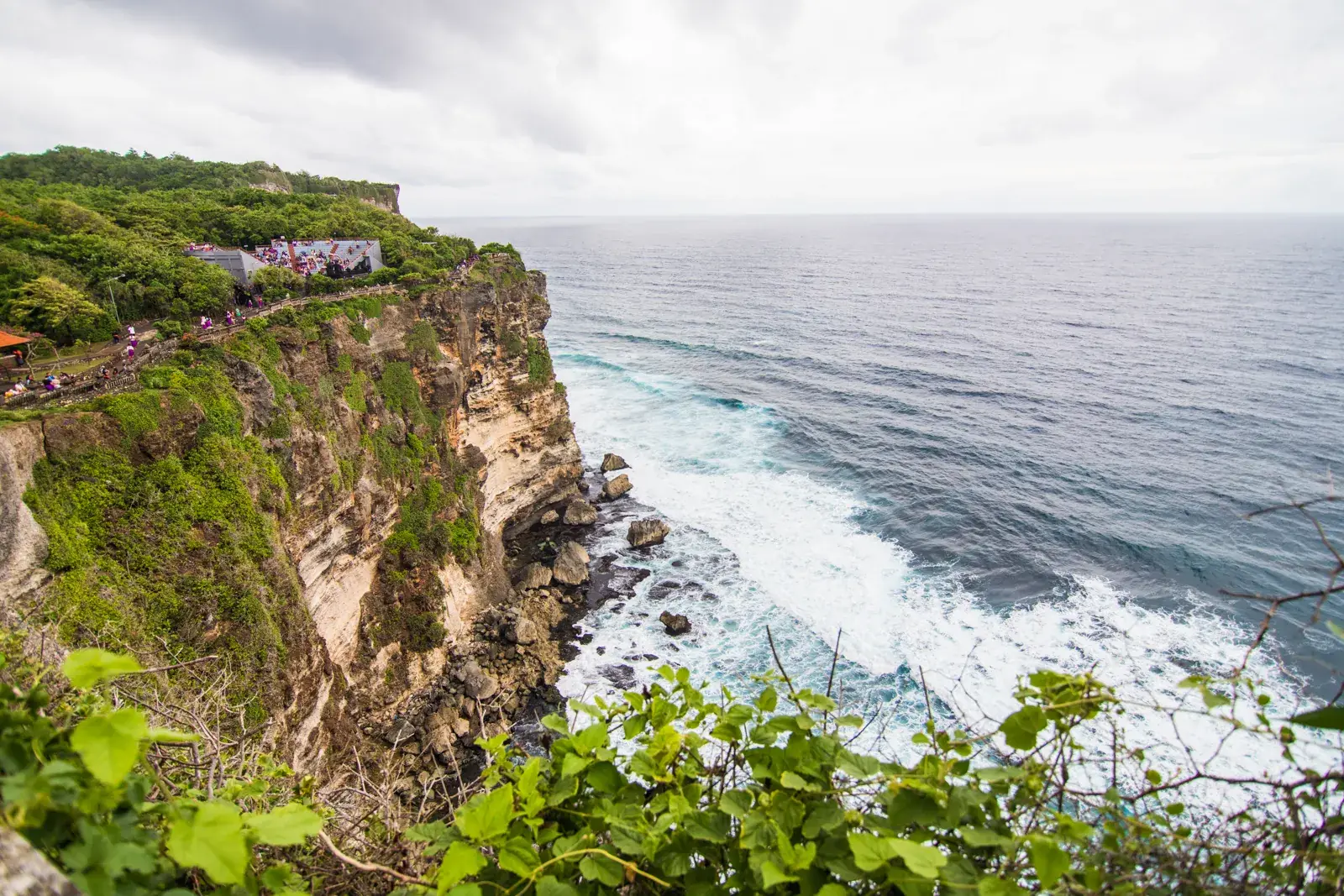
From April to October, Denpasar gets less than 100 mm (3.9 in) of rain a month, and barely 25 mm (1.0 in) in August. Highs ease slightly (30 °C, or 86 °F, in July–August) and nights are more pleasant, especially at altitude. It is also the season of regular waves on the west coast and the Bukit Peninsula, sought after by experienced surfers.
- Pros: often clear skies, dry trails for hiking and the sunrise climb of Mount Batur, good visibility for diving and snorkeling at Amed and Nusa Penida
- Cons: heavy crowds and high prices in July–August, traffic jams in the south of the island (Canggu, Seminyak, Kuta)
- Our tip: May, June and September have the same weather as the summer months, with fewer people and gentler prices
Rainy season (November to March): the green season
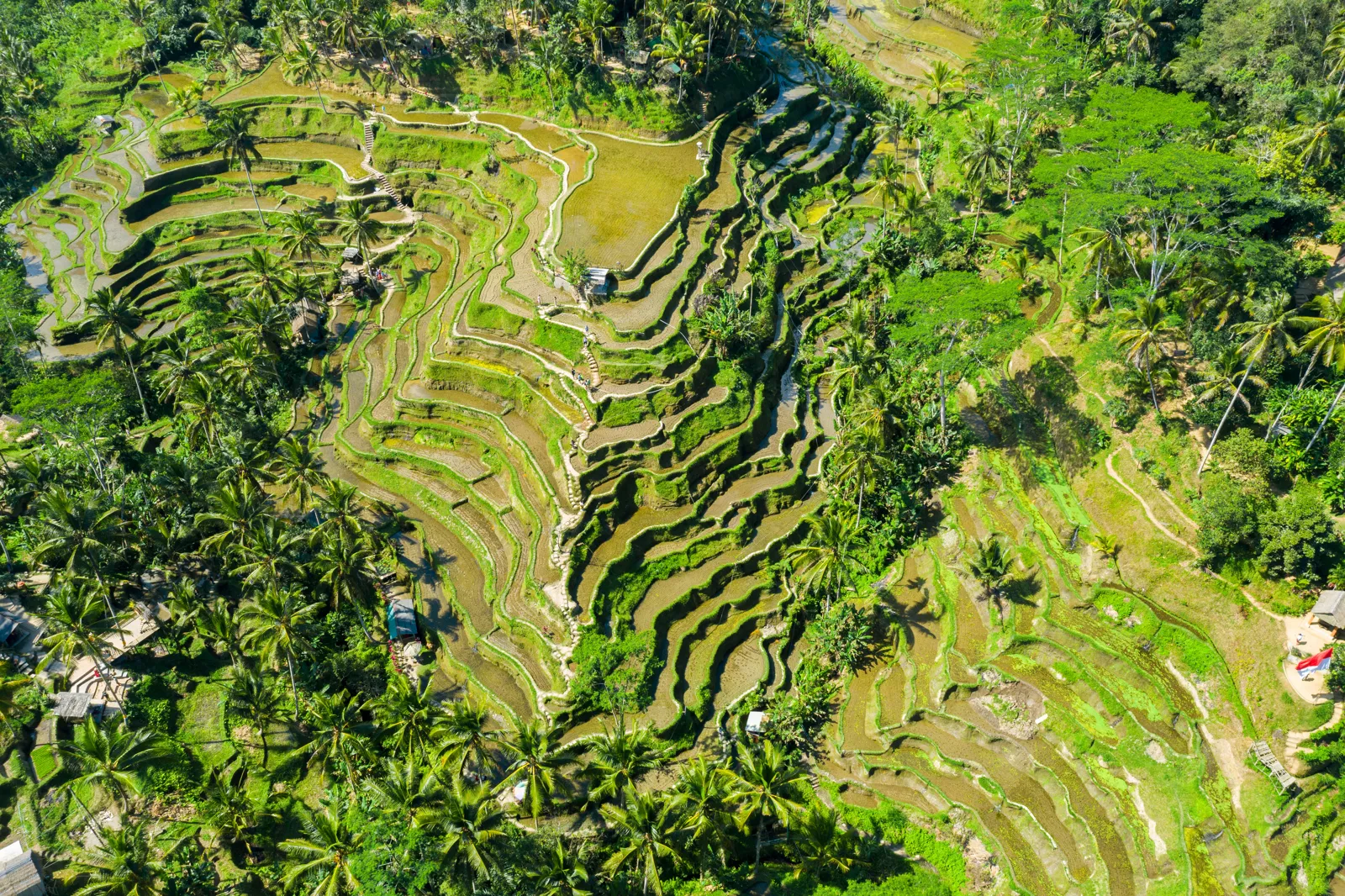
Rain increases from November (179 mm (7.0 in)) and peaks in January (345 mm (13.6 in) in Denpasar). It is still hot, around 33 °C (91 °F) in the afternoon, but humidity is high. The rice fields are then an intense green and the island is quieter, except over the year-end holidays. The heart of the wet season is covered in our page on Bali in January.
- Pros: low prices outside Christmas and New Year, fewer tourists, very green landscapes, waterfalls in full flow
- Cons: violent downpours, sometimes flooded roads, slippery hikes, a rougher sea and sometimes plastic waste washed up on some west-coast beaches
- Who is it for? Travelers on a small budget and those focused on culture, yoga or wellness in Ubud, for whom a few showers are not a problem
When to go to Bali and Indonesia by region
Bali shares the same seasonal rhythm as Java, Lombok and the Lesser Sunda Islands: dry from April–May to October, wet from November to March. Intensity varies, however, and the climate changes with altitude. Comparison of the official normals available:
| Month | Denpasar (Bali) | Jakarta (Java) |
|---|---|---|
| January | 33.0 °C (91 °F) / 345 mm (13.6 in) | 31.0 °C (88 °F) / 373 mm (14.7 in) |
| February | 33.4 °C (92 °F) / 274 mm (10.8 in) | 30.8 °C (87 °F) / 381 mm (15.0 in) |
| March | 33.6 °C (92 °F) / 234 mm (9.2 in) | 32.1 °C (90 °F) / 210 mm (8.3 in) |
| April | 34.4 °C (94 °F) / 88 mm (3.5 in) | 32.8 °C (91 °F) / 164 mm (6.5 in) |
| May | 33.1 °C (92 °F) / 93 mm (3.7 in) | 33.2 °C (92 °F) / 103 mm (4.1 in) |
| June | 31.4 °C (89 °F) / 53 mm (2.1 in) | 32.9 °C (91 °F) / 80 mm (3.1 in) |
| July | 30.4 °C (87 °F) / 55 mm (2.2 in) | 32.7 °C (91 °F) / 78 mm (3.1 in) |
| August | 29.6 °C (85 °F) / 25 mm (1.0 in) | 33.0 °C (91 °F) / 52 mm (2.0 in) |
| September | 31.4 °C (89 °F) / 47 mm (1.9 in) | 33.4 °C (92 °F) / 61 mm (2.4 in) |
| October | 33.6 °C (92 °F) / 63 mm (2.5 in) | 33.4 °C (92 °F) / 112 mm (4.4 in) |
| November | 32.7 °C (91 °F) / 179 mm (7.0 in) | 32.8 °C (91 °F) / 135 mm (5.3 in) |
| December | 33.0 °C (91 °F) / 276 mm (10.9 in) | 32.0 °C (90 °F) / 183 mm (7.2 in) |
Jakarta’s dry season is less pronounced: it still gets 50 to 80 mm (2.0 to 3.1 in) of rain a month in June–August (1991–2020 normals), compared with 25 to 55 mm (1.0 to 2.2 in) in Denpasar (1961–1990 normals). Bali, further east, has a clearer dry season. The further east you go (Lombok, Flores, Komodo), the longer and drier the dry season generally is, but we have no public official normals for those stations, so we do not show them. If you are still torn with the Andaman coast or the Gulf, our comparison to help you choose between Bali and Thailand sets the seasons side by side.
Southern Bali (Canggu, Seminyak, Uluwatu, Sanur, Nusa Dua)
This is the climate of the main table: hot all year, dry from May to October. The west coast (Kuta, Seminyak, Canggu) gets Indian Ocean swell; the beaches of Sanur and Nusa Dua, protected by a reef, have calmer water, especially at high tide. Best window: May to September. That May-to-September window starts at the right time for Sanur and Nusa Dua: our guide to the weather in Bali in May covers the sea and swell.
Ubud and the center of the island
Ubud, at an altitude of about 200 meters (656 ft), is a little cooler and more humid than the coast: showers are more frequent there, even in the dry season. The rice fields are at their best at the end of the rainy season and the start of the dry season, from April to June, depending on the crop cycles.
The mountains (Kintamani, Mount Batur, Munduk, Bedugul)
At altitude, nights are cool all year and clouds are frequent. For the sunrise climb of Mount Batur, the dry season gives the best chance of clear skies; bring a warm jacket, as it is cold at the summit before dawn.
Nusa Penida, Lombok and the Gili Islands
These neighboring islands follow the same calendar as Bali. In the rainy season, fast-boat crossings can be rough, or even canceled in a strong sea. The climb of the Rinjani volcano, on Lombok, is generally closed for part of the rainy season: check the opening dates with the national park before booking.

When to go to Bali depending on your plans
| Your plans | Best time | Where? |
|---|---|---|
| First trip (culture and beaches) | May to September | Ubud, Uluwatu, Sanur, Nusa Penida |
| Beach and swimming | May to October | Nusa Dua, Sanur, Amed, Nusa Lembongan |
| Surfing (experienced level) | May to September on the west coast and the Bukit Peninsula | Uluwatu, Padang Padang, Canggu |
| Diving and snorkeling | April to November | Amed, Tulamben, Nusa Penida, Menjangan |
| Hiking and volcanoes | May to September | Mount Batur, Munduk, Sidemen; Rinjani on Lombok |
| Green rice fields | April to June | Jatiluwih, Tegallalang, Sidemen |
| Small budget | February–March, November (outside the holidays) | Ubud, Sidemen, Amed |
| Family trip | School holiday periods, July–August (book early) | Sanur, Nusa Dua, Ubud |
| Honeymoon | May–June, September–October | Uluwatu, Ubud, Gili Islands |
Major events to plan your trip around
Bali follows two Balinese calendars, the Saka lunar calendar and the 210-day Pawukon calendar. Festival dates therefore change every year relative to our calendar.
| When | Event | Where |
|---|---|---|
| Usually in March (sometimes early April) | Nyepi, the Day of Silence (Balinese New Year): 24 hours with no going out, no lights and no traffic, airport closed | Whole island |
| Eve of Nyepi | Ogoh-ogoh parades: giant effigies paraded and then burned | Villages and towns across Bali |
| Every 210 days | Galungan, then Kuningan ten days later: streets decorated with penjor (bamboo poles) | Whole island |
| June–July | Bali Arts Festival (Pesta Kesenian Bali) | Denpasar |
| October or November, depending on the year | Ubud Writers and Readers Festival | Ubud |
| Late December – early January | Year-end holidays (prices and crowds at their highest) | South of the island |
Nyepi in practice: if your stay includes this day, you will need to stay in your accommodation for 24 hours, from dawn until the next morning. Hotels continue to serve their guests, discreetly. No flights take off or land in Bali that day (according to the UK FCDO, GOV.UK, updated 18 September 2026, Ngurah Rai International Airport is closed for the entire day): do not plan an arrival or departure on that date. Many travelers enjoy the experience, provided they have planned for it.
Bali month by month
Bali in January: The wettest month (345 mm (13.6 in) in Denpasar), hot and humid. Prices are high in the first days of the year, then fall. Best for travelers who accept rain.
Bali in February: Still very wet, but one of the quietest and cheapest months. Waterfalls and rice fields in full flow.
Bali in March: Rain drops sharply (234 mm (9.2 in)). The usual month for Nyepi: check the date before booking your flights.
Bali in April: End of the rainy season: showers are less frequent, the countryside is very green and crowds are still moderate. A good transition month.
Bali in May: Excellent: dry season is settled, 93 mm (3.7 in) of rain over 8 days, reasonable crowds. One of the best weather-and-price combinations of the year.
Bali in June: Dry and a little less hot (31.4 °C (89 °F)). Tourists start to arrive toward the end of the month. A very good month to combine Bali, Lombok and Nusa Penida.
Bali in July: Dry and sunny, but in the middle of high season: expensive flights, full hotels, congested roads in the south. Book early.
Bali in August: The driest month (25 mm (1.0 in)). Same situation as July for crowds. Cool nights in the mountains.
Bali in September: Still dry, with crowds and prices falling once the summer school holidays end. One of our favorite months.
Bali in October: Still mostly dry, with the heat returning. Moderate crowds. The first showers may arrive toward the end of the month.
Bali in November: The rains return (179 mm (7.0 in)), often as late-day showers. Low prices, and the island is quiet.
Bali in December: Rainy (276 mm (10.9 in)). Quiet until mid-December, then heavy crowds and high prices for the holidays.
When to book your trip to Bali
For July–August and the year-end holidays, book your flights and accommodation 4 to 6 months ahead: seats on the most convenient itineraries go quickly, and well-located villas and hotels in Uluwatu, Canggu or Ubud also fill up early. In May–June, September or during the rainy season, 2 to 3 months is generally enough. For the heart of the rainy season, see our page on going to Bali in February.
Planning your trip to Bali
- Entry requirements: rules for visas, passport validity and online forms change regularly; see our page on the entry requirements for Indonesia. A tourist levy of 150,000 Indonesian rupiah applies to foreign tourists arriving in Bali, payable online or on arrival (UK FCDO, GOV.UK, updated 18 September 2026).
- Time difference: Bali is on Central Indonesia Time, UTC+8, with no daylight saving time: 8 hours ahead of London in winter and 7 in summer; 13 hours ahead of New York in winter and 12 in summer. Jakarta is one hour behind.
- Currency: the Indonesian rupiah (IDR). Cards are accepted in hotels and many restaurants in the south, but warungs, markets and short rides are paid in cash. Use our currency converter to estimate your budget.
- Health: dengue is among the diseases reported as prevalent in Indonesia (U.S. Department of State, travel.state.gov, last updated July 9, 2026): protect yourself from mosquito bites. Rabies is present in Bali, with many street dogs and monkeys around temples and tourist areas: seek immediate medical assistance if you are bitten or scratched (UK FCDO, GOV.UK, updated 18 September 2026). Check with a doctor or travel clinic well before departure.
To plan your stay on the ground, see our Bali travel guide: what to see, where to stay and itineraries.
Also worth reading as you plan: when to go to Lombok, when to go to Thailand, when to go to Sri Lanka.
Frequently asked questions
What is the best month to visit Bali?
May, June and September are the best compromises: dry season, little rain (less than 100 mm, or 3.9 in, a month in Denpasar) and more reasonable crowds than in July–August. July and August are just as dry, but more expensive and busier.
When is the rainy season in Bali?
It runs from November to March. Rain peaks in January, with 345 mm (13.6 in) in Denpasar according to the BMKG’s 1961–1990 normals, then drops sharply from April.
Can you visit Bali in the rainy season?
Yes. It is still hot and showers are often concentrated late in the day. Prices are lower and the island is quieter, except over the year-end holidays. Just keep your plans flexible for hikes and boat crossings.
What is the cheapest time to go to Bali?
February, March and November, during the rainy season, avoiding the year-end holidays. May and early June also often offer good rates with weather that is already dry.
What is Nyepi and should you avoid it?
Nyepi is the Balinese New Year, usually in March. For 24 hours the whole island shuts down: no going out, and the airport is closed. There is no need to avoid it, but do not plan an arrival or departure that day and check the exact date before booking.
Is Bali hot all year?
Yes, on the coast: average highs stay between 29.6 and 34.4 °C (85 and 94 °F) depending on the month in Denpasar. At altitude (Ubud, Kintamani, Munduk), evenings and nights are noticeably cooler.
Should you go to Bali in August?
It is the driest month of the year (about 25 mm, or 1.0 in, in Denpasar), with highs around 30 °C (86 °F): the weather is ideal. The flip side is that it is also the peak for crowds and prices: book early, or choose September, still dry but less busy.
How can you avoid the crowds in Bali in July–August?
Visit the best-known sites early in the morning, stay in the east or north of the island (Sidemen, Amed, Munduk) rather than the south, and book flights and accommodation several months ahead. If your dates are flexible, June and September offer the same dry season with fewer people.
What about the rest of Indonesia?
Bali is only one of the roughly 17,000 islands of the archipelago. Java (the temples of Borobudur and Prambanan, the Bromo and Ijen volcanoes), Lombok, Flores and Komodo National Park broadly follow the same seasonal calendar, while other regions, such as the Maluku Islands, have a different rhythm. To plan a wider itinerary, see our Indonesia travel guide.
Our sources
- Denpasar: 1961–1990 normals for the Denpasar station, published by the Indonesian Agency for Meteorology, Climatology and Geophysics (BMKG) on the World Meteorological Organization’s World Weather Information Service
- Jakarta: 1991–2020 normals for the Jakarta-Kemayoran station, published by the World Meteorological Organization (NOAA archive)
- Health, safety and local information read on 26 October 2026: UK FCDO, foreign travel advice for Indonesia (GOV.UK, updated 18 September 2026), and U.S. Department of State, Indonesia country information (travel.state.gov, last updated July 9, 2026)
- Our methodology
Updated November 2026.