Visiting Marseille means strolling around the Vieux-Port, climbing to Notre-Dame-de-la-Garde, getting lost in Le Panier, visiting the Mucem and Fort Saint-Jean, taking the boat to the Château d’If and the Frioul islands, then hiking in the Calanques National Park. Allow two to three days; the best times are May-June and September-early October. To extend your stay inland, see our page on things to do in Aix-en-Provence.
France’s second city, founded by Greek sailors about 2,600 years ago, Marseille stretches along some 50 km (31 mi) of coastline. It is also the sunniest city in mainland France according to Météo-France normals. This guide brings together the highlights, a 1- to 3-day itinerary, where to stay, the budget and the month-by-month climate, with a sunshine comparison with Paris that we calculated ourselves.

Our travel deals for Marseille
Affiliate links: we earn a commission, at no extra cost to you.
 FlightsKiwi.comCompare flights and airline combinations to Marseille.Compare flights

Marseille at a glance
- Airport Marseille Provence (MRS), at MarignaneAbout 25 km (16 mi) north-west, linked to Saint-Charles station by shuttle bus
- By train TGV high-speed trains to Marseille Saint-Charles
- Ideal length 2 to 3 days, 4 with Cassis or a day in the Calanques
- Best time May-June and September-early October
- Entry Schengen area: no visa for up to 90 days for US citizens (tourism or business) and UK citizens (in any 180-day period) · travel.state.gov · GOV.UK
- Public transport metro, tram, buses and sea shuttlesRTM network
- Currency the euro (€) · currencies
- Time zone UTC+1, UTC+2 in summer: 1 hour ahead of London, 6 hours ahead of New YorkLocal time now: –:–
- Electricity check voltage and plug types before you go · plugs
- Budget see our budget section
Things to do in Marseille: the highlights
The Vieux-Port
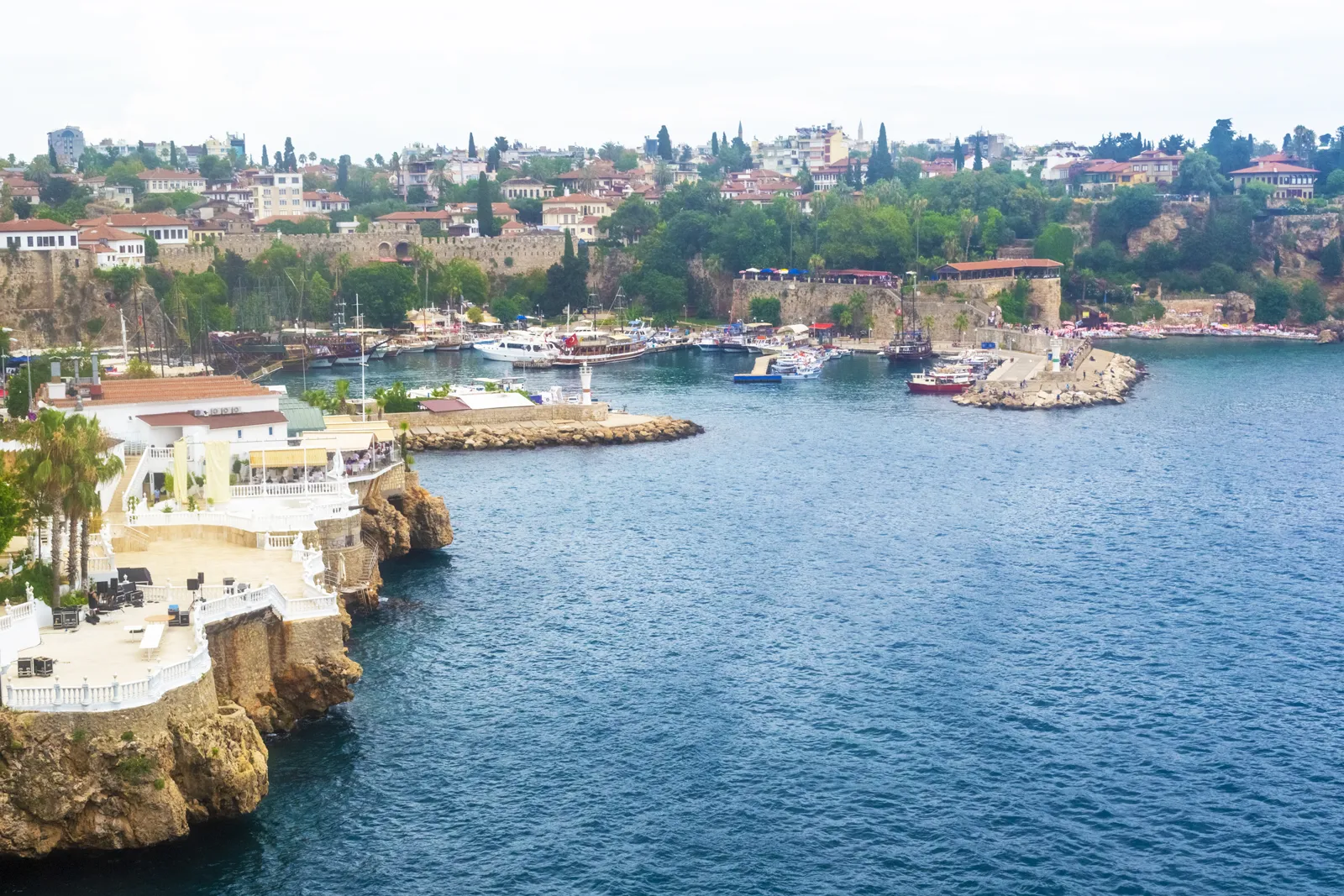
The heart of the city since Antiquity. Here you will find the morning fish market on the Quai des Belges, Norman Foster’s mirrored canopy and the two forts guarding the harbour entrance, Saint-Jean and Saint-Nicolas. A small ferry crosses between the two quays in a few minutes, and the boats to the Château d’If and the Frioul islands leave from here.
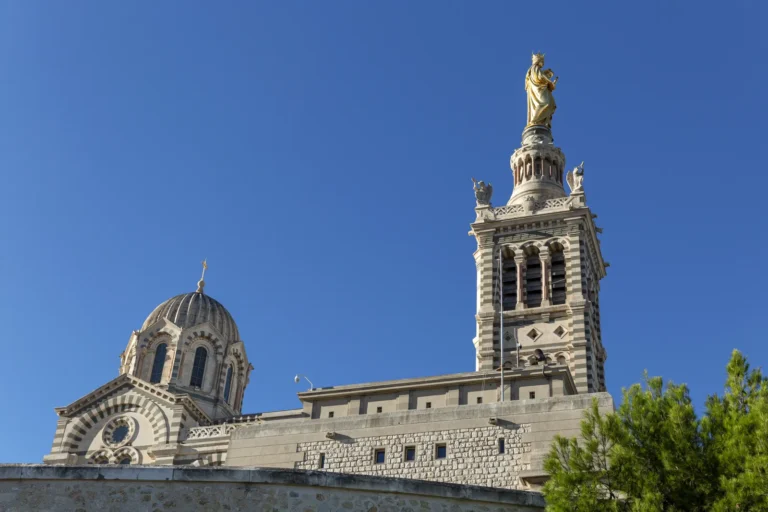
At the top of the hill, our guide to visiting Notre-Dame de la Garde covers opening hours, access by bus 60 and the best time for the view.
Notre-Dame-de-la-Garde
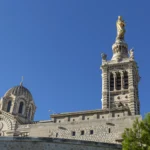
Nicknamed « la Bonne Mère » (the Good Mother), the 19th-century basilica watches over the city from its hilltop. The interior is covered in mosaics and sailors’ ex-votos; the forecourt offers the best panorama of Marseille, the islands and the hills. You can walk up (steep), take the bus from the Vieux-Port or ride the little tourist train.
Le Panier
The oldest district of the city rises in tiers north of the Vieux-Port: stepped lanes, colourful façades, workshops and soap shops. The Vieille Charité, a 17th-century former almshouse with a Baroque chapel, now houses museums of archaeology and of African, Oceanian and Native American art.
The Mucem, Fort Saint-Jean and La Major
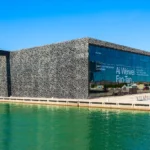
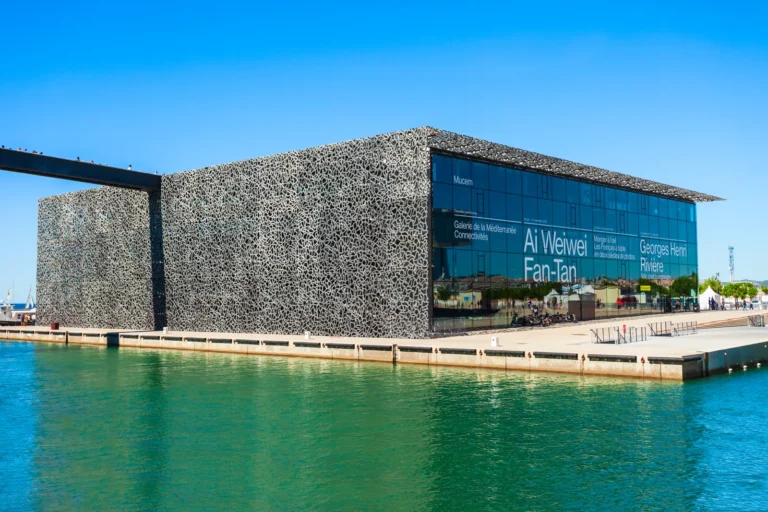
Opened in 2013, the Museum of European and Mediterranean Civilisations occupies a lace-like concrete cube linked by a footbridge to Fort Saint-Jean, whose gardens and ramparts are free to explore. Right next door, the neo-Byzantine La Major cathedral is one of the largest churches built in France in the 19th century.
The Château d’If and the Frioul islands
A boat ride of about twenty minutes takes you to the Château d’If, a former fortress-prison made famous by The Count of Monte Cristo, then to the wild Frioul islands, with coves and trails. Crossings depend on the weather: the mistral can cancel them.
The Corniche and the Vallon des Auffes
The Corniche Kennedy runs along the sea for several kilometres from Les Catalans. The Vallon des Auffes, a small fishing harbour with huts squeezed beneath a bridge, is one of the most photographed spots. Further south, the Prado beaches and Parc Borély are the main areas for swimming and relaxing.
The Calanques National Park
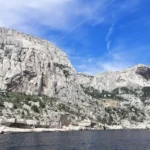
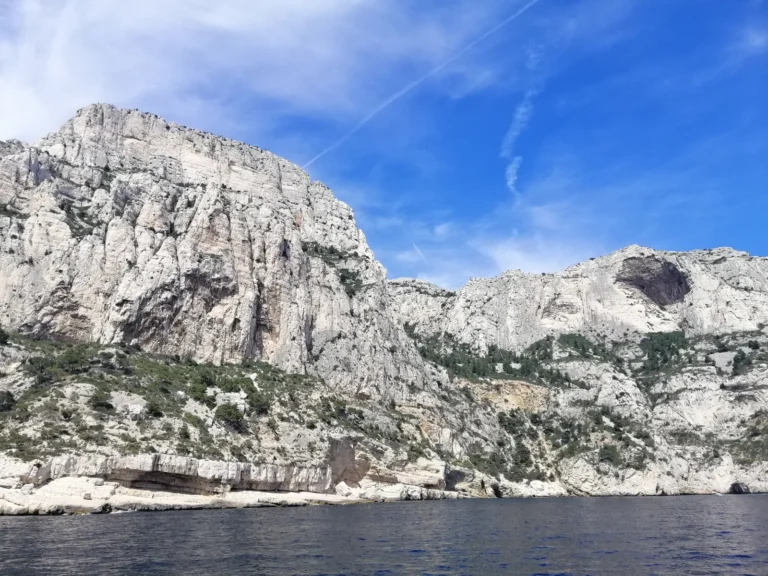
Between Marseille and Cassis, the national park protects limestone cliffs and turquoise coves (Sormiou, Morgiou, Sugiton, En-Vau). You discover them on foot from Les Goudes, Callelongue or Luminy, or by boat from the Vieux-Port. In summer, access to the hills is regulated according to the wildfire risk and can be closed on some days: check the access map published daily by the Bouches-du-Rhône prefecture. Some very busy calanques require a reservation at peak times: check the park website.
South of the city, our page on visiting the Calanques of Marseille covers access rules, the Sugiton reservation and transport.
Cours Julien, Noailles and La Canebière
Cours Julien is the district of street art, bars and small music venues. Just below, the Noailles market recalls a souk with its North African and Middle Eastern grocers. La Canebière, the historic avenue, runs down to the Vieux-Port.
Palais Longchamp and the Cité Radieuse
Palais Longchamp, a grand monument celebrating the arrival of water from the Durance, houses the Museum of Fine Arts and the Natural History Museum. On Boulevard Michelet, Le Corbusier’s Cité Radieuse, a UNESCO World Heritage Site, can be partly visited (rooftop terrace, interior shopping street).
At the table, try bouillabaisse (an expensive dish, served in a few restaurants that respect the traditional recipe), panisses (chickpea fritters), navettes (orange-blossom biscuits) and pastis on a terrace.
Itinerary: Marseille in 1, 2 or 3 days
Marseille in 1 day
- Morning: fish market and Vieux-Port, then Le Panier and the Vieille Charité
- Lunch: in Le Panier or on the harbour
- Afternoon: Mucem and Fort Saint-Jean, La Major cathedral
- Late afternoon: Notre-Dame-de-la-Garde for sunset
Marseille in 2 days
- Day 1: as above
- Day 2: boat to the Château d’If and the Frioul in the morning, Corniche Kennedy and the Vallon des Auffes in the afternoon, evening at Cours Julien
Marseille in 3 days
- Days 1 and 2: as above
- Day 3: hike in the Calanques (Sugiton from Luminy, or Sormiou) or a boat trip; if the hills are closed, Palais Longchamp and the Cité Radieuse
With an extra day, head to Cassis and its calanques by train or bus, or continue to the island of Porquerolles.
When to go to Marseille
The best months to visit Marseille are May, June and September: 23 to 28 °C (73 to 82 °F) in the afternoon, little rain and a warming sea. July and August are hot (nearly 31 °C / 88 °F) and very busy, with a wildfire risk that can close the Calanques. Autumn is the rainy season: September to November bring the highest totals, often in short stormy downpours. Winter is mild and bright, but the mistral can make the air cold.
| Month | High | Low | Rain | Crowds | Prices | Verdict |
|---|---|---|---|---|---|---|
| January | 11.8 °C (53 °F) | 3.6 °C (38 °F) | 47.1 mm (1.9 in) | Low | Low | ⚠️ Mild and bright, cold mistral possible |
| February | 12.8 °C (55 °F) | 3.7 °C (39 °F) | 29.8 mm (1.2 in) | Low | Low | ⚠️ The driest winter month |
| March | 16.4 °C (62 °F) | 6.5 °C (44 °F) | 29.5 mm (1.2 in) | Medium | Medium | ✅ Sunny, still cool |
| April | 19.3 °C (67 °F) | 9.4 °C (49 °F) | 51.6 mm (2.0 in) | Medium | Medium | ✅ Pleasant spring, a few showers |
| May | 23.5 °C (74 °F) | 13.3 °C (56 °F) | 37.7 mm (1.5 in) | High | High | ✅ Ideal: 23 °C and nearly 300 hours of sun |
| June | 27.9 °C (82 °F) | 17.2 °C (63 °F) | 27.9 mm (1.1 in) | High | High | ✅ Warm, sea warming up |
| July | 30.7 °C (87 °F) | 19.7 °C (67 °F) | 10.8 mm (0.4 in) | Very high | Very high | ⚠️ Hot and very busy, Calanques sometimes closed |
| August | 30.5 °C (87 °F) | 19.4 °C (67 °F) | 25.8 mm (1.0 in) | Very high | Very high | ⚠️ Hot, crowds, wildfire risk |
| September | 25.9 °C (79 °F) | 15.9 °C (61 °F) | 82.0 mm (3.2 in) | High | High | ✅ Warm sea, fewer people; storms possible |
| October | 21.3 °C (70 °F) | 12.6 °C (55 °F) | 73.3 mm (2.9 in) | Medium | Medium | ⚠️ Mild but rainy at times |
| November | 15.7 °C (60 °F) | 7.7 °C (46 °F) | 75.9 mm (3.0 in) | Low | Low | ❌ The most rain days |
| December | 12.4 °C (54 °F) | 4.4 °C (40 °F) | 40.9 mm (1.6 in) | Low to medium | Medium | ⚠️ Cool, the least sunny |
When to go to Marseille: key points
- Best times: May-June and September-early October
- Hottest month: July, average high of 30.7 °C (87 °F)
- Wettest month: September by total (82 mm / 3.2 in), November by rain days (7)
- Sunshine: about 2,900 hours a year, the highest in mainland France
- Swimming: June to September; see our page on sea temperatures
- Calanques in summer: access to the hills depends on the wildfire risk, check the day before
Marseille vs Paris: how much more sun, month by month?
Marseille is famously sunnier than Paris. Here is by how much, based on Météo-France 1991-2020 normals for the Marignane and Paris-Montsouris stations, with the number of rain days to expect during a one-week stay.
| Month | Sun in Marseille | Sun in Paris | Ratio | Rain days per 7 days in Marseille |
|---|---|---|---|---|
| January | 148 h | 59 h | × 2.5 | 1.2 |
| February | 173 h | 84 h | × 2.1 | 1.1 |
| March | 235 h | 135 h | × 1.7 | 0.9 |
| April | 251 h | 177 h | × 1.4 | 1.4 |
| May | 299 h | 201 h | × 1.5 | 1.0 |
| June | 338 h | 204 h | × 1.7 | 0.7 |
| July | 372 h | 222 h | × 1.7 | 0.3 |
| August | 334 h | 215 h | × 1.6 | 0.6 |
| September | 264 h | 175 h | × 1.5 | 1.1 |
| October | 196 h | 119 h | × 1.6 | 1.3 |
| November | 151 h | 70 h | × 2.2 | 1.6 |
| December | 138 h | 57 h | × 2.4 | 1.1 |
- The gap is widest in winter: in December and January, Marseille gets about 2.4 to 2.5 times more sun than Paris; it is the best season for a bright break, even if the water is cold.
- In summer the gap narrows (about 1.7 times more in June-July), but Marseille then totals more than 330 hours of sun a month.
- A week in July means on average about 0.3 rain days; a week in November, about 1.6.
- To see where Marseille ranks among 53 cities, see our ranking of the sunniest cities in France.
Sunset time in Marseille
Notre-Dame-de-la-Garde, the Corniche and the Mucem are the classic sunset viewpoints. Times calculated for the 15th of each month:
On the waterfront, our guide to visiting the Mucem gives opening hours, prices, free admission and the J4 – Fort Saint-Jean route.
| Month | Sunrise | Sunset | Day length |
|---|---|---|---|
| January | 8:07 am | 5:28 pm | 9 h 20 |
| February | 7:36 am | 6:08 pm | 10 h 33 |
| March | 6:50 am | 6:44 pm | 11 h 54 |
| April | 6:56 am | 8:21 pm | 13 h 25 |
| May | 6:14 am | 8:55 pm | 14 h 41 |
| June | 5:57 am | 9:20 pm | 15 h 23 |
| July | 6:12 am | 9:16 pm | 15 h 05 |
| August | 6:44 am | 8:42 pm | 13 h 58 |
| September | 7:18 am | 7:49 pm | 12 h 31 |
| October | 7:52 am | 6:56 pm | 11 h 04 |
| November | 7:31 am | 5:14 pm | 9 h 43 |
| December | 8:03 am | 5:03 pm | 9 h 00 |
Marseille month by month
January: 12 °C (54 °F) in the afternoon, 148 hours of sun. Quiet, ideal for museums and exploring the city on foot.
February: cool but dry (30 mm / 1.2 in). A good month for hiking in the Calanques, without the heat.
March: 16 °C (61 °F), more than 230 hours of sun. The first café terraces.
April: 19 °C (67 °F), a few showers (52 mm / 2.0 in).
May: 23.5 °C (74 °F), nearly 300 hours of sun: one of the best months.
June: 28 °C (82 °F), the sea warms up, Fête de la Musique on the Vieux-Port. Keep an eye on access to the Calanques.
July: the hottest (30.7 °C / 87 °F) and driest month. Crowds, high prices, access to the hills to check daily.
August: just as hot (30.5 °C / 87 °F), storms possible at the end of the month.
September: 26 °C (79 °F) and a still-warm sea, but the wettest month by total (82 mm / 3.2 in) because of storms.
October: 21 °C (70 °F), changeable weather, still plenty of sun.
November: 16 °C (61 °F), the most rain days (7). Low prices.
December: 12 °C (54 °F), the least sunny (138 hours) but 2.4 times more than Paris. Santon fair on La Canebière.
For the sea, see our sea temperature by month. Other seasonal ideas: where to go in May and where to go in September.
Where to stay in Marseille
| Area | Best for | Good to know |
|---|---|---|
| Vieux-Port | First visit | Everything on foot, boat departures, lively in the evening |
| Le Panier | Atmosphere | Sloping lanes and steps, a few B&Bs |
| Saint-Charles | Arriving by TGV | Practical, less pleasant in the evening |
| Joliette | A modern stay | Close to the Mucem and the cruise terminal, tram |
| Corniche, Endoume and Prado | Sea and calm | Further from the centre, sea views, bus to the port |
Getting around Marseille
- By train: TGV high-speed trains serve Marseille Saint-Charles. See our tips for travelling cheaply by train.
- From the airport: a shuttle bus links the airport with Saint-Charles station; Vitrolles-Aéroport station, linked by shuttle, is served by regional TER trains.
- Metro and tram: the metro (lines 1 and 2) serves the Vieux-Port, Saint-Charles, Noailles and La Joliette; the tram links La Joliette with the centre.
- Boat: shuttles to the Château d’If and the Frioul, the Vieux-Port ferry, and seasonal sea shuttles to L’Estaque or La Pointe-Rouge.
- Bus: essential for Notre-Dame-de-la-Garde, the Corniche, Les Goudes and Luminy.
- Car: best avoided in town (traffic jams, parking); useful for the Côte Bleue or the hinterland.
Marseille is also a major cruise port: see our cruises from Marseille.
Budget for visiting Marseille
| Item (per person per day) | Low budget | Comfort |
|---|---|---|
| Accommodation (sharing a double room) | roughly €35 to €55 | roughly €80 to €150 |
| Meals | roughly €25 to €35 | roughly €50 to €80 |
| Transport | roughly €5 to €10 | roughly €10 to €20 |
| Sightseeing and boats | roughly €5 to €15 | roughly €20 to €40 |
| Total | roughly €70 to €110 | roughly €150 to €250 |
Entry requirements, health and safety
- US citizens: no visa for up to 90 days in the Schengen area, including France, for tourism or business; your passport should be valid at least three months beyond your stay, and you may be asked for proof of funds and a return ticket (U.S. Department of State, travel.state.gov, last updated August 11, 2025).
- UK citizens: no visa for up to 90 days in any 180-day period; your passport must have been issued less than 10 years before arrival and be valid at least 3 months after you leave the Schengen area. Under the EU Entry/Exit System (EES), fingerprints and a photo may be taken at your first entry (UK FCDO, GOV.UK, updated 22 October 2026).
- Health: UK travellers need a GHIC or valid EHIC for state healthcare; everyone should have travel insurance covering medical costs. Emergency numbers: 15 (medical), 17 (police), 18 (fire), 112 (European emergency number) (GOV.UK, travel.state.gov).
- Crime: as in any big city, watch your belongings on the metro, in crowds and around the station; the UK FCDO (GOV.UK) advises sensible precautions against street crime and warns that pickpockets can work in gangs, one distracting you while the other goes into your bag.
- Wildfires: the UK FCDO (GOV.UK, updated 22 October 2026) notes that the wildfire risk is highest along the Mediterranean coast in hot, dry weather and that causing a wildfire is illegal, even by accident.
Practical tips for Marseille
Checklist before a trip into the Calanques
- Check the hills access map (Bouches-du-Rhône prefecture) the evening before, from June to September
- Check whether the calanque you are heading for requires a reservation
- At least 1.5 litres (50 fl oz) of water per person, a hat, walking shoes (no flip-flops)
- No shops or drinking water in most coves
- No fires or cigarettes in the hills
- Mistral forecast: take care on the ridges; boats are sometimes cancelled
- Mistral: this north-westerly wind often blows for several days; it clears the sky but cools the air and churns up the sea.
- Swimming: the Prado beaches and some coves have lifeguards in season, not all of them; ask about the designated swimming areas.
- Museums: many close on Mondays; check opening hours.
Frequently asked questions
How many days do you need to visit Marseille?
Two days for the Vieux-Port, Le Panier, the Mucem, Notre-Dame-de-la-Garde and the Château d’If; three days to add a day in the Calanques.
What is the best time to visit Marseille?
May, June and September: 23 to 28 °C (73 to 82 °F) in the afternoon according to Météo-France 1991-2020 normals at Marignane, with the sea warm enough from June.
Is Marseille really the sunniest city in France?
According to Météo-France 1991-2020 normals, yes: about 2,900 hours a year at Marignane, against 1,717 at Paris-Montsouris, or about 69% more.
Are the Calanques open in summer?
Not always. From June to September, access to the hills depends on the wildfire risk, published daily by the prefecture. Access by sea remains possible.
What to do in Marseille when it rains?
The Mucem, the Vieille Charité, the Marseille History Museum, Palais Longchamp and the Cité Radieuse.
Do you need a car in Marseille?
No. Metro, tram, buses and boats are enough; a car is only useful for the Côte Bleue or the hinterland.
Our sources
- Météo-France: climate data sheet, 1991-2020 statistics, Marignane station (Marseille Provence Airport); Paris-Montsouris sunshine (same period), collected for our ranking of the sunniest cities
- Sunrise and sunset times, sunshine ratios: Destination de Voyage calculations
- Entry requirements, health and safety checked on 26 October 2026: U.S. Department of State, France country information (last updated August 11, 2025) and UK FCDO, GOV.UK foreign travel advice for France (updated 22 October 2026).
- Our methodology
Updated October 2026.
To extend your trip, see our Provence guide, our pages on the Camargue and the Verdon Gorge, our French Riviera guide, our ideas for cheap weekend breaks, our page on visiting Lyon and our France travel guide.