Lake Titicaca, shared between Peru and Bolivia, lies at more than 3,800 m (12,470 ft) on the Altiplano. On the Peruvian side, you explore it from Puno: the floating islands of the Uros, made of totora reeds, the island of Taquile and its textile art, and a homestay night on Amantaní. Allow 2 to 3 days, preferably in the dry season, from May to October, and above all time to acclimatise to the altitude.
This guide covers what to do at Lake Titicaca, how to get there, Puno’s month-by-month climate (official SENAMHI normals), the precautions against altitude sickness according to the UK and US governments, and a calculation specific to this page: the temperature gap between day and night, which exceeds 15 °C (27 °F) in the southern winter.

Our travel deals for Lake Titicaca
Affiliate links: we earn a commission, at no extra cost to you.
 FlightsKiwi.comCompare flights and airline combinations to Lake Titicaca.Compare flights
- eSIMSailyAnother eSIM plan to compare: data, validity, network.See Saily plans


Lake Titicaca at a glance
- Location Altiplano, Peru-Bolivia border; gateway town on the Peruvian side: Puno (official weather station at 3,825 m / 12,549 ft)
- Languages Spanish, Quechua and Aymara
- Currency the Peruvian sol (PEN)
- Time zone UTC−5, no daylight saving: same as New York in winter, 5 to 6 hours behind London — see the time difference in Peru
- Airports Juliaca airport (Inca Manco Cápac), linked to Lima by domestic flights; Lima is Peru’s international gateway
- Entry US and UK: passport valid 6 months from arrival; UK: visa-free, normally up to 90 days; see entry requirements
- Altitude the UK FCDO describes altitude sickness as a serious risk in Puno: plan time to acclimatise
Things to do at Lake Titicaca: the highlights
The Uros floating islands
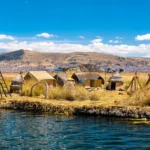
A short distance from Puno harbour, families live on artificial islets built from layers of totora reeds, which have to be constantly renewed. The visit, very popular, is by boat, with a demonstration of how the islands are built and crafts for sale. For a less touristy approach, some islands also offer accommodation.
Taquile Island
Further out, Taquile is known for its textile art, inscribed by UNESCO as Intangible Cultural Heritage: the men knit their own hats, whose patterns indicate their status. Stone stairways, farmed terraces and views of the Bolivian cordillera; walking leaves you breathless at this altitude. To prepare, read our page on altitude sickness: thresholds and prevention.
Amantaní Island and a homestay night
Amantaní welcomes visitors into families for a night, with a shared meal and a climb at sunset to the island’s two summits, Pachatata and Pachamama. It is the experience most recommended by the other guides we have read; bring warm clothes, as the nights are cold.
The Capachica peninsula and community tourism
North of Puno, the villages of the Capachica peninsula (Llachón, Paramis, etc.) are developing community tourism: kayaking, hikes, homestays, with fewer visitors than the Uros.
Puno and the Candelaria festival
Puno is a transit town, with its Plaza de Armas and cathedral. It comes alive above all for the Virgen de la Candelaria festival, one of the largest religious and folk festivals in Peru, inscribed on UNESCO’s Intangible Cultural Heritage list: dances, costumes and bands over several days (book accommodation early).
Sillustani and Chucuito
Away from the lake, the Sillustani burial site lines up funerary towers (chullpas) on the shore of Lake Umayo. South of Puno, Chucuito and Juli have colonial churches on the road to Bolivia.
Itinerary: how many days at Lake Titicaca? A 3-day plan
- Day 1: arrive in Puno, rest (acclimatisation), an easy stroll around town.
- Day 2: boat to the Uros, then Amantaní, homestay night.
- Day 3: Taquile, back in Puno in the late afternoon; Sillustani as an option the next day.
The lake fits into a classic tour with Cusco and Machu Picchu. On the Bolivian side, Copacabana and the Island of the Sun can be reached by road; check the UK and US travel advice for Bolivia as well before crossing.
Getting to Lake Titicaca
- By air: flight from Lima to Juliaca (Inca Manco Cápac airport; check airlines and schedules on the airport website), then by road to Puno.
- From Cusco: by road (regular buses or tourist buses with stops) or by panoramic train, depending on the season’s timetable.
- From Arequipa: by road across the Altiplano.
- Acclimatisation: arriving from Cusco (already at altitude) is more gradual than a direct flight from Lima, at sea level.
When to go to Lake Titicaca
The best period runs from May to October, in the dry season: less than 25 mm (1.0 in) of rain a month from May to September in Puno according to SENAMHI, mostly clear skies and afternoons around 15 to 17 °C (59 to 63 °F). On the other hand, nights are freezing in June and July, with average minimums below 0 °C (32 °F). From December to March is the rainy season (up to 159 mm (6.3 in) in January): showers are frequent in the afternoon, but the nights are less cold.
| Month | Max | Min | Day/night gap (°C) | Rain | Verdict |
|---|---|---|---|---|---|
| January | 16.0 °C (61 °F) | 5.9 °C (43 °F) | 10.1 | 158.7 mm (6.2 in) | ⚠️ Rainy season |
| February | 15.7 °C (60 °F) | 5.9 °C (43 °F) | 9.8 | 144.9 mm (5.7 in) | ⚠️ Rain |
| March | 15.6 °C (60 °F) | 5.5 °C (42 °F) | 10.1 | 116.3 mm (4.6 in) | ⚠️ Rain |
| April | 15.7 °C (60 °F) | 4.0 °C (39 °F) | 11.7 | 50.8 mm (2.0 in) | ✅ End of the rains |
| May | 15.5 °C (60 °F) | 1.2 °C (34 °F) | 14.3 | 7.2 mm (0.3 in) | ✅ Dry, cold nights |
| June | 14.8 °C (59 °F) | -0.5 °C (31 °F) | 15.3 | 3.0 mm (0.1 in) | ✅ Dry, freezing nights |
| July | 14.9 °C (59 °F) | -0.8 °C (31 °F) | 15.7 | 3.4 mm (0.1 in) | ✅ Dry, freezing nights |
| August | 15.7 °C (60 °F) | 0.4 °C (33 °F) | 15.3 | 9.6 mm (0.4 in) | ✅ Dry, sunny |
| September | 16.6 °C (62 °F) | 2.3 °C (36 °F) | 14.3 | 23.5 mm (0.9 in) | ✅ Ideal |
| October | 17.2 °C (63 °F) | 3.8 °C (39 °F) | 13.4 | 44.1 mm (1.7 in) | ✅ Ideal |
| November | 17.7 °C (64 °F) | 4.7 °C (40 °F) | 13.0 | 40.0 mm (1.6 in) | ✅ Pleasant |
| December | 17.2 °C (63 °F) | 5.6 °C (42 °F) | 11.6 | 87.6 mm (3.4 in) | ⚠️ Rain returns |
Afternoon temperatures vary little through the year (from 14.8 to 17.7 °C / 59 to 64 °F): what changes is the night. The gap between afternoon and night reaches 15.7 °C (28 °F) in July, against 9.8 °C (18 °F) at its lowest: the key figure for preparing a night on Amantaní. To compare with Lima, Cusco or the Amazon, see the best time to visit Peru.
Altitude: altitude sickness at Lake Titicaca
The UK FCDO (GOV.UK, updated 9 October 2026) describes altitude sickness as a serious risk in parts of Peru, including Puno and Cusco, and refers travellers to TravelHealthPro; the U.S. Department of State lists Puno among Peru’s high-altitude cities and advises people with pre-existing medical conditions to consult a doctor before travelling. Typical symptoms are breathlessness, headache, nausea and poor sleep. If symptoms appear, stop climbing, go down to a lower altitude with someone and see a doctor. Prevention relies on gradual acclimatisation.
| Stop | Approximate altitude | Good to know |
|---|---|---|
| Lima | Sea level | International arrival point |
| Cusco | about 3,400 m (11,155 ft) | A good acclimatisation stop before the lake |
| Puno (SENAMHI station) | 3,825 m (12,549 ft) | Altitude of the lake and islands |
| Amantaní summits | above the lake | Slow climb, breathlessness common |
- Go up gradually: ideally a few days in Cusco before Puno.
- Take the first day easy: no physical effort on arrival.
- Stay hydrated and limit alcohol for the first few days.
Sunrise and sunset over the lake
| Month | Sunrise | Sunset | Day length |
|---|---|---|---|
| January | 5:20 am | 6:18 pm | 12 h 58 |
| February | 5:36 am | 6:12 pm | 12 h 36 |
| March | 5:43 am | 5:54 pm | 12 h 12 |
| April | 5:47 am | 5:32 pm | 11 h 44 |
| May | 5:55 am | 5:17 pm | 11 h 23 |
| June | 6:04 am | 5:16 pm | 11 h 11 |
| July | 6:07 am | 5:24 pm | 11 h 16 |
| August | 5:57 am | 5:31 pm | 11 h 35 |
| September | 5:35 am | 5:35 pm | 12 h 00 |
| October | 5:12 am | 5:39 pm | 12 h 27 |
| November | 4:59 am | 5:50 pm | 12 h 51 |
| December | 5:03 am | 6:07 pm | 13 h 04 |
Close to the tropics, the lake has days of 11 h 11 to 13 h 04 all year round: in June, the sun sets around 5:16 pm, and the cold sets in immediately.
Where to stay at Lake Titicaca
| Option | Best for | Highlights |
|---|---|---|
| Puno (centre) | Convenience, all budgets | Boat departures, restaurants, base for Sillustani |
| Lakeside hotels | Couples, comfort | Lake views, quiet; a little outside town |
| Homestay on Amantaní | Cultural experience | A night with a family, shared meal; simple comfort |
| Capachica, Uros islands | Community tourism | Fewer visitors, contact with locals |
Entry requirements, health and safety
- US citizens: your passport must be valid for at least six months from the date of entry. Your length of stay is set by border officials on arrival, and overstays lead to fines; make sure your entry is recorded, even at remote land crossings (U.S. Department of State, travel.state.gov, last updated August 20, 2026).
- UK citizens: you can travel to Peru without a visa for tourism; you will normally be allowed to stay up to 90 days in a 180-day period. Your passport must be valid for at least 6 months after the date you arrive. At international airports your entry is registered digitally; if you arrive by land, make sure you get an entry stamp (UK FCDO, GOV.UK, updated 9 October 2026).
- Safety at the lake: according to the UK FCDO (GOV.UK, updated 9 October 2026), armed robbers have attacked travellers walking on their own at Lake Titicaca: take care, ask the local tourist information centre about known safe zones, and travel with a group at the southern end of the lake if walking at night. Puno is among the regions that have seen recent protests.
- Transport: watch your belongings on buses and at bus terminals; use taxis registered at the terminals, as criminals pose as taxi drivers (GOV.UK).
- Health: altitude sickness (see above); insurance covering medical care and repatriation is essential.
- Crossing into Bolivia: check Bolivia’s own entry requirements and safety advice before crossing the border.
See also our travel insurance guide.
Practical tips for Lake Titicaca
- Sun: at this altitude, the sun is intense even when it feels cool: sunscreen, hat, sunglasses.
- Clothing: wear layers; nights are cold and accommodation is often poorly heated.
- Money: cash in soles for the islands, where cards are not accepted.
- Respect: ask before photographing people; buy crafts directly from families.
Frequently asked questions
What is the altitude of Lake Titicaca?
The lake lies above 3,800 m (12,470 ft); Puno’s official weather station, on the lakeshore, is at 3,825 m (12,549 ft).
What is the best time to visit Lake Titicaca?
From May to October, in the dry season: little rain and clear skies, but very cold nights in June and July (average minimums below 0 °C (32 °F) according to SENAMHI).
How many days do you need at Lake Titicaca?
Two to three days: one day to acclimatise in Puno, then a trip to the Uros, Amantaní (homestay night) and Taquile.
How do you avoid altitude sickness at Lake Titicaca?
By going up gradually (for example via Cusco), avoiding effort on the first day and going down if symptoms appear. The UK FCDO describes altitude sickness as a serious risk in Puno; see your doctor before you travel.
How do you get to Lake Titicaca from Lima?
By plane to Juliaca, then by road to Puno.
Our sources
- SENAMHI (Peru): 1991-2020 normals from SENAMHI (Peru’s National Meteorology and Hydrology Service), Puno station, 3,825 m, via the Wikipedia article « Puno »
- Destination de Voyage calculation: day/night temperature gap, sunrise and sunset, day length (NOAA solar algorithm)
- Wikipedia (EN), « Inca Manco Cápac International Airport » and « Jorge Chávez International Airport », checked on 21 October 2026
- Entry requirements, health and safety checked on 26 October 2026: U.S. Department of State, Peru country information (last updated August 20, 2026) and UK FCDO, GOV.UK foreign travel advice for Peru (updated 9 October 2026)
- Our methodology
Updated October 2026.
To extend your trip, see our Peru guide and our other destinations in Latin America.