This Agadir travel guide starts with the sunshine: a trip to Agadir promises mild sunshine almost all year: 21 °C (70 °F) in the afternoon in January, 27 °C (81 °F) in August, and about 3,000 hours of sunshine a year. Rebuilt after the 1960 earthquake, the city is modern and faces its large sandy bay, lined with a seafront promenade. But what is there to do in Agadir beyond the beach? Climb to the kasbah, wander through the Souk El Had, surf at Taghazout, explore Souss-Massa National Park or Paradise Valley. This guide brings together the highlights, the best time to go, the budget and tips for planning your stay.
Our travel deals for Agadir
Affiliate links: we earn a commission, at no extra cost to you.
FlightsKiwi.comCompare flights and airline combinations to Agadir.
You can go to Agadir all year, but the best periods are spring (March to June) and autumn (September-October): 23 to 26 °C (73 to 79 °F) in the afternoon, very little rain and generous sunshine. Summer stays moderate (27 °C / 81 °F at its warmest on average), often with morning haze. Winter is the big winter-sun season: 21 to 22 °C (70 to 72 °F) in the afternoon, but cool nights (8 to 10 °C / 46 to 50 °F) and most of the rain, which remains modest.
Agadir owes its mildness to the Atlantic Ocean and the cold Canary Current: the differences between seasons are small, and the water stays cool even in summer. Your choice of dates therefore depends mainly on what you are looking for: heat for the beach, mild weather to escape winter, waves for surfing or low prices.
When to go to Agadir: the essentials
Best periods: March to June, September and October
For the beach: June to October, with an Atlantic that is always cool
For winter sun: November to February, 21 to 24 °C (70 to 75 °F) in the afternoon
For surfing: autumn and winter, when the swell is most consistent at Taghazout
Warmest month: August, an average high of 27 °C (81 °F)
Wettest month: December (49 mm / 1.9 in), followed by November (42 mm / 1.7 in)
Sunniest month: May, nearly 300 hours of sunshine
Agadir climate month by month
Month
High °C (°F)
Low °C (°F)
Rain mm (in)
Sunshine (h)
Crowds
Prices
Verdict
January
21.2 (70 °F)
8.4 (47 °F)
32 (1.3 in)
235
Low
Low
⚠️ Mild by day, cool nights
February
22 (72 °F)
10.1 (50 °F)
28.6 (1.1 in)
225
Medium (winter vacations)
Medium
✅ Pleasant winter sun
March
23.4 (74 °F)
12.3 (54 °F)
31.3 (1.2 in)
267
Medium
Medium
✅ Mild and bright
April
23.2 (74 °F)
14.1 (57 °F)
13.8 (0.5 in)
274
High (Easter)
High
✅ Ideal for sightseeing
May
24.2 (76 °F)
15.9 (61 °F)
5.6 (0.2 in)
297
Medium
Medium
✅ The sunniest
June
25.6 (78 °F)
18.1 (65 °F)
0.8 (0.0 in)
267
Medium
Medium
✅ Warm but not too hot
July
26.7 (80 °F)
19.2 (67 °F)
0.2 (0.0 in)
253
High
High
⚠️ Pleasant, but crowded
August
27 (81 °F)
19.5 (67 °F)
3.1 (0.1 in)
248
Very high
Very high
⚠️ The hottest, the most expensive
September
26.1 (79 °F)
18.6 (65 °F)
3.7 (0.1 in)
235
Medium
Medium
✅ Warm, fewer people
October
26.1 (79 °F)
16.7 (62 °F)
21.2 (0.8 in)
242
High (autumn vacations)
High
✅ Mild, one of the best months
November
24.1 (75 °F)
12.9 (55 °F)
42.3 (1.7 in)
228
Low
Low
⚠️ Mild, rains return
December
22.1 (72 °F)
10.1 (50 °F)
49 (1.9 in)
222
High (holidays)
High
⚠️ The wettest, still mild
Temperatures, rainfall and sunshine: 1991-2020 normals for the Agadir-Inezgane station, Direction générale de la Météorologie du Maroc, published by the World Meteorological Organization (NOAA archive). Crowds and prices: estimates based on European and Moroccan school vacations.
Agadir season by season
Spring (March to May): 23 to 24 °C (73 to 75 °F), much less rain from April, maximum sunshine in May. Ideal for combining the beach, a hike to Paradise Valley and sightseeing. The water stays cool.
Summer (June to August): 25 to 27 °C (77 to 81 °F) in the afternoon, which makes Agadir a refuge when Marrakech exceeds 37 °C (99 °F). Morning haze is common and humidity higher. July and August are the busiest months, with both European and Moroccan vacationers.
Autumn (September-October): 26 °C (79 °F), a sea less cool than in spring, fewer people after the summer holidays. The first rains arrive in October.
Winter (November to February): 21 to 24 °C (70 to 75 °F) in the sun, but 8 to 13 °C (46 to 55 °F) at night and more frequent rain (about 3 rainy days a month). Accommodation is rarely heated: check before booking. This is the season for long stays in the sun and for surfers.
Agadir month by month
January: 21 °C (70 °F) by day, 8 °C (47 °F) at night, 32 mm (1.3 in) of rain. Winter sun and low prices after the holidays; swimming for the brave.
February: 22 °C (72 °F), slightly less rain. European winter school vacations push up demand: book early.
March: 23 °C (74 °F) and more than 260 hours of sunshine. A good month to visit Agadir and its surroundings.
April: 23 °C (74 °F), little rain (14 mm / 0.5 in). In high demand during the Easter vacations.
May: the sunniest month (nearly 300 hours), 24 °C (76 °F), almost dry. One of the best months.
June: 26 °C (78 °F), dry skies, before the summer crowds. Excellent for the beach.
July: 27 °C (80 °F), frequent morning haze, lively beaches. A refuge from the heat inland.
August: the hottest (27 °C / 81 °F) and busiest. Prices at their highest.
September: 26 °C (79 °F), pleasant sea, fewer people: a very good month for the beach.
October: 26 °C (79 °F), first showers (21 mm / 0.8 in). A good compromise between beach, sightseeing and prices, outside the autumn school vacations.
November: 24 °C (75 °F), but the rains return (42 mm / 1.7 in). Quiet, with falling prices.
December: the wettest (49 mm / 1.9 in) but mild (22 °C / 72 °F). High demand around the holidays.
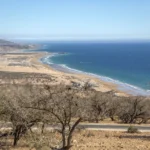
Agadir’s main beach stretches for several kilometers along a sheltered bay. The seafront promenade (the corniche) can be walked or cycled, with cafés and restaurants. The UK FCDO notes, however, that many beaches in Morocco have limited or no lifeguard cover and that strong currents and unexpected waves can occur: swim near the lifeguard posts and respect the flags.
The kasbah of Agadir Oufella
On the hill overlooking the city, the ramparts of the old kasbah, partly destroyed by the 1960 earthquake, offer a view of the bay, the port and the city. You can get there by car, by taxi or by the cable car that leaves from the foot of the hill. The Arabic inscription on the hillside, « God, the Nation, the King », lights up in the evening.
The Souk El Had
It is one of the largest markets in Morocco: several thousand stalls behind a wall, with fruit and vegetables, spices, argan oil, pottery, babouche slippers and handicrafts. Bargaining is expected.
The marina and the port
North of the beach, the marina gathers restaurants, shops and apartments around the pleasure boats. Further on, the fishing port, one of the most important in the country, has stalls where you choose your fish and have it grilled on the spot. Several boat trips leave from the marina.
Museums and gardens
The Museum of Amazigh Heritage displays jewelry, carpets and everyday objects from southern Morocco. The Agadir Memorial, or Memory Museum, shows the city before and after the 1960 earthquake. The Olhão Garden and the Valley of the Birds, a small animal park in the city center, are shady breaks. East of the city, the Medina Polizzi is a re-creation of a traditional medina built from the 1990s by the artist Coco Polizzi.
Taghazout and Tamraght: surfing
About twenty kilometers (12 mi) to the north, the villages of Tamraght and Taghazout are well-known surf spots, with schools, surf camps and waves for all levels. The atmosphere is more laid-back than in Agadir. The Taghazout Bay resort also has more upscale hotels and a golf course.
Paradise Valley
In the hinterland, on the road to Imouzzer, Paradise Valley is a palm-filled gorge where a river forms natural pools. People swim and hike there, especially in spring; the flow depends on the rains and the pools can be almost dry by late summer. The UK FCDO warns that swimming in rivers can be dangerous, with deep mud and steep underwater slopes.
Souss-Massa National Park
South of Agadir, this coastal park protects dunes, river mouths and cliffs. It is known for its birds, especially the endangered northern bald ibis. Outings are best done with a guide. The Tifnit dunes, further south, are also popular for walks.
Taroudant and the surrounding area
About 80 km (50 mi) to the east, Taroudant is a town surrounded by rammed-earth ramparts, with two souks that are calmer than those of Marrakech. The trip is often combined with the Tiout oasis. Further afield, Essaouira (about 3 hours by road) and Marrakech (about 3 hours by highway) can be visited on a circuit. Before adding the Atlantic coast to your circuit, our Essaouira travel guide explains what the town has to offer.
Suggested itineraries
Agadir in 3 days
Day 1: the beach, the promenade and sunset at the kasbah of Agadir Oufella
Day 2: the Souk El Had in the morning, the Museum of Amazigh Heritage, an evening at the marina
Day 3: a surf lesson in Taghazout or Tamraght
A week in the Souss
Days 1 to 3: Agadir (beach, kasbah, souk, marina, Medina Polizzi)
Agadir is an affordable destination, whether in an all-inclusive resort hotel or an apartment. Indicative amounts per person per day, excluding flights:
Item
Tight budget
Comfort
Accommodation (shared double room)
about US$17 to 35
about US$55 to 125 (all-inclusive)
Meals
about US$9 to 17
about US$30 to 45 (or included)
Local transportation
about US$3 to 7
about US$11 to 20
Activities and excursions
about US$6 to 17
about US$20 to 45
Total per day
roughly US$40 to 65
roughly US$100 to 200
Indicative estimates, varying with the season and the exchange rate, converted from euros at the European Central Bank rate of 23 October 2026 and rounded. Prices peak in July-August and during European school vacations.
To cut costs: go in November, January or June, book early for winter vacations, eat at the port or in the restaurants of the Talborjt district and use city buses or petit taxis.
Who is Agadir for?
Our verdicts by traveler profile, based on the places, conditions and budget ranges in this guide:
Winter sun: ideal: 21 to 24 °C (70 to 75 °F) in the afternoon from November to February, with cool nights and accommodation that is rarely heated, so check.
Families: a very good choice: a large sheltered beach, all-inclusive resort hotels on the seafront, the Valley of the Birds in the city center. Swim near the lifeguard posts, as currents can be strong.
Surfing: excellent: Taghazout and Tamraght have schools and waves for all levels, with the most consistent swell in autumn and winter.
Tight budget: yes: roughly US$40 to 65 per person per day if you stay in Talborjt, eat at the port and get around by bus or petit taxi. Avoid July-August and school vacation periods.
Couples: yes: sunsets from the kasbah, marina restaurants, upscale hotels in Taghazout Bay.
Nature: as day trips: the pools of Paradise Valley in spring, the birds of Souss-Massa National Park with a guide, the Tifnit dunes.
Culture: as an extra: the Museum of Amazigh Heritage, the Agadir Memorial, the ramparts of Taroudant. For historic medinas, choose Marrakech or Fez.
Getting around Agadir
Airport: Al Massira Airport is about 25 km (16 mi) southeast of the center. Allow about 30 minutes by taxi; agree on the fare before setting off.
Petit taxis: orange in Agadir, they operate within the city; ask for the meter or agree on the fare beforehand. The U.S. Department of State notes that petit taxis are generally safe during the day, that city buses are not considered safe and that trains have a good safety record; it also reports harassment of ride-share drivers and passengers by taxi drivers. The UK FCDO warns that cars booked through ride-sharing apps may be unlicensed.
Grands taxis: shared taxis for trips to Taghazout, Inezgane or Taroudant.
Buses: the urban network serves the city and the coast; CTM and Supratours link Agadir to Marrakech, Essaouira and the rest of the country. There is no train in Agadir.
Car: useful for the surrounding area. The U.S. Department of State describes traffic accidents as a significant hazard in Morocco and driving practices as very poor; avoid driving at night.
Agadir airport transfer: Aerobus, taxi and private transfer
Agadir Al Massira Airport is outside the city, to the southeast. There is no train: you can choose between the dedicated bus line run by the city bus operator ALSA, a taxi and a transfer booked in advance.
The ALSA AE Aerobus
ALSA, the operator of Agadir’s city buses, runs the AE Aerobus line between the airport and the Valley of the Birds interchange in the city center. Its official page gives a 50-minute journey, with a ticket at 50 MAD one way and 80 MAD round trip per person. Tickets are sold on board or at the ALSA sales office at the airport. Departures are spread throughout the day, with different timetables on weekdays, Saturdays and Sundays: check the schedule on alsa.ma before you arrive, especially if you land late (checked 26 October 2026).
Taxis
Taxis wait outside the terminal. We could not find an up-to-date official fare list, and the amounts published by guidebooks differ. Agree on the price with the driver before getting in, specifying the number of bags and the exact address of your hotel.
Option
Where to catch it
Official fare
Source
AE Aerobus (ALSA)
In front of the terminal, ALSA office at the airport
50 MAD one way, 80 MAD round trip
alsa.ma
Taxi
Terminal exit
No official fare list available: agree on the price before departure
—
Private transfer
Meeting point in the arrivals hall
Price fixed at booking
Chosen provider
The right choice for you (Destination de Voyage summary): alone or as a couple with little luggage and a daytime arrival, the Aerobus is the simplest option on a tight budget; for three or four people, or if your hotel is in Taghazout, Tamraght or outside the beach area, a taxi or transfer avoids a change in town; at night, first check the time of the last Aerobus.
Booking a transfer in Agadir
A private transfer booked in advance (a driver waiting on arrival, price fixed at booking) is mainly worthwhile for a late arrival, bulky luggage, a family with young children or a group sharing the cost. Before booking, check what the price includes (tolls, luggage, waiting time if the flight is delayed), the exact meeting point in the terminal, the cancellation conditions and the name of the company that actually operates the trip.
Sources: ALSA, « Airport Shuttle » page (alsa.ma), checked on 26 October 2026.
Where to stay in Agadir
Seafront and tourist zone: large hotels and resorts along the beach, often all-inclusive; ideal for a beach or family stay
Marina: apartments and recent hotels, within walking distance of restaurants
Talborjt and the center: simpler, cheaper hotels, closer to local life, 10-15 minutes’ walk from the beach
Taghazout, Tamraght: surf camps, guesthouses and, in Taghazout Bay, upscale hotels
Entry requirements, health and safety
US citizens: according to the U.S. Department of State (travel.state.gov, last updated July 30, 2026), you need a valid passport with at least one blank page; no visa is required for visits of less than 90 days. If you stay beyond 90 days without requesting an extension, you will have to appear before a judge before leaving. Carry a copy of your passport at all times.
UK citizens: according to the UK FCDO (GOV.UK, updated 19 August 2026), you can visit without a visa for up to 90 days for tourism. Your passport must be valid for at least 3 months after the date you arrive and must not be damaged; make sure it is stamped on entry. A polio vaccination certificate is required if you come from a polio-affected country.
Health: check vaccine recommendations at least 8 weeks before your trip (TravelHealthPro for UK travelers, the CDC for US travelers). Rabies is present and stray dogs are common: do not approach them and seek medical advice immediately after a bite or scratch (UK FCDO). In many areas tap water is not drinkable and ice may be made with tap water (U.S. Department of State).
Crime: petty crime is common in tourist areas, especially in medinas and on beaches (pickpocketing, bag-snatching, theft by motorcyclists), and criminals have used knives in street attacks in major cities and along beaches (UK FCDO, updated 19 August 2026). People posing as official guides commonly harass tourists: use a guide with an official badge.
Terrorism: the UK FCDO considers that terrorists are likely to try to carry out attacks in Morocco, including in places popular with tourists and in crowded places; stay aware of your surroundings and follow the advice of the local authorities. Protests can occur without warning in large cities.
Swimming: many beaches in Morocco have limited or no lifeguard cover; strong currents and unexpected waves can occur, so avoid swimming in isolated areas (UK FCDO).
Earthquakes: earthquakes are a risk in Morocco; the 2023 earthquake killed almost 3,000 people. Familiarize yourself with the safety instructions in your hotel (UK FCDO).
Local laws: drinking alcohol anywhere other than a licensed restaurant or bar is illegal; possession of any drugs, including cannabis, carries severe penalties; same-sex relations are illegal (UK FCDO). There have been deaths caused by alcoholic drinks containing methanol.
Emergencies: police 190, gendarmerie 177, ambulance and fire 150 according to the UK FCDO; the U.S. Department of State gives 15 for emergency services and 190 for police from a mobile phone. Check locally on arrival.
Money: withdraw dirhams from ATMs or change money in town. The dirham is a closed currency that cannot easily be exchanged outside Morocco (UK FCDO). Keep cash for the souk, petit taxis and tips. Our currency converter helps you estimate your budget.
Bargaining: expected in the souk; decide on your price before you start.
Dress: swimwear on the beach, covered clothing in town and in the souk.
Winter evenings: bring a sweater or jacket; nights are cool and accommodation rarely heated.
Ramadan: eating, drinking or smoking in public in the daytime may cause offense (UK FCDO); the next Ramadan starts in February 2027, and opening hours change.
Internet: a local SIM card or an eSIM is practical and inexpensive.
May, June and September are among the most pleasant: 24 to 26 °C (75 to 79 °F) in the afternoon, very little rain and plenty of sunshine. October is also a good choice, outside school vacations.
Is Agadir warm in winter?
It is mild by day (21 to 22 °C / 70 to 72 °F from December to February on average) but cool at night (8 to 10 °C / 46 to 50 °F). Swimming is possible for the hardy, as the Atlantic is cool.
Can you swim in Agadir in April?
Yes, but the water is still cool. The air reaches 23 °C (74 °F) in the afternoon and there is little rain. Stay near the lifeguard posts: currents can be strong.
Agadir or Marrakech?
Agadir for the beach and mild weather all year; Marrakech for the medina, palaces and souks, with very hot summers and cold winter nights. The two cities are about three hours apart by highway, so you can combine them.
What to do in Agadir in 3 days?
One day for the beach and the kasbah, one day for the Souk El Had and museums, one day in Taghazout for surfing or in Paradise Valley.
Is Agadir safe?
The UK FCDO considers that terrorists are likely to try to carry out attacks in Morocco and reports petty crime in tourist areas and on beaches. In practice, the main risks are swimming (strong currents) and the roads.
Our sources
Entry, health and safety information read on 26 October 2026: U.S. Department of State, Morocco country information (travel.state.gov, last updated July 30, 2026), and UK FCDO, foreign travel advice for Morocco (GOV.UK, updated 19 August 2026)
Climate data: 1991-2020 normals for the Agadir-Inezgane station, Direction générale de la Météorologie du Maroc, published by the World Meteorological Organization (NOAA archive)


 FlightsKiwi.comCompare flights and airline combinations to Agadir.Compare flights