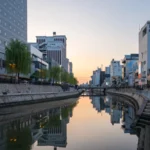
Fukuoka, at the northern tip of the island of Kyūshū, is the island’s largest city and one of Japan’s youngest: a metropolis of more than a million and a half people created in 1889 by the merger of two towns, Fukuoka, the samurai town around the castle, and Hakata, a merchant port. People come for its street stalls (yatai), Hakata ramen, its festivals and as a base for the Dazaifu shrine. Here is what to see in Fukuoka, how to get there, where to stay and what weather to expect month by month, based on the official normals of the Japan Meteorological Agency, plus what the US and UK governments say about entry and safety.
Time zoneUTC+9 all year (no daylight saving): 9 h ahead of London in winter (8 h in summer) and 14 h ahead of New York in winter (13 h in summer)
Best timesMarch-May and October-November; June-July is the rainy season
Getting thereFukuoka Airport, very close to the centre and linked by subway; Hakata Station for the Shinkansen
EntryUS citizens: visa-free stays of up to 90 days (U.S. State Department); UK citizens: visa on arrival for up to 90 days (UK FCDO)
Seeyatai, Ōhori Park and the castle ruins, Canal City, Dazaifu Tenmangū shrine
What to see in Fukuoka: the highlights
The yatai and Hakata cuisine
Fukuoka is known for its yatai, open-air food stalls that do a roaring trade at night. You eat Hakata ramen, with a pork-bone broth that has become a speciality known throughout Japan, chicken skewers (yakitori) and fish from the Sea of Japan. Sit at the counter, order simply and free up your seat after the meal: the stalls are small.
Hakata: the historic district
East of the Naka River, Hakata was the merchant town. It has kept its dialect (Hakata-ben) and its dolls (Hakata ningyō), and gives its name to the city’s two big festivals. The Hakata Machiya Folk Museum presents the traditional life and crafts of the inhabitants. The Hakata-za, opened in 1996, stages kabuki. Near Hakata Station, Canal City Hakata, a shopping complex crossed by a canal, brings together shops, restaurants, cinemas and a theatre.
Ōhori Park and the castle ruins
West of the river, Fukuoka Castle (or Maizuru Castle) was completed in the early Edo period for the lord Kuroda Nagamasa; it has been a national historic site since 1957. Walls, moats and a few towers remain within Maizuru Park. Just to the west, Ōhori Pond corresponds to the castle’s former great moat, about 600 metres (1,970 ft) across; it is now at the heart of a park where you can stroll around the water.
Tenjin
Tenjin is the big shopping and business district. It is home to ACROS, a cultural and convention centre opened in 1995, whose stepped facade is covered with terraced gardens.
Dazaifu Tenmangū shrine
South-east of Fukuoka, in Dazaifu, the Shinto shrine of Dazaifu Tenmangū is built over the tomb of Sugawara no Michizane (845-903), a scholar exiled to Kyūshū and deified as Tenjin, protector of studies. A statue of an ox recalls the legend of his burial, and the shrine has about 6,000 plum trees of 167 varieties, in memory of the poems Michizane dedicated to these trees.
Hakata Bay
The Uminonakamichi peninsula, north of Hakata Bay, has a park, beaches and a large marine aquarium. History can also be read on the coast: after the first Mongol invasion of 1274, the samurai built a stone wall along the bay, parts of which have been uncovered.
The festivals
Two festivals mark the year: Hakata Dontaku, in early May during Golden Week, with performance stages across the centre, and Hakata Gion Yamakasa, in July, the city’s oldest festival, in which teams run carrying floats on their shoulders. Check the dates for the year on the official sites: the city is then in high demand.
Fukuoka in 2 or 3 days
Day 1: Hakata (Hakata Machiya Folk Museum, temples), Canal City, then dinner at a yatai.
Day 2: Ōhori Park and the castle ruins in the morning, Tenjin and ACROS, then the Tenjin shops.
Day 3: Dazaifu Tenmangū and its plum trees, or the Uminonakamichi peninsula.
Where to stay in Fukuoka
Around Hakata Station, practical for the Shinkansen and the airport, or in Tenjin, for shopping and evening life. The subway links the two districts. During festivals and Golden Week, book early. Locals appreciate the effort: learn a few words of Japanese before you go with Targumi, with 30% off via our link.
Getting to Fukuoka and getting around
According to Wikipedia, Fukuoka Airport is about 3 km (2 mi) east of Hakata Station; the domestic terminal is linked to the centre by the city subway, while the international terminal is on the other side of the runways. From abroad you will usually arrive with at least one connection: check routes on the airport and airline sites. By rail, Hakata Station is served by the Sanyō Shinkansen, extended to Hakata in 1975, which links Fukuoka with Hiroshima, Osaka and beyond.
In the city, the subway (in service since 1981), buses and walking are enough for most needs. The subway links the airport, Hakata Station and Tenjin.
Transfer, transport pass or rental car?
From the airport, the subway is the simplest option to Hakata and Tenjin. For Dazaifu, Itoshima or the rest of Kyūshū, trains, buses and regional passes cover most needs; a rental car is useful only for the countryside. Driving in Japan is on the left, and GOV.UK says UK visitors need the 1949 version of the international driving permit plus their UK licence and insurance documents. Before buying a pass or booking a rental, compare the operator’s official site and resellers: coverage, validity, cancellation terms.
When to go to Fukuoka: month-by-month climate
Fukuoka has a humid subtropical climate: mild winters, hot and humid summers, a rainy season (tsuyu) in June-July and possible typhoons in late summer. The table combines the official normals with our calculations.
Month
Max °C (°F)
Min °C (°F)
Rain mm (in)
Precipitation days (≥ 1 mm)
Day/night range °C (°F)
Sunrise / sunset on the 15th
Day length
January
10.2 (50)
3.9 (39)
74 (2.9)
9.3
6.3 (11.3)
07:22 / 17:32
10 h 10 min
February
11.6 (53)
4.4 (40)
70 (2.8)
8.8
7.2 (13.0)
07:03 / 18:02
10 h 59 min
March
15.0 (59)
7.2 (45)
104 (4.1)
10.1
7.8 (14.0)
06:29 / 18:25
11 h 56 min
April
19.9 (68)
11.5 (53)
118 (4.6)
9.7
8.4 (15.1)
05:48 / 18:48
13 h 00 min
May
24.4 (76)
16.1 (61)
134 (5.3)
8.6
8.3 (14.9)
05:18 / 19:11
13 h 53 min
June
27.2 (81)
20.3 (69)
250 (9.8)
11.6
6.9 (12.4)
05:07 / 19:29
14 h 22 min
July
31.2 (88)
24.6 (76)
299 (11.8)
11.0
6.6 (11.9)
05:18 / 19:29
14 h 11 min
August
32.5 (90)
25.4 (78)
210 (8.3)
9.8
7.1 (12.8)
05:40 / 19:05
13 h 25 min
September
28.6 (83)
21.6 (71)
175 (6.9)
9.7
7.0 (12.6)
06:01 / 18:25
12 h 25 min
October
23.7 (75)
16.0 (61)
94 (3.7)
6.8
7.7 (13.9)
06:22 / 17:45
11 h 23 min
November
18.2 (65)
10.6 (51)
91 (3.6)
8.5
7.6 (13.7)
06:49 / 17:15
10 h 27 min
December
12.6 (55)
5.8 (42)
68 (2.7)
8.5
6.8 (12.2)
07:14 / 17:11
9 h 57 min
Temperatures, rainfall and precipitation days (≥ 1 mm): 1991-2020 normals for the Fukuoka station (47807), Japan Meteorological Agency (JMA), published by the World Meteorological Organization (NOAA/NCEI archive). Day/night range, sunrise, sunset and day length: Destination de Voyage calculations (NOAA solar algorithm, 15th of each month, Japan time).
Reading the table: June and July alone receive 549 mm (21.6 in), nearly a third of the year’s precipitation: this is the rainy season. August is the hottest month (32.5 °C, 91 °F maximum, 25.4 °C, 78 °F at night). October has the fewest precipitation days of the autumn months (6.8 days) and remains mild (23.7 °C, 75 °F). Winter is cool but rarely freezing (10 to 13 °C, 50 to 55 °F in the afternoon from December to February). At the summer solstice the day exceeds 14 hours and the sun sets around 19:30; in mid-December around 17:10 (calculated).
According to the U.S. Department of State (travel.state.gov, last updated August 11, 2025), US citizens can make « visa free » tourist or business stays of up to 90 days. Your passport must be valid for the entire time you are staying in Japan, and you should have proof of a return or onward ticket. You cannot work on the local economy or change to another visa while in Japan. All visitors must provide fingerprints and have their photo taken on arrival, and immigration officers may deny entry if you lack proof of how you will support yourself.
UK citizens
According to the UK FCDO (GOV.UK foreign travel advice, updated 28 August 2026), you can get a visa on arrival for tourism or business for up to 90 days and do not need to apply before you travel. Your passport must be valid for the length of your stay (no additional validity is required) and you need a blank page for your visa stamp. You can apply at your nearest immigration office for an extension of another 90 days.
If the two governments’ wording differs (US: « visa free »; UK: visa on arrival), check the current rules with the Japanese embassy before you travel.
Health and safety
Regional note: neither GOV.UK nor the U.S. State Department singles out Fukuoka for specific warnings in the sections we read; the general advice for Japan applies. The U.S. State Department’s weather section lists typhoons, earthquakes and heavy snow as the main natural hazards in Japan.
Past earthquake: according to Wikipedia, a 2005 earthquake (20 March) struck the Fukuoka area and Genkai Island was the most affected; this is a reminder to know the instructions posted in your hotel.
Emergencies: dial 110 for police and 119 for ambulance and fire (GOV.UK).
Earthquakes and tsunamis: GOV.UK says Japan is in a major earthquake zone; take note of instructions in hotel rooms and at train stations, and monitor Japan Meteorological Agency information, including tsunami warnings.
Typhoons and heavy rain: according to GOV.UK, the typhoon season runs from June to December and peaks from July to September, with the highest risk in the south; intense rain can cause floods and landslides. Follow local authorities and any evacuation orders.
Medication: GOV.UK warns that some common medicines are illegal in Japan, including Vicks inhalers, cold and flu medication containing pseudoephedrine and some painkillers containing codeine; the U.S. State Department notes that some prescription drugs legal in the United States are illegal in Japan. Check with the Japanese embassy before you travel.
Food imports: it is illegal to bring meat products, including sausages, bacon and ham, into Japan without permission from the Animal Quarantine Service (GOV.UK).
Money: GOV.UK says Japan is still a predominantly cash-based society and that cards issued outside Japan may not always work; post offices, 7-Eleven stores and JP Post Bank cash machines accept some foreign cards.
Health care: medical facilities are of a high quality but treatment is expensive (GOV.UK); make sure your travel insurance covers medical costs.
An eSIM installed before departure lets you use maps and timetables as soon as you land. Check that your phone is compatible: see our Japan eSIM page and the travel eSIM guide.
If you… then…
If you…
Then…
Want to avoid the rain
Avoid June-July; aim for October-November or March-May
Want to see a festival
Early May (Hakata Dontaku) or July (Yamakasa), dates to be checked
Love street food
The yatai, in the evening
Arrive by plane
Subway from the domestic terminal; shuttle for the international terminal
Travel in August-September
Watch for typhoons (GOV.UK: the season runs from June to December, peaking July to September)
Are continuing to Honshū
Sanyō Shinkansen from Hakata Station towards Hiroshima and Osaka
Frequently asked questions
What is the best time to visit Fukuoka?
March to May and October-November. June and July account for nearly a third of annual precipitation (JMA 1991-2020 normals), and August is hot and humid.
What should I see in Fukuoka in one day?
Hakata and Canal City, Ōhori Park and the castle ruins, then a yatai in the evening.
How do I get from Fukuoka Airport to the centre?
By subway from the domestic terminal. The international terminal is on the other side of the runways.
What is a yatai?
An open-air food stall set up in the evening.
Do I need a visa for Fukuoka?
According to the U.S. State Department (last updated August 11, 2025), US citizens can stay visa-free for up to 90 days; according to the UK FCDO (updated 28 August 2026), UK citizens get a visa on arrival for up to 90 days. Check the Japanese embassy before you travel.
Is Dazaifu worth the detour?
Yes: the Dazaifu Tenmangū shrine, built over the tomb of Sugawara no Michizane, can be visited in half a day; its roughly 6,000 plum trees make it a walking destination at blossom time.
Our sources
World Meteorological Organization, 1991-2020 climate normals, Fukuoka station (47807), Japan Meteorological Agency (NOAA/NCEI archive)
Wikipedia articles « Fukuoka » (French and English), « Fukuoka Castle », « Dazaifu Tenmangū », « Canal City Hakata », « Fukuoka Airport »
Astronomical calculations: NOAA solar algorithm, applied by Destination de Voyage to the coordinates of Fukuoka (15th of each month, year 2027)


 Learn the languageTargumiLearn a few words of Japanese before you go — 30% off via our link.See the course