Visiting Hiroshima starts with understanding what happened here on August 6, 1945, at the Peace Memorial Park and in front of the Atomic Bomb Dome (Genbaku Dome). But the rebuilt city is also a pleasant stop in western Japan: wide avenues, rivers, Shukkei-en garden, okonomiyaki, and above all Miyajima island and its torii standing in the sea, less than an hour away. This Hiroshima travel guide covers what to do, how long to stay, the best time to go, how to get there from Tokyo, Kyoto or Osaka, and where to stay.
Flights London → Hiroshima
“From” fare provided by Kiwi.com (affiliate link), seen in recent searches; it varies with dates.

Our travel deals for Hiroshima
Affiliate links: we earn a commission, at no extra cost to you.
 Learn the languageTargumiLearn a few words of Japanese before you go — 30% off via our link.See the course
- eSIMSailyAnother eSIM plan to compare: data, validity, network.See Saily plans


Hiroshima at a glance
- Location western Honshu, on the Seto Inland SeaCapital of Hiroshima Prefecture
- Airports Hiroshima Airport; most international travelers arrive via Tokyo (Narita, Haneda) or Osaka (Kansai) · details
- Ideal length 2 days(1 day in the city, 1 day on Miyajima), 3 with Iwakuni or Onomichi
- Best time April–May and October–November
- Time zone UTC+9, no daylight saving · detailsLocal time now: –:–
- Entry visa-free up to 90 days for US and UK citizens; passport valid for the whole stay · US: travel.state.gov · UK: GOV.UKUK: visa on arrival, one blank passport page needed
- Currency Japanese yen (JPY) · currencies
- Electricity 100 V, type A/B plugs (two flat pins); US plugs fit, UK travelers need an adapter · plugs
- Budget see our budget section
Things to do in Hiroshima: the highlights
Peace Memorial Park
The park covers the former Nakajima district, between two branches of the Ota River, which was flattened by the bomb. Here you will find the arch-shaped Cenotaph, aligned with the Flame of Peace and the Dome; the Children’s Peace Monument, surrounded by thousands of paper cranes folded all over the world; and the Peace Bell, which visitors can ring. The park is open freely and at no charge, day and night. Allow at least an hour to walk around it without rushing.
Peace Memorial Museum
This is the most important visit, and the most harrowing. The museum traces the city before the bomb, the explosion, then the effects of heat, blast and radiation, through belongings of the victims, photographs and testimonies of survivors (hibakusha). Allow about two hours. There is an admission fee and the line can be long in high season: arrive at opening time. With young children, prepare the visit in advance, as some rooms are very hard to take in.
The Atomic Bomb Dome (Genbaku Dome)
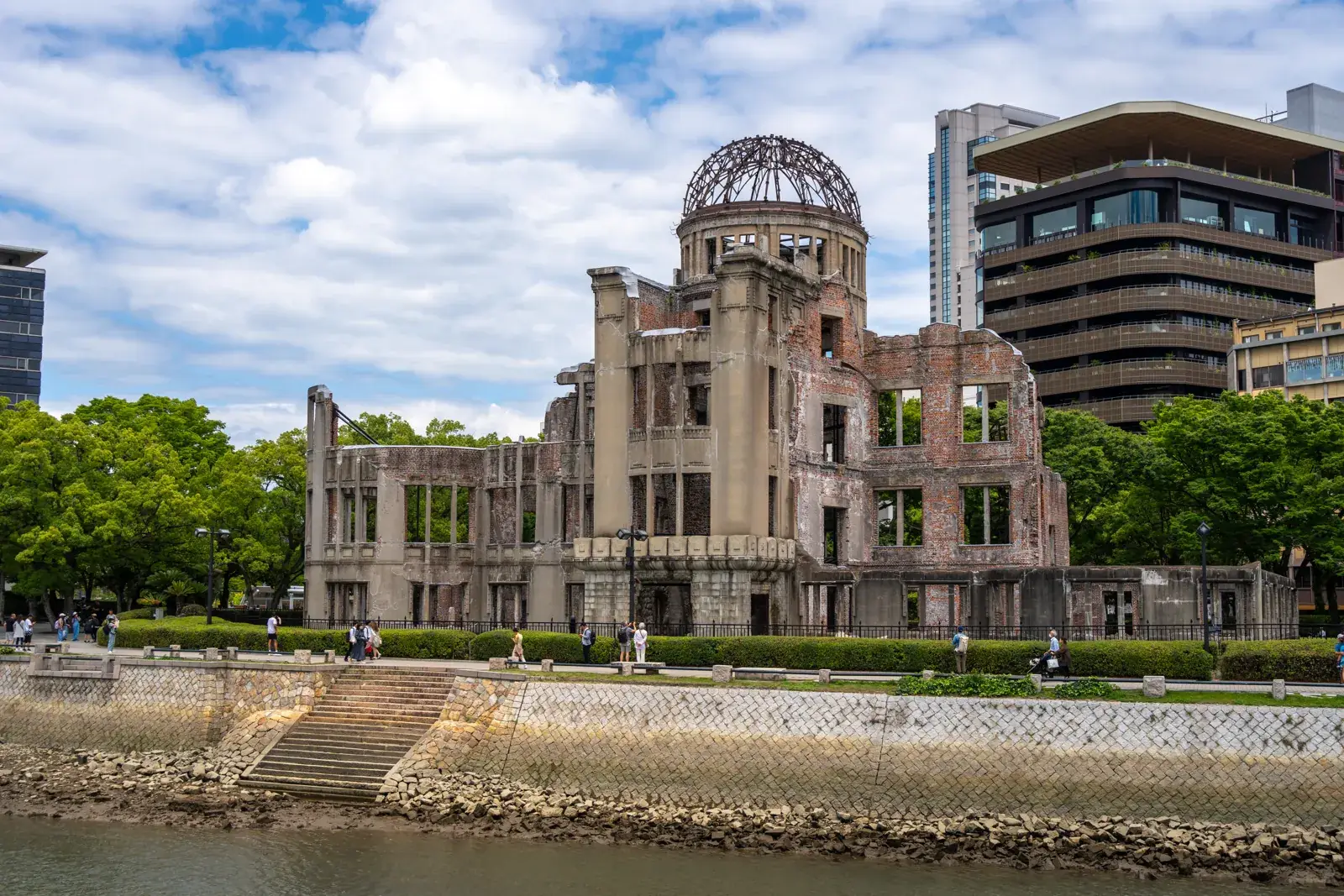
The former Industrial Promotion Hall, of which only the metal frame of the dome remains, stood almost directly beneath the point of the explosion. It has been preserved as it was and has been a UNESCO World Heritage Site since 1996. You view it from the outside; it is particularly striking at dusk, lit up, from the opposite bank.
Hiroshima Castle and Shukkei-en garden
The castle keep, destroyed in 1945, was rebuilt in concrete in 1958; it houses a museum on the history of the city and the samurai, but its closure has been announced for earthquake-resistance reasons: check whether it is open before you go. The grounds, the moats and Gokoku Shrine remain accessible. Ten minutes’ walk away, Shukkei-en garden, laid out in the 17th century for the Asano lords, recreates landscapes in miniature around a pond, with bridges, teahouses and maples; it is one of the city’s finest gardens in autumn.
Hondori, Nagarekawa and okonomiyaki
The covered Hondori shopping street, which starts from the Peace Park, is the city’s commercial heart. The Nagarekawa and Yagenbori districts are packed with bars and izakaya. For Hiroshima-style okonomiyaki, a savory pancake layered with cabbage, soba or udon noodles and egg, cooked on a griddle in front of you, head to Okonomimura, a multi-story building full of small counters, or to the restaurants at the station (Ekimae Hiroba). Oysters from Hiroshima Bay are the other local specialty, especially in winter.
Mitaki-dera temple and viewpoints
In the hills to the northwest, Mitaki-dera temple climbs through the forest around three waterfalls, with a vermilion pagoda and moss-covered statues; it is a lovely spot in maple season. For a view over the city and the islands, take a taxi up Mount Ogon (Ogonzan) at sunset, or go to the rooftop of Orizuru Tower, next to the Dome, where you can also fold a paper crane.
Miyajima and Itsukushima Shrine
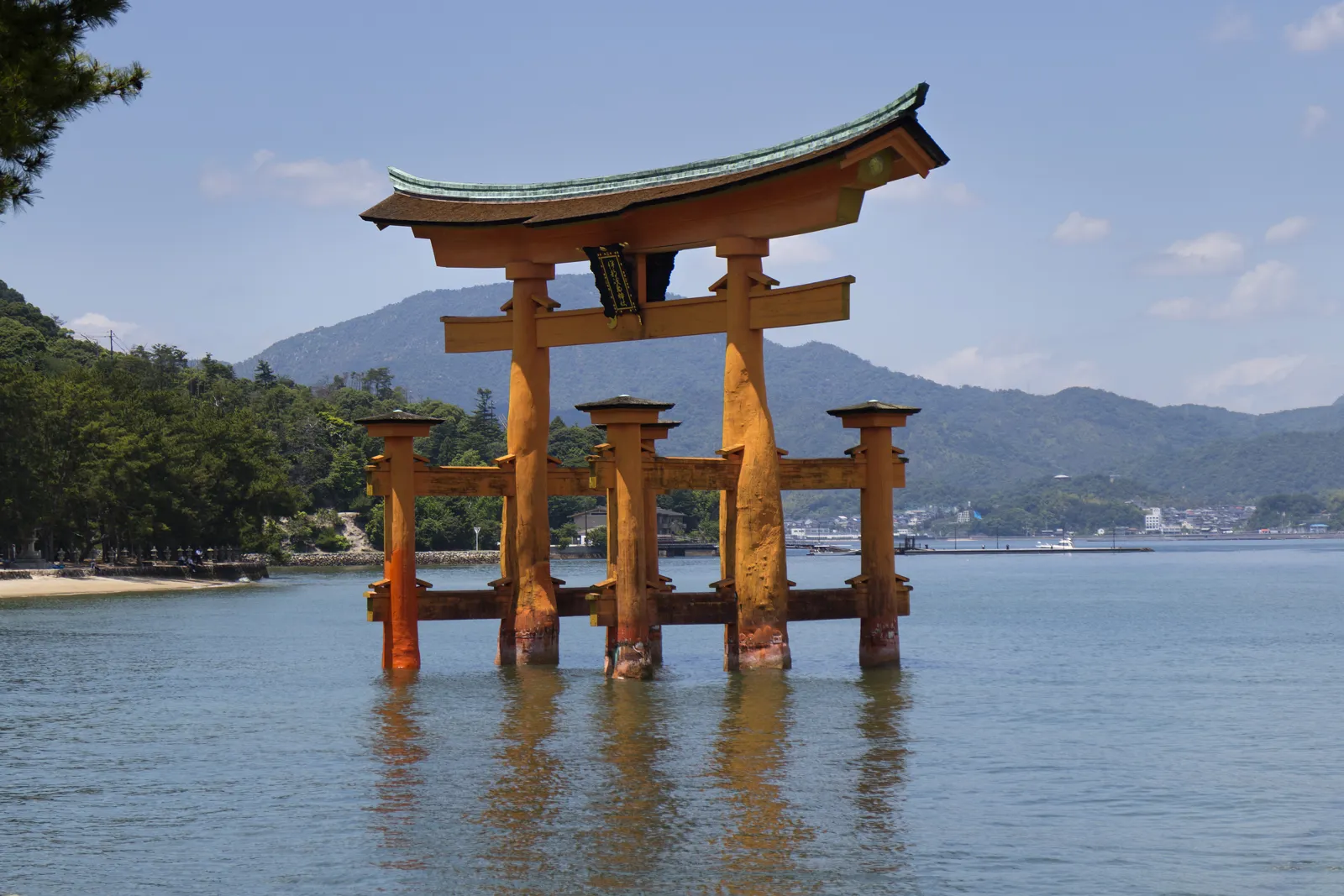
Miyajima island (Itsukushima) is the side trip not to miss. Itsukushima Shrine, built on stilts, and its great torii in the bay have been a UNESCO World Heritage Site since 1996. At high tide the torii seems to float; at low tide you can walk out to its base: check the tide tables to see both. Then climb Mount Misen, on foot or by ropeway, for the view over the Inland Sea, and stroll along Omotesando street, where you can try momiji manju, small maple-leaf-shaped cakes. Deer roam freely: do not feed them. Since October 2023, a visitor tax of ¥100 per person has been collected. Ferries leave from Miyajimaguchi, about 30 minutes by train from Hiroshima, or high-speed boats go directly from the Peace Park.
Around Hiroshima: Iwakuni, Onomichi, Kure
- Iwakuni: its five-arched wooden bridge, Kintai-kyo, spans the Nishiki River; it combines with Miyajima on the same day.
- Onomichi: a small hillside port town with many temples, the starting point of the Shimanami Kaido, a cycling route that links Honshu to Shikoku via a chain of bridges between the islands.
- Kure: a former major naval port, home to the Yamato Museum devoted to shipbuilding.
- Okunoshima: « Rabbit Island, » where hundreds of rabbits roam free, with a museum on the poison gas factory that once operated there in secret.
Itinerary: how long to stay in Hiroshima?
Two days cover the essentials; three if you want to spend a night on Miyajima or add Iwakuni and Onomichi. A day trip from Kyoto or Osaka is possible, but forces you to choose between the city and Miyajima.
- Day 1: Peace Memorial Museum at opening time, the park and the Atomic Bomb Dome, okonomiyaki for lunch, the castle and Shukkei-en garden, evening in Hondori and Nagarekawa
- Day 2: Miyajima all day: Itsukushima Shrine at high tide, Mount Misen, the torii at low tide, back in the late afternoon
- Day 3 (optional): Kintai Bridge in Iwakuni in the morning, or Onomichi and a section of the Shimanami Kaido by bike
Hiroshima fits naturally after Kyoto and Osaka on a first trip to Japan, before heading back to Tokyo. Two- and three-week itineraries are detailed in our Japan travel guide.
When to go to Hiroshima
The best time to visit Hiroshima is spring (April–May) and autumn (October–November): 17–24 °C (63–75 °F) in the afternoon, moderate rainfall and, depending on the season, cherry blossoms in the Peace Park, then maples on Miyajima and in Shukkei-en. June and July are the wettest months (rainy season, tsuyu), and August is the hottest, with an average high of nearly 33 °C (91 °F) and high humidity. Winter is cool but often dry and sunny, with few tourists.
The table shows the official Japan Meteorological Agency normals for Hiroshima. Rainy days are days with at least 1 mm (0.04 in) of precipitation.
| Month | Avg. max | Avg. min | Rain | Rainy days | Crowds | Prices | Verdict |
|---|---|---|---|---|---|---|---|
| January | 9.9 °C (50 °F) | 1.6 °C (35 °F) | 46 mm (1.8 in) | 6.8 | Low | Low | ⚠️ Cold but dry, few visitors |
| February | 10.9 °C (52 °F) | 2.2 °C (36 °F) | 64 mm (2.5 in) | 8.3 | Low | Low | ⚠️ Cold, oyster season |
| March | 14.5 °C (58 °F) | 5.1 °C (41 °F) | 118 mm (4.6 in) | 10.6 | High (cherry blossoms) | High | ✅ Mild, cherry blossoms in late March |
| April | 19.8 °C (68 °F) | 10.1 °C (50 °F) | 141 mm (5.6 in) | 9.9 | Very high (cherry blossoms) | High | ✅ Mild, cherry blossoms in early April |
| May | 24.4 °C (76 °F) | 15.1 °C (59 °F) | 170 mm (6.7 in) | 9.7 | High (Golden Week) | High (Golden Week) | ✅ Pleasant, watch out for Golden Week |
| June | 27.2 °C (81 °F) | 19.8 °C (68 °F) | 226 mm (8.9 in) | 11.9 | Medium | Medium | ❌ Rainy season |
| July | 30.9 °C (88 °F) | 24.1 °C (75 °F) | 280 mm (11.0 in) | 11.6 | Medium | Medium | ❌ Rain, then muggy heat |
| August | 32.8 °C (91 °F) | 25.1 °C (77 °F) | 131 mm (5.2 in) | 8.6 | High (August 6, holidays) | High | ⚠️ Very hot, August 6 ceremony |
| September | 29.1 °C (84 °F) | 21.1 °C (70 °F) | 163 mm (6.4 in) | 9.6 | Medium | Medium | ⚠️ Hot, typhoon risk |
| October | 23.7 °C (75 °F) | 14.9 °C (59 °F) | 109 mm (4.3 in) | 7.1 | High | High | ✅ Mild and dry, maples begin to turn |
| November | 17.7 °C (64 °F) | 8.9 °C (48 °F) | 69 mm (2.7 in) | 6.9 | Very high (autumn leaves) | High | ✅ Autumn maples, dry weather |
| December | 12.1 °C (54 °F) | 3.9 °C (39 °F) | 54 mm (2.1 in) | 7.6 | Medium | Medium | ⚠️ Cool, illuminations |
When to go to Hiroshima: key points
- Best times: April–May and October–November
- Cherry blossoms: usually late March to early April, depending on the year
- Autumn maples: usually mid-November to early December on Miyajima and in Shukkei-en
- Wettest month: July (280 mm (11.0 in)), then June (227 mm (8.9 in))
- Hottest month: August (32.8 °C (91 °F) average high)
- Typhoons: the season runs from June to December, peaking from July to September (UK FCDO, GOV.UK, updated 28 August 2026); follow the forecasts and local instructions
Note: on August 6, a memorial ceremony is held in the Peace Park in the morning, and floating lanterns are set on the river in the evening; the city is very busy then. Golden Week (late April to early May), a holiday period in Japan, pushes up prices and crowds on Miyajima.
| Plan | Best time |
|---|---|
| City sightseeing and the museum | Year-round; ideally March–May and October–November |
| Cherry blossoms | Late March to early April, depending on the year |
| Autumn maples on Miyajima | Mid-November to early December |
| Hiroshima oysters | Winter (December to February) |
| Cycling the Shimanami Kaido | April–May and October–November |
| Low prices and quiet | January–February, outside holidays |
To compare with Tokyo, Kyoto, Hokkaido or Okinawa, see our page on the best time to visit Japan, or our selections of where to go in April and where to go in November.
Budget for a trip to Hiroshima
Hiroshima is cheaper than Tokyo or Kyoto for accommodation. Transportation is the biggest expense if you do not have a rail pass. Rough amounts per person per day, excluding flights and the shinkansen:
| Item | Budget | Comfort |
|---|---|---|
| Accommodation (sharing a double room) | roughly ¥5,000–9,000 (business hotel, hostel) | roughly ¥14,000–26,000 (hotel, ryokan on Miyajima) |
| Meals | roughly ¥3,500–5,500 | roughly ¥8,000–14,000 |
| Local transportation (streetcar, ferry) | roughly ¥900–1,800 | roughly ¥2,600–4,400 (taxi, high-speed boat) |
| Sightseeing | roughly ¥900–2,600 | roughly ¥2,600–5,300 |
| Total per day | roughly ¥12,000–19,000 | roughly ¥28,000–49,000 |
To follow the yen exchange rate, use our currency converter.
Getting there and getting around Hiroshima
- Shinkansen: the Sanyo line links Hiroshima to Shin-Osaka in about 1 h 30 min, to Kyoto in about 1 h 45 min and to Tokyo in about 4 h (Nozomi trains). Nozomi and Mizuho trains require a supplement with the Japan Rail Pass; Hikari and Sakura trains are covered.
- By air: Hiroshima Airport, about 50 km (31 mi) east of the city; check current routes with the airlines. Most international travelers fly into Tokyo (Narita or Haneda) or Osaka (Kansai) and continue by shinkansen or domestic flight.
- Streetcar: the Hiroden network serves the station, the Peace Park, the city center and the Miyajimaguchi terminal; there is a flat fare within the city. IC cards (Suica, ICOCA) work.
- Sightseeing bus: the Meipuru-pu runs a loop between the station and the main sights.
- To Miyajima: JR train to Miyajimaguchi (about 30 min), then ferry (10 min); the JR ferry is covered by the Japan Rail Pass. High-speed boats also leave from the Peace Park.
- By bike: the city is flat; bike-share and rental bikes make it easy to get between the sights.
Where to stay in Hiroshima
- Around the station: the most convenient for a short stay by shinkansen and the trip to Miyajima; many business hotels.
- Hondori and Hacchobori: the lively center, close to the Peace Park, restaurants and bars; ideal for sightseeing on foot.
- Near the Peace Park: quiet in the evening, a few steps from the museum and the Dome.
- On Miyajima: a night in a ryokan lets you see the shrine in the evening and early morning, without the day-trip crowds; book early, as there are few places to stay.
During cherry blossom and autumn foliage season, Golden Week and around August 6, book several weeks ahead.
Entry requirements, health and safety
- US citizens: according to the U.S. Department of State (travel.state.gov, Japan page updated August 11, 2025), US citizens can make visa-free tourist or business stays of up to 90 days. Your passport must be valid for the entire stay, and you should have proof of a return or onward ticket.
- UK citizens: according to the FCDO (GOV.UK, updated 28 August 2026), British citizens get a visa on arrival for tourism or business for up to 90 days and do not need to apply before travel. Your passport must be valid for the length of your stay and have one blank page for the visa stamp.
- On arrival: all visitors are fingerprinted and photographed (U.S. Department of State).
- Food imports: it is illegal to bring meat products (sausages, bacon, ham) into Japan without permission from the Animal Quarantine Service (GOV.UK).
- Medication: according to the UK FCDO (GOV.UK, updated 28 August 2026), some common prescription and over-the-counter medicines are illegal in Japan, including Vicks inhalers, cold and flu medication containing pseudoephedrine and some painkillers containing codeine: check the status of your medication with the Japanese embassy. The U.S. Department of State advises carrying prescription medication in its original packaging with your doctor’s prescription.
- Health: check vaccine recommendations at least 8 weeks before your trip (GOV.UK). According to the UK FCDO (GOV.UK, updated 28 August 2026), medical facilities are of a high quality but treatment is expensive: travel insurance covering medical treatment, hospitalization and repatriation is essential.
- Safety: according to the U.S. Department of State, crime against US citizens in Japan is low. The risks to be aware of are mainly natural: Japan is in a major earthquake zone, and typhoons from June to December, peaking from July to September (UK FCDO, GOV.UK, updated 28 August 2026). Follow the authorities’ instructions if an alert is issued.
- Emergencies: dial 110 for the police and 119 for an ambulance or fire (GOV.UK). During natural disasters, the Japan National Tourism Organization’s Japan Visitor Hotline offers English-language assistance 24 hours a day: +81 50 3816 2787 (GOV.UK).
To choose your coverage, read our travel insurance guide.
Practical tips for Hiroshima
- At the museum and the park: these are places of remembrance. Speak quietly and avoid inappropriate poses in front of the Cenotaph or the Children’s Peace Monument.
- Money: cards are increasingly accepted, but Japan is still largely cash-based and some foreign cards are not accepted; keep cash for small restaurants and temples. ATMs at 7-Eleven stores and Japan Post accept some foreign cards (GOV.UK).
- Internet: an eSIM or a pocket Wi-Fi router is handy for train times and maps.
- Luggage: large suitcases are awkward on trains; luggage forwarding services between hotels (takkyubin) are convenient.
- Tides at Miyajima: check the tide table the day before to plan your day.
- Tipping: it is not customary in Japan.
- Language: A few words go a long way here: start learning Japanese on Targumi before your trip, with 30% off via our link.
Frequently asked questions
How many days do you need in Hiroshima?
Two days: one for the Peace Memorial Park and Museum, the Dome, the castle and Shukkei-en garden, and one for Miyajima. Allow three days to add Iwakuni or Onomichi.
Can you visit Hiroshima as a day trip from Kyoto or Osaka?
Yes, by shinkansen (about 1 h 30 min to 1 h 45 min), but the day is short for both the city and Miyajima. If you can, spend at least one night there.
What is the best time to visit Hiroshima?
April–May and October–November, which are mild and moderately rainy according to Japan Meteorological Agency normals. June–July are the wettest months and August the hottest.
Is there still radiation in Hiroshima?
The UK FCDO’s regional advice on radiation in Japan concerns only the restricted area around the Fukushima Daiichi nuclear power plant (GOV.UK, updated 28 August 2026); it gives no specific advice for Hiroshima, a rebuilt city of more than a million inhabitants.
How do you get to Miyajima from Hiroshima?
By JR train to Miyajimaguchi (about 30 minutes), then by ferry (10 minutes), or by high-speed boat from the Peace Park. A visitor tax of ¥100 per person is collected on arrival on the island.
Do you need a visa to visit Hiroshima?
US citizens can stay visa-free for up to 90 days for tourism or business (travel.state.gov), and British citizens get a visa on arrival for up to 90 days with no need to apply in advance (GOV.UK). Your passport must be valid for the whole stay.
Our sources
- Entry, health and safety information read on 24 October 2026: U.S. Department of State, Japan country information (travel.state.gov, last updated August 11, 2025), and UK FCDO, foreign travel advice for Japan (GOV.UK, updated 28 August 2026)
- Hiroshima climate normals: 1991–2020 normals from the Japan Meteorological Agency (JMA), Hiroshima station, as shown in the climate box of the Wikipedia article « Hiroshima, » accessed October 14, 2026
- Wikipedia, « Hiroshima Airport » article (airlines and destinations), accessed October 14, 2026
- Our methodology
Updated October 2026.
For the rest of your trip: our Japan travel guide, the best time to visit Japan, our guides to Kyoto, Osaka and Tokyo, neighboring South Korea, and all our destinations in Asia.