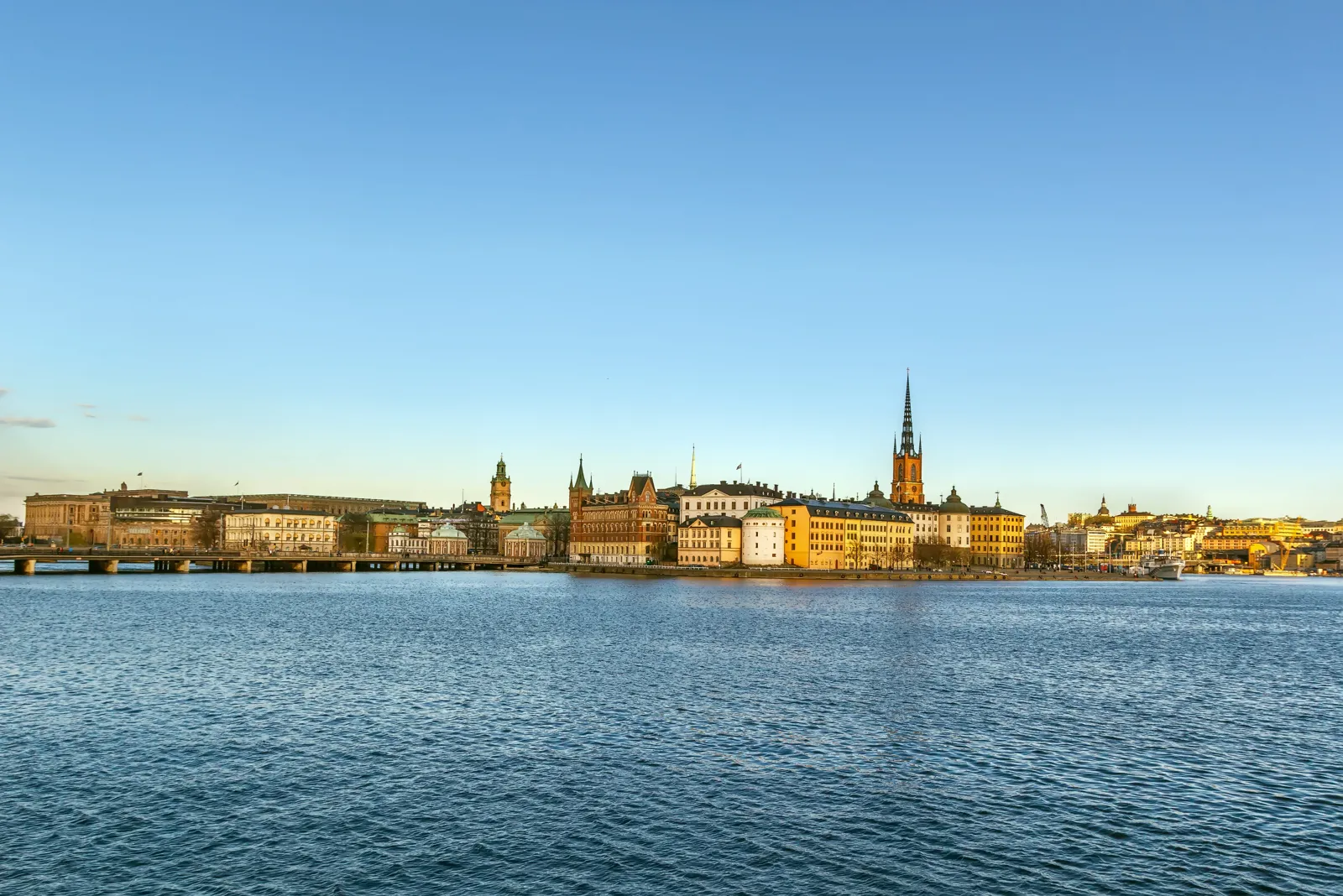
When is the best time to visit Sweden? From late May to early September for Stockholm, the west coast and the lakes: June, July and August are the mildest months (21 to 24 °C (70 to 75 °F) in the afternoon in Stockholm) and the days last almost all night. For the northern lights and snow in Lapland, aim for December to March. May, June and late August offer the best balance of weather, daylight and crowds.
Sweden stretches about 1,500 km (932 mi) from south to north, and its climate varies strongly from one region to another. The south, around Malmö and Göteborg, has a temperate climate close to that of Denmark. Stockholm has cold winters, around 0 °C (32 °F), and pleasant summers. North of the Arctic Circle, Swedish Lapland has a subarctic climate: long, very cold winters with the polar night, and a short summer lit by the midnight sun. Here is how to choose your dates, based on data from the Swedish Meteorological and Hydrological Institute (SMHI).

Our travel deals for Sweden
Affiliate links: we earn a commission, at no extra cost to you.
 FlightsKiwi.comCompare flights and airline combinations to Sweden.Compare flights

When to go to Sweden at a glance
- Best times late May to early September for the south and center of the country
- Hottest month July, with an average high of about 23.6 °C (74 °F) in Stockholm
- Coldest months January and February, with an average high of about 1 °C (34 °F) and a low of -3 °C (27 °F) in Stockholm; often -15 °C (5 °F) or lower at night in Lapland
- Driest months February to May in Stockholm (less than 35 mm (1.4 in) a month)
- Lapland in winter December to March for snow, dog sledding and the northern lights
- Highlights Midsummer in June, St. Lucia’s Day on December 13, Christmas markets
- Best avoided if possible November, which is gray, dark and snowless in the south
When to go to Sweden by priority
- Best weather: June to August; May and September for mild weather; February–March for Lapland
- Cheapest: January to March and November (low prices), outside holiday periods
- Fewest crowds: May and September (moderate crowds), April (low to moderate)
- Events: Walpurgis Night (Valborg) on April 30, Midsummer Eve on the Friday between June 19 and 25, Medieval Week in Visby in early August, St. Lucia’s Day on December 13
Sweden: the calendar at a glance
✅ Best months: may, June, July, August, September
❌ Period to avoid: January, November
Climate and weather in Sweden month by month
The table below gives the normals for the Stockholm-Observatorielunden station, in the middle of the capital, the gateway for most travelers. Winter temperatures are a little milder on the west coast and in the south, and much lower in the north of the country. For distances from Stockholm to Lapland, see our map of Sweden.
| Month | Avg. high | Avg. low | Rain | Crowds | Prices | Verdict |
|---|---|---|---|---|---|---|
| January | 1.0 °C (34 °F) | -2.9 °C (27 °F) | 37 mm (1.5 in) | Low | Low | ❌ Cold, gray, very short days |
| February | 1.2 °C (34 °F) | -3.2 °C (26 °F) | 29 mm (1.1 in) | Low (except school holidays) | Low | ⚠️ Cold but dry; ideal for Lapland |
| March | 4.7 °C (40 °F) | -1.1 °C (30 °F) | 27 mm (1.1 in) | Low | Low | ⚠️ End of winter; a good month for Lapland |
| April | 10.7 °C (51 °F) | 2.6 °C (37 °F) | 29 mm (1.1 in) | Low to moderate | Moderate | ⚠️ Cool spring, the light returns |
| May | 16.5 °C (62 °F) | 7.1 °C (45 °F) | 34 mm (1.3 in) | Moderate | Moderate | ✅ Mild, dry, nature in bloom |
| June | 20.8 °C (69 °F) | 11.6 °C (53 °F) | 62 mm (2.4 in) | High | High | ✅ Midsummer, almost white nights |
| July | 23.6 °C (74 °F) | 14.8 °C (59 °F) | 62 mm (2.4 in) | Very high | High | ✅ The hottest month, archipelagos and swimming |
| August | 22.1 °C (72 °F) | 14.2 °C (58 °F) | 66 mm (2.6 in) | High | High | ✅ Still warm, the wettest month |
| September | 16.6 °C (62 °F) | 10.2 °C (50 °F) | 53 mm (2.1 in) | Moderate | Moderate | ✅ Autumn colors, fewer crowds |
| October | 10.1 °C (50 °F) | 5.5 °C (42 °F) | 51 mm (2.0 in) | Low | Low to moderate | ⚠️ Cool and rainy, days getting shorter |
| November | 5.4 °C (42 °F) | 1.9 °C (35 °F) | 48 mm (1.9 in) | Low | Low | ❌ Gray and dark, the least attractive month |
| December | 2.5 °C (37 °F) | -1.2 °C (30 °F) | 48 mm (1.9 in) | Moderate (Christmas) | Moderate | ⚠️ Christmas atmosphere, very little daylight |
Note: in Sweden, daylight changes more than temperature. In Stockholm, the sun rises around 3:30 a.m. and sets around 10 p.m. at the summer solstice, and there are barely 6 hours of daylight in December. Farther north, beyond the Arctic Circle, the sun does not set at all for several weeks around Midsummer, and does not rise for part of December. Rainfall is modest in Stockholm, but summer is the wettest season: showers are frequent and often brief.
Sunshine in Stockholm
May, June and July are the sunniest months in Stockholm, with nearly 280 hours of sunshine each; December is the darkest, with about 33 hours. These long days from May to July are ideal for a trip to Stockholm, when the city makes the most of the light.
| Month | Sunshine in Stockholm (hours/month) |
|---|---|
| January | 44 |
| February | 75 |
| March | 151 |
| April | 216 |
| May | 277 |
| June | 277 |
| July | 280 |
| August | 235 |
| September | 170 |
| October | 96 |
| November | 45 |
| December | 33 |
The seasons in Sweden: pros and cons
Spring (April–May): the return of the light
April is still cool (about 11 °C (52 °F) in the afternoon in Stockholm) and snow can still lie in the center and north of the country. May changes everything: about 16.5 °C (62 °F), little rain, very long evenings and nature turning green all at once. On the evening of April 30, Walpurgis Night (Valborg) is celebrated with bonfires and songs, especially in university towns such as Uppsala and Lund. It is a very good season for cities, before the summer crowds arrive.
- Pros: one of the driest times of the year, prices still moderate, days lengthening very quickly
- Cons: cool nights, sea and lakes still cold, some outdoor activities not yet open
- Our tip: May is an excellent month for Stockholm, Göteborg and the south of the country
Summer (June to August): high season
Summer is the ideal season for enjoying Sweden outdoors: 21 to 24 °C (70 to 75 °F) in the afternoon in Stockholm, endless days, swimming in lakes and the sea, boat trips in the archipelago. Midsummer, whose eve (Midsommarafton) falls on the Friday between June 19 and 25, is one of the most important celebrations of the year: Swedes dance around the flower-decked maypole, often in the countryside. July is when Swedes take their main summer holidays: cities empty out a little in favor of country houses, but tourist sites, islands and the west coast are very busy.
- Pros: mild temperatures, almost constant daylight, all sites and boat connections in operation
- Cons: the highest prices, reservations essential on the islands, mosquitoes in the north and near lakes, frequent showers
- Who is it for? Families, and fans of hiking, canoeing, cycling and swimming
Autumn (September–October): colors and calm
September is still pleasant in the south and in Stockholm (about 16.5 °C (62 °F) in the afternoon) and the birch forests change color, very early in Lapland, from late August or early September. It is also the start of the northern lights season in the north, when nights turn dark again. October is cooler, grayer and rainier, especially on the west coast, where Göteborg receives more than 100 mm (3.9 in) of rain on average that month.
- Pros: fewer visitors, falling prices, autumn colors, the first northern lights in Lapland
- Cons: more rain, days shortening quickly, some summer activities closing
- Who is it for? Travelers who want to visit cities in peace or hike in Lapland before the snow
Winter (November to March): Lapland, snow and Christmas markets
Winter is long in Sweden. In Stockholm, afternoons are about 1 to 2.5 °C (34 to 37 °F) from December to February and nights around -3 °C (27 °F); snow is common but not guaranteed. In Lapland, this is the star season: in Kiruna, average highs are -8 °C (18 °F) in January and lows close to -17 °C (1 °F). Dog sledding, snowmobiling, the ice hotel and the northern lights then draw travelers. December is also the month of Christmas markets and St. Lucia’s Day on December 13, with its processions of singers dressed in white and crowned with candles. Snow, auroras and St. Lucia’s Day: a trip to Lapland between November and March shows this Nordic winter at its fullest. Before heading into the far north, read our guide to what to do in Kiruna.
- Pros: snowy landscapes and northern lights in the north, Christmas atmosphere, quiet cities and low prices in January–February (outside Lapland)
- Cons: very little daylight, intense cold in the north, difficult roads; November is often gray and snowless in the south
When to go to Sweden by region
The country is divided into three main areas: Götaland in the south (Malmö, Göteborg, Gotland), Svealand in the center (Stockholm, Uppsala, Dalarna) and Norrland in the north, which includes Lapland. Here is a comparison of the normals for three stations monitored by SMHI. For the Baltic island, see our guide to Gotland.
| Month | Stockholm | Göteborg | Kiruna (Lapland) |
|---|---|---|---|
| January | 1.0 °C (34 °F) / 37 mm (1.5 in) | 3.0 °C (37 °F) / 83 mm (3.3 in) | -7.9 °C (18 °F) / 26 mm (1.0 in) |
| February | 1.2 °C (34 °F) / 29 mm (1.1 in) | 3.2 °C (38 °F) / 61 mm (2.4 in) | -6.7 °C (20 °F) / 20 mm (0.79 in) |
| March | 4.7 °C (40 °F) / 27 mm (1.1 in) | 6.4 °C (44 °F) / 54 mm (2.1 in) | -2.4 °C (28 °F) / 15 mm (0.59 in) |
| April | 10.7 °C (51 °F) / 29 mm (1.1 in) | 12.1 °C (54 °F) / 51 mm (2.0 in) | 3.1 °C (38 °F) / 19 mm (0.75 in) |
| May | 16.5 °C (62 °F) / 34 mm (1.3 in) | 17.0 °C (63 °F) / 54 mm (2.1 in) | 8.9 °C (48 °F) / 45 mm (1.8 in) |
| June | 20.8 °C (69 °F) / 62 mm (2.4 in) | 20.1 °C (68 °F) / 74 mm (2.9 in) | 14.8 °C (59 °F) / 55 mm (2.2 in) |
| July | 23.6 °C (74 °F) / 62 mm (2.4 in) | 22.5 °C (73 °F) / 81 mm (3.2 in) | 18.5 °C (65 °F) / 93 mm (3.7 in) |
| August | 22.1 °C (72 °F) / 66 mm (2.6 in) | 21.9 °C (71 °F) / 93 mm (3.7 in) | 15.9 °C (61 °F) / 66 mm (2.6 in) |
| September | 16.6 °C (62 °F) / 53 mm (2.1 in) | 17.7 °C (64 °F) / 80 mm (3.1 in) | 10.2 °C (50 °F) / 58 mm (2.3 in) |
| October | 10.1 °C (50 °F) / 51 mm (2.0 in) | 12.0 °C (54 °F) / 103 mm (4.1 in) | 2.5 °C (37 °F) / 40 mm (1.6 in) |
| November | 5.4 °C (42 °F) / 48 mm (1.9 in) | 7.4 °C (45 °F) / 85 mm (3.3 in) | -2.8 °C (27 °F) / 26 mm (1.0 in) |
| December | 2.5 °C (37 °F) / 48 mm (1.9 in) | 4.2 °C (40 °F) / 93 mm (3.7 in) | -5.1 °C (23 °F) / 32 mm (1.3 in) |
In one table: the recommended period for each main region, month by month.
| Region | Jan | Feb | Mar | Apr | May | June | Jul | Aug | Sep | Oct | Nov | Dec |
|---|---|---|---|---|---|---|---|---|---|---|---|---|
| Stockholm and its archipelago | ❌ | ⚠️ | ⚠️ | ⚠️ | ✅ | ✅ | ✅ | ✅ | ✅ | ⚠️ | ❌ | ⚠️ |
| Göteborg, west coast and south | ❌ | ❌ | ⚠️ | ⚠️ | ✅ | ✅ | ✅ | ✅ | ✅ | ⚠️ | ❌ | ⚠️ |
| Dalarna and the lake district | ⚠️ | ⚠️ | ⚠️ | ❌ | ⚠️ | ✅ | ✅ | ✅ | ⚠️ | ❌ | ❌ | ⚠️ |
| Lapland (Kiruna, Abisko) | ✅ | ✅ | ✅ | ⚠️ | ⚠️ | ⚠️ | ✅ | ✅ | ⚠️ | ⚠️ | ⚠️ | ✅ |
| Gotland and Öland | ❌ | ❌ | ❌ | ❌ | ⚠️ | ✅ | ✅ | ✅ | ⚠️ | ❌ | ❌ | ❌ |
Stockholm and its archipelago
The capital can be visited all year thanks to its museums, but from May to September it takes on another dimension: terraces along the quays, swimming in Lake Mälaren or the sea, boat trips to the archipelago, which has tens of thousands of islands and islets. Many ferry links to the outer islands are reduced out of season. In December, the Christmas markets in Gamla Stan and Skansen make up for the lack of light.
Göteborg, the west coast and the south
The west coast, from Bohuslän to Göteborg, and Skåne (Malmö, Lund, Ystad) have milder but much wetter winters than Stockholm. Göteborg gets more rain in every season, with a peak in October. Aim for June to August for fishing villages, granite islands and swimming, and May or September for quiet cities.
The center: Dalarna and the lake district
Dalarna, around Lake Siljan, is the heart of Swedish traditions: it is one of the best-known regions for celebrating Midsummer. The large lakes Vänern and Vättern can be explored by car, bike or canoe. The best period runs from June to August; in winter, the region is suited to cross-country skiing.
Swedish Lapland (Kiruna, Abisko, Jokkmokk)
North of the Arctic Circle, two seasons stand in contrast. From December to March it is the Arctic winter: reliable snow, very low temperatures and northern lights on clear nights. March combines snow, longer days and slightly less biting cold. From mid-June to August, the midnight sun lights up hikes, notably on the Kungsleden trail, but mosquitoes are numerous in July. Late-summer landscapes, when the tundra turns red, also attract hikers. In winter, bring equipment suited to extreme temperatures.
Gotland and Öland
These two Baltic islands, the sunniest in the country in summer, are best visited from June to August. Visby, on Gotland, hosts its Medieval Week in early August. Out of season, many accommodations and restaurants close and ferries are less frequent.
When to go to Sweden by trip type
| Trip | Best time | Where? |
|---|---|---|
| City break in Stockholm | May–June, late August–September | Stockholm, Uppsala |
| Archipelagos and swimming | Late June to mid-August | Stockholm archipelago, west coast, Gotland, Öland |
| Midsummer | Late June (Friday between June 19 and 25) | Dalarna, Stockholm archipelago, countryside |
| Northern lights | Late September to March | Abisko, Kiruna, Jokkmokk |
| Dog sledding and snow | December to March (March for more daylight) | Swedish Lapland |
| Hiking and midnight sun | Mid-June to August | Kungsleden, Abisko, Lapland |
| Canoeing and lakes | June to August | Värmland, Dalarna, Småland |
| Christmas markets and St. Lucia’s Day | Late November to December | Stockholm, Göteborg, Uppsala |
| Budget | January–February, November (outside Lapland) | Stockholm, Göteborg, Malmö |
Major events in Sweden
| Date | Event | Location |
|---|---|---|
| Early February | Jokkmokk Sami winter market (centuries-old tradition) | Jokkmokk |
| April 30, evening | Walpurgis Night (Valborg): bonfires and songs | Nationwide, especially Uppsala and Lund |
| June 6 | Swedish National Day | Nationwide |
| Friday between June 19 and 25 | Midsummer Eve (Midsommarafton): maypole, dancing, traditional meal | Nationwide |
| Early August | Visby Medieval Week | Gotland |
| August | August | Nationwide |
| Late November to December | Crayfish season (kräftskiva) | Stockholm (Gamla Stan, Skansen), Göteborg |
| December 10 | Nobel Prize award ceremony (by invitation) | Stockholm |
| December 13 | St. Lucia’s Day: candlelit processions | Nationwide |
Sweden month by month: what to expect
Sweden in January: The heart of winter: about 1 °C (34 °F) in the afternoon in Stockholm, -3 °C (27 °F) at night, and barely 6 to 7 hours of daylight. An ideal month for snowy Lapland and the northern lights, and for Stockholm’s museums at low prices.
Sweden in February: Cold and dry in Stockholm (29 mm (1.1 in)). An excellent month for Lapland, with lengthening days. The Sami market in Jokkmokk takes place in early February.
Sweden in March: Still winter in the north, with snow and much more light: one of the best months for activities in Lapland. In Stockholm, about 5 °C (41 °F) and dry weather.
Sweden in April: Cool spring (11 °C (52 °F) in Stockholm), Easter and Walpurgis Night on the 30th. Snow melts in the center of the country; the north is still snowy.
Sweden in May: One of the best months for cities: about 16.5 °C (62 °F), dry weather, nature in bloom and very long evenings. Tourist sites return to summer hours.
Sweden in June: The longest days, about 21 °C (70 °F) in the afternoon in Stockholm. Midsummer at the end of the month. The start of the island season and of the midnight sun in Lapland.
Sweden in July: The hottest month (23.6 °C (74 °F) in Stockholm). Swedish summer holidays: archipelagos, beaches and the west coast are very busy. Book early.
Sweden in August: Still warm (22 °C (72 °F)), but the wettest month in Stockholm (66 mm (2.6 in)). Crayfish season brightens the evenings. Crowds ease after mid-August.
Sweden in September: About 16.5 °C (62 °F) in Stockholm, fewer people, autumn colors and the first northern lights in the north. A good compromise.
Sweden in October: Cool (10 °C (50 °F)) and rainy, especially on the west coast. Days shorten quickly. A good month for museums and for hunting the northern lights in Lapland.
Sweden in November: Gray and dark (5 °C (41 °F)), often snowless in the south: the least attractive month. Christmas markets open at the end of the month.
Sweden in December: Cold (2.5 °C (37 °F) in the afternoon in Stockholm), barely 6 hours of daylight, but a Christmas atmosphere, St. Lucia’s Day on the 13th and the start of the winter season in Lapland, in the middle of the polar night.
When to book your trip to Sweden
For a stay from June to August, book your accommodation 2 to 3 months ahead, more if you are aiming for the archipelago islands, Gotland during Medieval Week or a cabin by a lake. For Lapland in winter, accommodation and activities (dog sledding, aurora outings, ice hotel) often need to be booked 4 to 6 months ahead, especially for the Christmas and February holiday periods. Out of season, a few weeks’ notice is usually enough. Compare offers when you book.
Planning your trip to Sweden
- Entry requirements: rules depend on your nationality and can change, so check the entry requirements for Sweden before you book.
- Currency: the Swedish krona (SEK), not the euro. Cards are accepted almost everywhere and some businesses no longer accept cash. Our currency converter helps you estimate prices.
- Gear: in summer, a waterproof jacket and insect repellent for the north; in winter, warm layered clothing and shoes suited to snow and ice.
To go further, see our complete Sweden travel guide. Not sure which destination to pick? See our ideas for where to go in June, in July and in December, or check when to go to Finnish Lapland, or compare with the best time to visit Norway and the best time to visit Denmark.
What to wear in Sweden by season
- Summer (June to August): 21 to 24 °C (70 to 75 °F) in the afternoon in Stockholm but 12 to 15 °C (54 to 59 °F) at night: light clothing, a sweater, a waterproof jacket for showers, a swimsuit for the lakes and archipelagos, and a sleep mask in the north.
- Spring and autumn: 10 to 17 °C (50 to 63 °F) in the afternoon, much less in the morning: layers, a warm windproof jacket, waterproof shoes.
- Winter in Stockholm: around 0 °C (32 °F), often damp: a warm coat, hat, gloves, non-slip shoes.
- Winter in Lapland: thermal wool underwear, fleece, snow pants, mittens and insulated boots; activity providers often lend extreme-cold suits.
Frequently asked questions
What is the best month to visit Sweden?
For Stockholm and the south, June is often the most balanced: about 21 °C (70 °F) in the afternoon, the longest days of the year and Midsummer. May and late August are good alternatives. For Lapland in winter, February and March combine snow, slightly less intense cold and longer days.
When can you see the northern lights in Sweden?
In the north of the country, from late September to about March, when nights are dark. You need a clear sky and to get away from city lights. Abisko, Kiruna and Jokkmokk are the most common bases. No sighting is guaranteed: plan for several nights on site.
Is Sweden very cold in winter?
It depends on the region. In Stockholm, the January and February normals are about 1 °C (34 °F) in the afternoon and -3 °C (27 °F) at night (SMHI, 1991–2020). In Lapland, in Kiruna, January averages are around -8 °C (18 °F) by day and -17 °C (1 °F) at night, with much colder spells.
When is Midsummer in Sweden?
Midsummer Eve (Midsommarafton) is celebrated on the Friday between June 19 and 25. It is a de facto public holiday: many shops and services close or reduce their hours, and many Swedes head to the countryside.
Can you swim in Sweden?
Yes, from late June to August, in the sea and in the very many lakes, whose water is often a little warmer than the sea in midsummer. The water remains cool. Preferably swim in supervised areas.
What is the cheapest time to visit Sweden?
January, February (outside school holidays and outside Lapland), November and the period from late March to April. Lapland, by contrast, is most expensive in winter, and the coasts and islands in midsummer.
What is the coldest month in Sweden?
In Stockholm, February is the coldest month, with about 1.2 °C (34 °F) in the afternoon and -3.2 °C (26 °F) at night, just ahead of January (1.0 °C (34 °F) and -2.9 °C (27 °F)), according to SMHI’s 1991–2020 normals. In the north, in Swedish Lapland, temperatures are much lower.
What is the best time to visit Stockholm?
From May to September: about 16.5 °C (62 °F) in the afternoon in May and September, 21 to 24 °C (70 to 75 °F) from June to August, and nearly 280 hours of sunshine a month from May to July. May, June and late August offer the best balance of weather, daylight and crowds.
How many hours of daylight are there in Stockholm?
At the summer solstice, the sun rises around 3:30 a.m. and sets around 10 p.m. In December there are barely 6 hours of daylight. Beyond the Arctic Circle, the sun does not set for several weeks around Midsummer.
What should you wear in Sweden in summer?
Light clothing for afternoons of 21 to 24 °C (70 to 75 °F) in Stockholm, but also a sweater and a waterproof jacket: nights remain cool (12 to 15 °C (54 to 59 °F)) and summer is the wettest season, with often brief showers.
Our sources
- Swedish Meteorological and Hydrological Institute (SMHI): 1991–2020 normals for the Stockholm-Observatorielunden and Göteborg stations; 2002–2021 averages for Kiruna airport (rainfall from Rensjön); sunshine for Stockholm-Observatorielunden read in the Wikipedia article “Stockholm” (SMHI climate box) on October 5, 2026
- Dates of traditions and events (Valborg, Midsummer Eve, National Day, St. Lucia’s Day, Jokkmokk winter market, Medieval Week in Visby, Nobel Prize award ceremony) checked on November 11, 2026: Jokkmokk Winter Market, Medieval Week on Gotland, NobelPrize.org, Göteborg & Co
- Our methodology
Updated November 2026.