
Things to do in Moorea: drive up to the Belvedere above Cook’s and Opunohu bays, loop the island on the coast road, swim with rays in the lagoon, relax on Temae and Ta’ahiamanu beaches, walk among marae and pineapple fields, and watch whales from July to October. Moorea, Tahiti’s « sister island », is only a short boat ride from Papeete.
This Moorea guide covers the highlights, itineraries from 1 to 5 days, a budget, where to stay and the month-by-month climate. It also includes an original comparison of rainfall on Moorea, Tahiti and Bora Bora, calculated from Météo-France data, to help you choose your dates and your island combination. For the whole archipelago, see our French Polynesia travel guide.

Our travel deals for Moorea
Affiliate links: we earn a commission, at no extra cost to you.
 FlightsKiwi.comCompare flights and airline combinations to Moorea.Compare flights
- eSIMSailyAnother eSIM plan to compare: data, validity, network.See Saily plans


Moorea at a glance
- Location Windward Islands, Society archipelagoAbout 17 km (11 mi) northwest of Tahiti
- Area and population about 134 km² (52 sq mi), just over 16,000 inhabitants
- Languages French and Tahitian
- Currency CFP franc (XPF) · currencies
- Time zone UTC−10 · details10 to 11 hours behind London, 5 to 6 hours behind New YorkLocal time now: –:–
- Airports international flights land at Tahiti-Faa’a · detailsMoorea’s Temae airfield is served by Air Tahiti
- From Tahiti ferries and fast boats Papeete – Vaiare, several crossings a day · details
- Entry US and UK: no visa for up to 90 days · travel.state.gov · GOV.UK
- Electricity check voltage and plug type with your accommodation · plugs
- Budget see our budget section
Things to do in Moorea: the highlights
The Belvedere and Opunohu Valley
This is the island’s most famous view. A road climbs through Opunohu Valley to the Belvedere, at 240 m (787 ft), in the heart of the old crater. From there you can see both Cook’s Bay and Opunohu Bay, separated by Mount Rotui (899 m, 2,949 ft). On the way, the valley has restored marae, the stone platforms where Polynesian ceremonies were held, and marked hiking trails. Go up in the morning if you can, before clouds gather on the peaks.
Cook’s Bay and Opunohu Bay
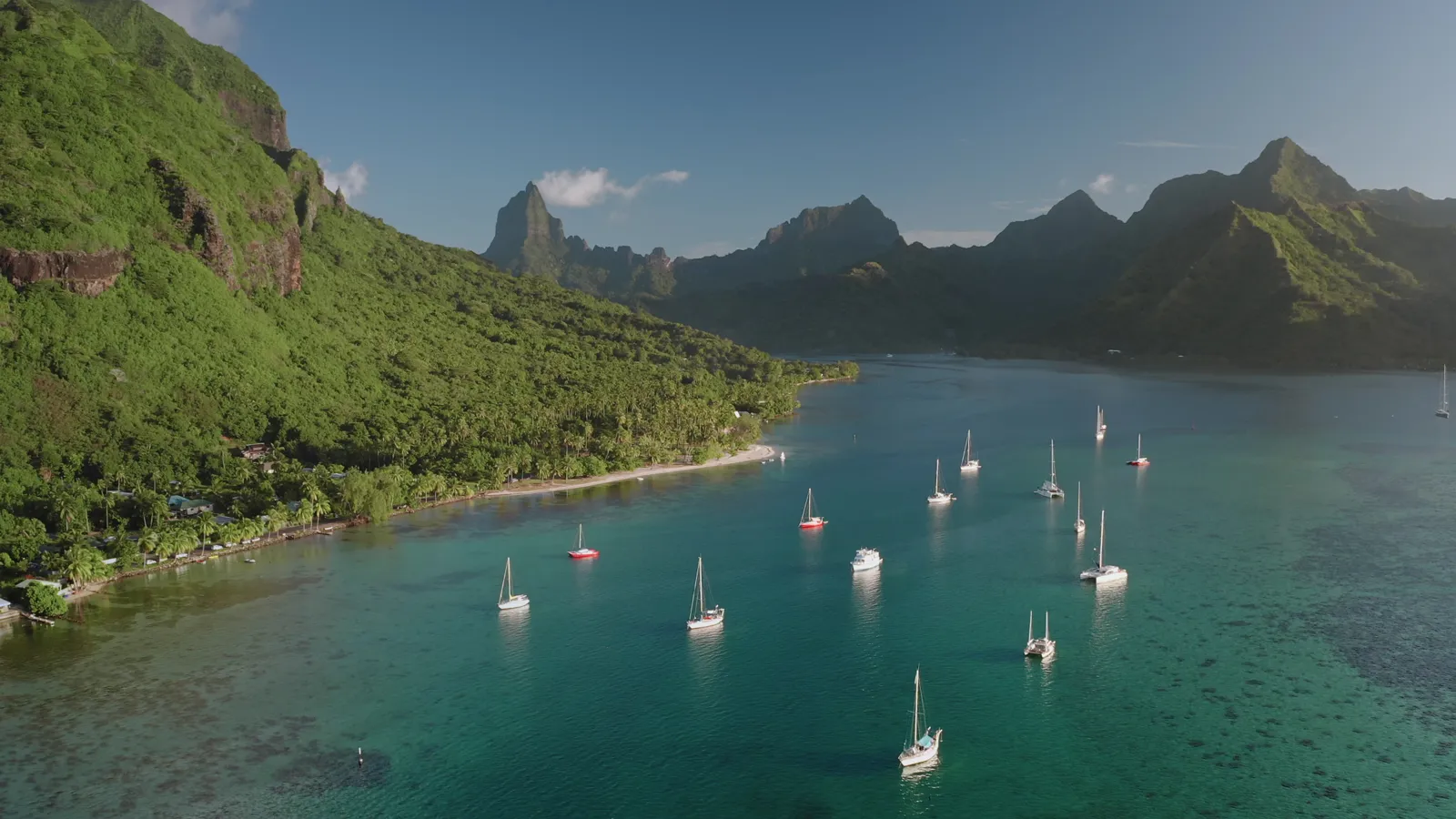
The two large bays on the north coast give Moorea its recognisable shape. Cook’s Bay is named after the navigator, who in fact anchored in its neighbour, Opunohu Bay, when he passed through in 1777. The road follows their shores at the foot of lush volcanic peaks. Boat trips cruise through them before heading out into the lagoon.
The lagoon: rays, blacktip sharks and motu

A coral reef broken by twelve passes rings the island and shelters a shallow lagoon. Boat or outrigger canoe trips stop at sandbanks where you swim among stingrays and small blacktip reef sharks, then at a motu (islet) for lunch. Choose an operator that does not feed the animals, and do not touch the wildlife.
Beaches: Temae, Ta’ahiamanu and Les Tipaniers
Near the airport in the northeast, the public beach at Temae has white sand and clear water, with a view of Tahiti. At the head of Opunohu Bay, Ta’ahiamanu beach, also public, is popular with families. In Haapiti, in the northwest, the Tipaniers area is known for snorkelling, with a motu you can reach by kayak or shuttle. Sandy beaches are fewer than you might imagine: most of the shoreline is lined with private property and hotels.
The island loop
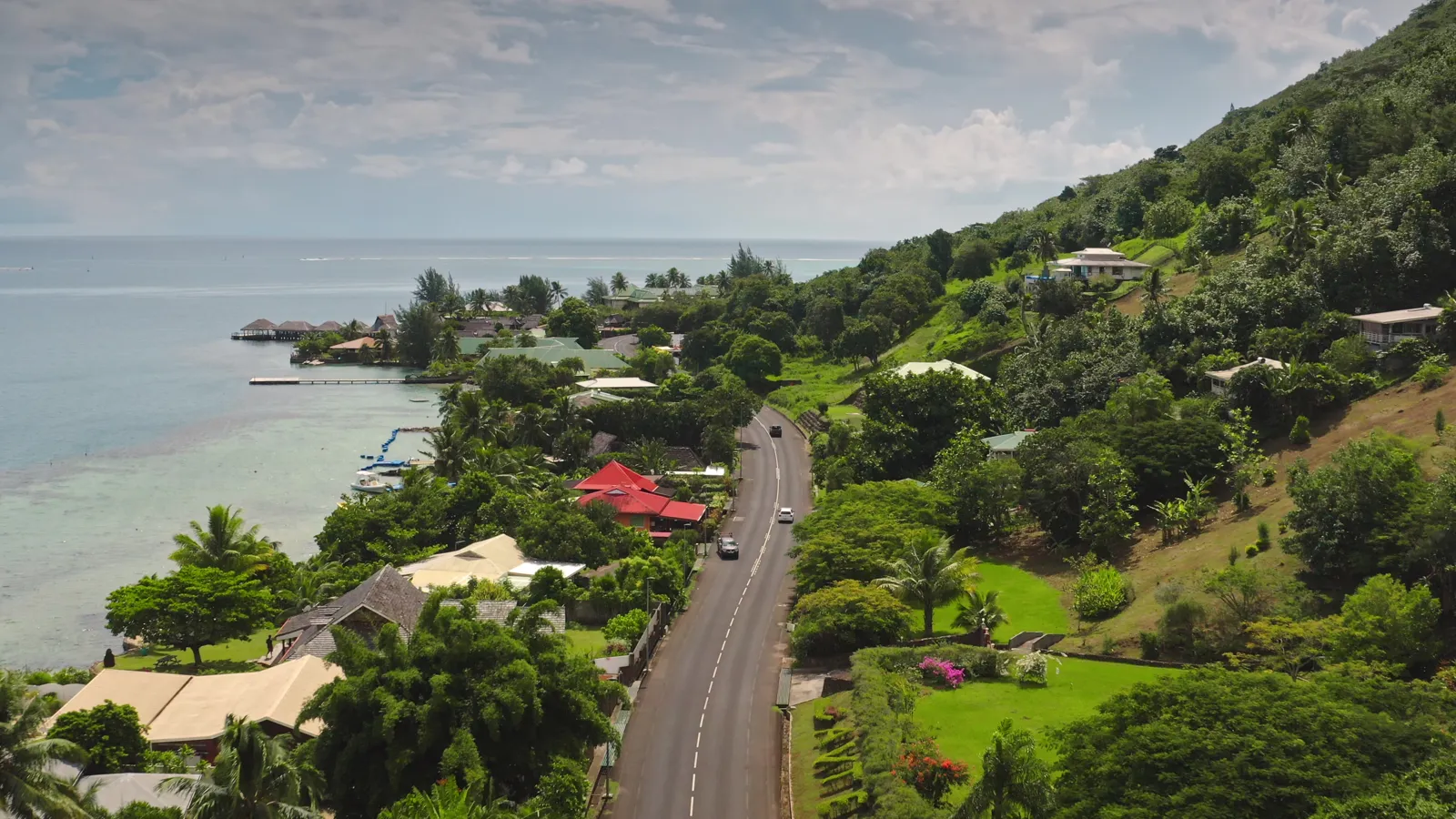
The coast road loops all the way around Moorea: you can do it in a relaxed day, stopping at viewpoints, beaches, village churches and roulottes (food trucks). The main villages are Maharepa, Paopao, Papetoai, Haapiti, Afareaitu and Vaiare, where the boats arrive. A car, scooter or e-bike all work; distances are short, but the interior is hilly.
The agricultural school and the pineapple route
The island’s interior is covered with pineapple plantations, Moorea’s emblem. The Opunohu agricultural high school, on the road to the Belvedere, sells jams, juices and produce from its orchards, and its trails cross the fields. A fruit juice factory, built in the valley in the 1970s, processes part of the harvest: ask about tours and tastings.
Hiking in the interior
Several trails start in Opunohu Valley: the marae loop, the Three Coconut Trees Pass and more demanding climbs to the ridges. The ascents are short but steep, slippery after rain and very exposed to the sun on the ridges. Start early, carry plenty of water and hire a local guide for the summits.
Diving and whales
The passes and the outer reef are known for diving (sharks, rays, turtles). From about July to late October, humpback whales visit the waters of the Society Islands: whale-watching trips leave from Moorea and must follow strict approach-distance rules. Before diving, the UK FCDO advises checking the operator’s credentials, the safety equipment and that oxygen is on board; the only hyperbaric chamber in French Polynesia is in Papeete (GOV.UK, updated 10 December 2025).
Polynesian culture
Beyond the marae, Moorea offers dance evenings and cultural workshops, notably at Tiki Village in Haapiti, and craft displays (weaving, pareos, carving). The churches of Papetoai and Paopao reflect the island’s missionary history: English missionaries settled here from 1817.
Itinerary: how many days in Moorea?
Moorea in 1 day from Tahiti
- First boat from Papeete to Vaiare, car rental at the ferry terminal
- Morning: the Belvedere and Opunohu Valley, marae, the agricultural school
- Lunch: a roulotte or snack bar on Cook’s Bay
- Afternoon: Ta’ahiamanu or Temae beach
- Late afternoon: back to Vaiare for the last boat (check the time)
Moorea in 3 days
- Day 1: island loop by car, the Belvedere, beaches
- Day 2: full-day lagoon excursion (rays, sharks, motu, lunch)
- Day 3: a morning hike in Opunohu Valley, snorkelling at Les Tipaniers in the afternoon
4 to 5 days: add a dive or a whale-watching trip (July–October), a day of kayaking or paddleboarding, a cultural evening and some rest. Moorea pairs naturally with Tahiti (arrival and departure) and a Leeward Island such as Bora Bora: 10 days to two weeks in total lets you see all three.
When to go to Moorea
The best time to visit Moorea is May to October, during the cooler, drier season: 28 to 30 °C (82 to 86 °F) in the afternoon, steady trade winds and fewer showers. July, August and September are the driest months. From November to April, the hot season is wetter (nearly 290 mm (11.4 in) of rain in January and more than 320 mm (12.6 in) in December at the Temae station), and cyclones are possible, especially in February.
When to go to Moorea: key points
- Best time: May to October
- Driest months: July and August, about 56 to 59 mm (2.2 to 2.3 in) of rain and 5 to 6 rainy days
- Wettest months: December and January, about 290 to 320 mm (11.4 to 12.6 in)
- Humpback whales: from about July to late October
- Cyclones: possible from November to April, highest risk in February according to Météo-France
- Sea: warm enough to swim all year
| Month | High °C (°F) | Low °C (°F) | Rain on Moorea mm (in) | Rainy days | Crowds | Prices | Verdict |
|---|---|---|---|---|---|---|---|
| January | 31.0 (88) | 24.4 (76) | 287 (11.3) | 14 | Moderate | Medium | ⚠️ Very hot, frequent showers, cyclone risk |
| February | 31.1 (88) | 24.5 (76) | 214 (8.4) | 12 | Low | Low | ⚠️ Wet, peak cyclone risk |
| March | 31.5 (89) | 24.7 (76) | 178 (7.0) | 10 | Low | Low | ⚠️ Still humid, end of the hot season |
| April | 31.3 (88) | 24.5 (76) | 103 (4.1) | 9 | Moderate (Easter) | Medium | ✅ Transition, prices still moderate |
| May | 30.4 (87) | 23.6 (74) | 123 (4.8) | 9 | Moderate | Medium | ✅ Start of the dry season |
| June | 29.6 (85) | 22.6 (73) | 88 (3.5) | 7 | Moderate | Medium to high | ✅ Dry and pleasant, a good compromise |
| July | 29.2 (85) | 22.1 (72) | 56 (2.2) | 5 | Very high | High | ✅ Driest, whales, Heiva in Tahiti |
| August | 29.0 (84) | 21.9 (71) | 59 (2.3) | 6 | Very high | High | ✅ Very dry, whales, busy holidays |
| September | 29.3 (85) | 22.3 (72) | 66 (2.6) | 6 | High | High | ✅ Dry, whales, fewer crowds |
| October | 29.7 (85) | 23.0 (73) | 108 (4.3) | 8 | Moderate | Medium | ✅ Usually still dry, whales |
| November | 30.4 (87) | 23.9 (75) | 137 (5.4) | 10 | Moderate | Medium | ⚠️ Rains return |
| December | 30.6 (87) | 24.3 (76) | 322 (12.7) | 15 | High (holidays) | High | ❌ The wettest month |
Why two sources? The official normals for the Moorea station were not available online at the time of our update, and its temperatures were only measured for a few years. We therefore show the official temperatures for Faa’a, across the channel, which are very close to Moorea’s climate, and we recalculated Moorea’s rainfall from the monthly records published by Météo-France. The same calculation applied to Faa’a gives exactly that station’s official normals.
Moorea, Tahiti or Bora Bora: which gets the most rain?
Here is our exclusive data: monthly rainfall and the number of rainy days you can expect during a 7-day stay on the three most visited islands. Destination de Voyage calculation from Météo-France 1991–2020 monthly data: rainy days (at least 1 mm) in the month × 7 / number of days in the month. This is an average: any given week can be drier or wetter.
| Month | Moorea (Temae) | Tahiti (Faa’a) | Bora Bora (airport) |
|---|---|---|---|
| January | 287 mm · 3.1 d | 268 mm · 2.9 d | 245 mm · 3.9 d |
| February | 214 mm · 3.0 d | 245 mm · 3.0 d | 212 mm · 3.8 d |
| March | 178 mm · 2.3 d | 167 mm · 2.2 d | 168 mm · 3.3 d |
| April | 103 mm · 2.0 d | 99 mm · 1.9 d | 144 mm · 2.8 d |
| May | 123 mm · 1.9 d | 104 mm · 1.7 d | 112 mm · 2.6 d |
| June | 88 mm · 1.6 d | 75 mm · 1.2 d | 86 mm · 2.3 d |
| July | 56 mm · 1.2 d | 44 mm · 1.0 d | 62 mm · 2.1 d |
| August | 59 mm · 1.3 d | 41 mm · 1.1 d | 64 mm · 2.0 d |
| September | 66 mm · 1.5 d | 50 mm · 1.1 d | 65 mm · 2.2 d |
| October | 108 mm · 1.8 d | 103 mm · 1.6 d | 109 mm · 2.4 d |
| November | 137 mm · 2.2 d | 105 mm · 1.9 d | 139 mm · 2.9 d |
| December | 322 mm · 3.4 d | 279 mm · 3.2 d | 251 mm · 3.8 d |
- Moorea gets slightly more rain than Tahiti’s west coast: about 1,740 mm (68.5 in) a year against 1,580 mm (62.2 in) at Faa’a, mostly in December–January.
- Bora Bora has similar totals but more frequent showers: about 2 rainy days a week even in July–August, against just over one on Moorea. These are often brief showers.
- In July–August, Moorea and Tahiti are the driest: just over one rainy day expected per week.
- In December–January, expect 3 to 4 days with showers per week on all three islands: plan fallback activities (culture, food, spa).
The shoulder months, April–May and October–November, remain good options to pay less. To compare with the other archipelagos, see our page on when to go to French Polynesia.
Dry season and wet season in Moorea
- Cool season (May to October): 28 to 30 °C (82 to 86 °F) by day, 22 °C (72 °F) at night, clearer skies, dry trails. It is also whale season and the most popular period, especially July–August.
- Hot season (November to April): 30 to 31 °C (86 to 88 °F), heavier air, heavy but often short showers, lush vegetation. Lower prices outside the year-end holidays. This is the only period with a risk of tropical depressions.

Moorea by trip type
| Trip type | Best time | Where? |
|---|---|---|
| Lagoon, snorkelling | May to October (clearer water in dry weather) | Northwest coast (Haapiti, Les Tipaniers), boat trips |
| Hiking | June to September | Opunohu Valley, the Belvedere, ridges with a guide |
| Humpback whales | July to late October | Supervised trips from the north coast |
| Honeymoon | May–June, September–October | Overwater hotels on the north and northwest coasts |
| Families | July–August, April | Temae and Ta’ahiamanu beaches |
| Low budget | April–May, November | Family guesthouses, roulottes |
Budget for visiting Moorea
| Item (per person per day) | Budget | Comfort |
|---|---|---|
| Accommodation (shared double room) | about US$55 to 100 (family guesthouse, campsite) | about US$225 to 505 (hotel, overwater bungalow) |
| Meals | about US$35 to 50 (roulottes, snack bars, supermarket) | about US$80 to 125 |
| Transport (ferry, shared car rental) | about US$15 to 30 | about US$35 to 55 |
| Activities | about US$15 to 35 | about US$55 to 135 (lagoon, diving, whales) |
| Total | roughly US$125 to 190 per person per day | roughly US$335 to 615 per person per day |
Getting to Moorea and getting around
- Getting there: international flights land at Tahiti-Faa’a airport, usually after at least one connection.
- By boat from Papeete: several companies (including Aremiti and Terevau) link the port of Papeete to the Vaiare quay with daily crossings. Check timetables with the operators and book on busy days (weekends, holidays).
- By air: Air Tahiti serves the Temae airfield, generally on routes to other islands; for a simple round trip from Tahiti, the boat is more practical.
- On the island: car or scooter rental (at the ferry terminal or your hotel), e-bikes, few taxis. There is no practical bus network for sightseeing: plan your own transport. The U.S. Department of State advises extra care when riding bicycles or mopeds, and notes that using a mobile phone while driving is illegal.
Where to stay in Moorea
| Area | Best for | Good to know |
|---|---|---|
| North coast (Maharepa, Cook’s Bay) | Close to shops, the Belvedere and lagoon trips | Few beaches, a range of guesthouses and hotels |
| Opunohu Bay and Papetoai | Hikers, those who like quiet | Ta’ahiamanu public beach nearby |
| Haapiti and the northwest | Snorkelling, sunsets, overwater hotels | The most popular lagoon, far from Vaiare |
| East coast (Temae, Afareaitu, Vaiare) | Short stays, close to the ferry | Temae beach, views of Tahiti |
Moorea has international hotels with overwater bungalows, small hotels, family guesthouses and a few campsites. Guesthouses are the best option on a tight budget, often with a kitchen. Book early for July–August and the year-end holidays.
Entry requirements, health and safety
- US citizens: according to the U.S. Department of State (travel.state.gov, last updated October 22, 2026), no visa is needed on a regular tourist passport for stays of no more than 90 days in any six months. Tourists must hold a return ticket, and the 12-page U.S. emergency passport is not valid for visa-free entry.
- UK citizens: according to the UK FCDO (GOV.UK, updated 10 December 2025), you can visit without a visa for up to 90 days for tourism or business. Your passport must have an expiry date at least 3 months after the date you plan to leave French Polynesia.
- Connections: if you connect in another country, check its transit rules (for example, an ESTA for a stopover in the United States) with your airline.
- Health: dengue and chikungunya are among the health risks (GOV.UK): use repellent and cover up in the evening. The sun is very strong all year. Medical care is limited outside the main islands, and most providers accept only cash (travel.state.gov).
- Swimming: currents in the passes, sharp coral and stonefish: wear water shoes and follow the operators’ instructions.
- Cyclones and safety: tropical storms including cyclones can occur from November to April; follow local news and official alerts. Avoid isolated areas, including beaches, after dark (GOV.UK).
- Emergencies: ambulance 15, police 17, fire 18 (GOV.UK).
Medical and evacuation costs from French Polynesia can be very high: check your travel insurance before you leave.
Practical tips for Moorea
- Money: cards are accepted in hotels and most shops; carry cash for roulottes and small stalls. Work out your budget with our currency converter.
- Time difference: all the details on our page about time in French Polynesia and our tips against jet lag.
- Shopping: supermarkets are concentrated around Maharepa and Vaiare; stock up before heading to the west coast.
- Etiquette: marae are sacred sites, so do not climb on the stones. Ask before crossing private land to reach a beach.
- Mobile data: coverage is decent around the island, weaker in the valleys; Wi-Fi in accommodation varies.
Frequently asked questions
What can you do in Moorea in one day?
Take the first boat from Papeete, rent a car in Vaiare, drive up to the Belvedere through Opunohu Valley, have lunch on Cook’s Bay, then swim at Temae or Ta’ahiamanu before the last boat.
How do you get from Tahiti to Moorea?
By boat, from the port of Papeete to the Vaiare quay, with several crossings a day; check timetables with the operators. Air Tahiti also serves the Temae airfield, mainly on routes to other islands.
How many days do you need in Moorea?
One day is enough for the Belvedere and the island loop, but 3 to 4 nights let you add a lagoon trip, a hike and some rest. Many travellers combine Moorea with Tahiti and a Leeward Island over 10 to 15 days.
What is the best time to visit Moorea?
May to October, during the cooler, drier season. By our calculations from Météo-France data, July and August average only 56 to 59 mm (2.2 to 2.3 in) of rain on Moorea, against more than 320 mm (12.6 in) in December.
Moorea or Bora Bora: which should you choose?
Moorea is closer to Tahiti, more mountainous and cheaper, ideal for hiking and a first trip. Bora Bora is known for its lagoon and overwater hotels, with slightly more frequent showers by our calculations. If your budget allows, do both.
Can you see whales in Moorea?
Yes, from about July to late October humpback whales visit the waters of the Society Islands. Supervised whale-watching trips leave from Moorea, and approach distances are regulated.
Our sources
- Météo-France, monthly climate data for French Polynesia (MENSQ_987 file published on data.gouv.fr): Moorea-aéro (Temae), Faa’a and Bora Bora-Motu-aéro stations; 1991–2020 rainfall and rainy-day averages calculated by Destination de Voyage
- Météo-France: 1991–2020 normals, Faa’a station (Tahiti airport, about 17 km (11 mi) from Moorea)
- Entry, health and safety information read on 26 October 2026: U.S. Department of State, French Polynesia country information (travel.state.gov, last updated October 22, 2026), and UK FCDO, foreign travel advice for French Polynesia (GOV.UK, updated 10 December 2025)
- Wikipedia (French): « Moorea » article (geography, history, sea and air links), consulted on 14 October 2026
- Tahiti Tourisme: « Moorea, Tahiti’s sister island » page, consulted on 14 October 2026
- European Central Bank reference rates of 23 October 2026 (budget conversion)
- Our methodology
Updated October 2026.
To plan the rest of your trip, see our guides to Tahiti, Bora Bora and French Polynesia, and our destinations in Oceania.
