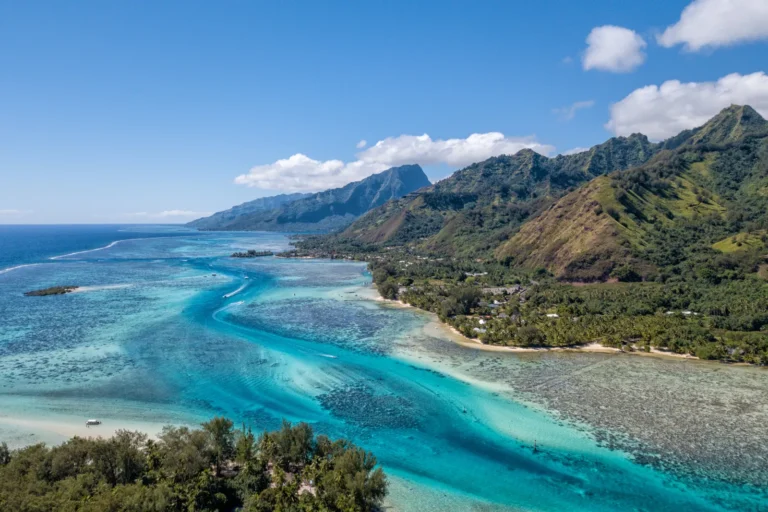
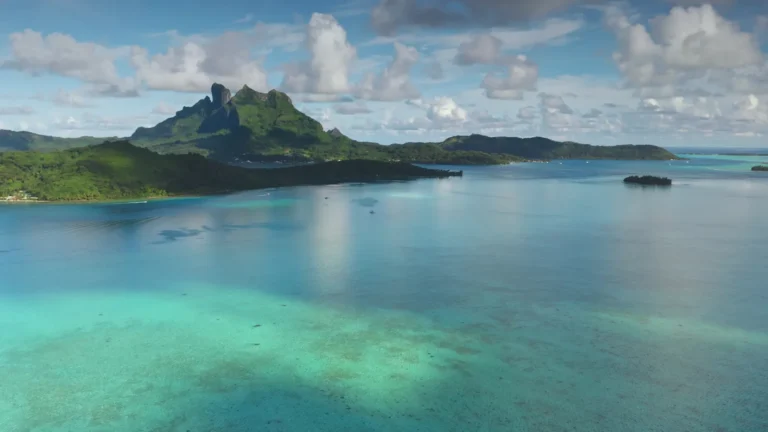
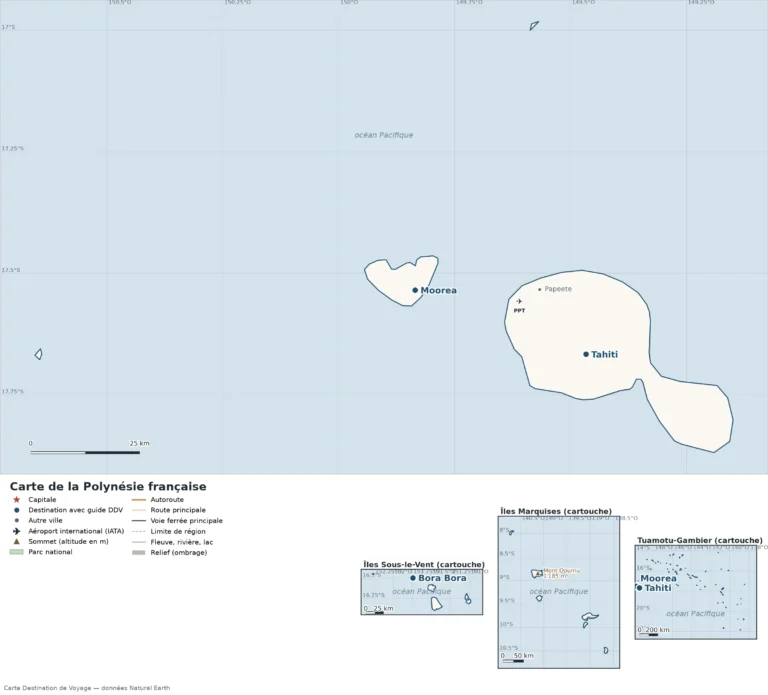
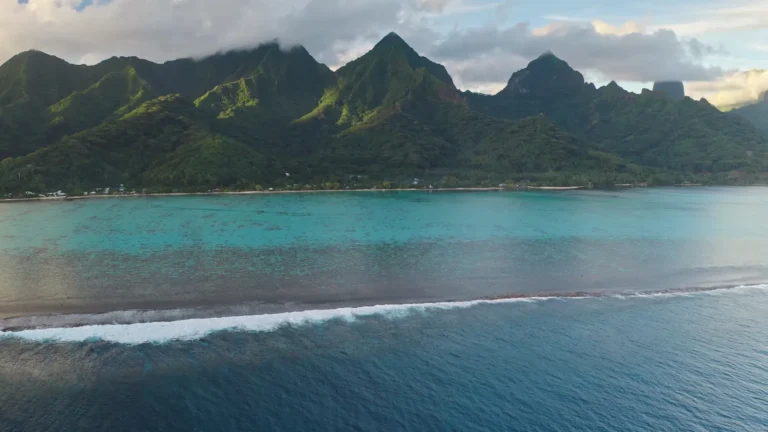
This Tahiti travel guide starts from one idea: the island is more than a stopover on the way to Bora Bora. The largest island in French Polynesia (about 1,045 km², 403 sq mi) joins two extinct volcanoes: Tahiti Nui, dominated by Mount Orohena (2,241 m, 7,352 ft), and the Tahiti Iti peninsula. Deep valleys, black-sand beaches, Papeete and its market, Teahupo’o: this guide helps you choose what to see, where to stay and how many days to plan. If another island tempts you after Tahiti, see when to go to Bora Bora, season by season.

Our travel deals for Tahiti
Affiliate links: we earn a commission, at no extra cost to you.
 FlightsKiwi.comCompare flights and airline combinations to Tahiti.Compare flights
- eSIMSailyAnother eSIM plan to compare: data, validity, network.See Saily plans


Tahiti at a glance
- Main town Papeete, capital of French Polynesia
- Languages French (official language) and Tahitian
- Currency CFP franc (XPF) · currencies
- Time zone UTC−10 · details10 to 11 hours behind London, 5 to 6 hours behind New YorkLocal time now: –:–
- Airports Tahiti-Faa’a International AirportMost routes from Europe and North America involve at least one connection
- Entry US and UK: no visa for up to 90 days · travel.state.gov · GOV.UK
- Electricity check voltage and plug type with your accommodation · plugs
- Budget see our budget section
When to go to Tahiti
✅ Best months: April, may, June, July, August, September, October
❌ Period to avoid: February
The best time is May to October: the cooler, drier season with no cyclone risk. According to Météo-France normals at Faa’a, July, August and September get only 41 to 50 mm (1.6 to 2.0 in) of rain a month, against nearly 280 mm (11.0 in) in December. It is hot all year, 29 to 31 °C (84 to 88 °F) in the afternoon. From November to April, the hot season is wetter, with the highest cyclone risk in February. Full details: when to go to Tahiti.
Things to do in Tahiti: the highlights
Papeete, its market and roulottes
Papeete’s municipal market (Mapuru a Paraita) is the best starting point: fruit, fish, monoi oil, flower crowns and crafts, especially lively early on Sunday mornings. The waterfront has been redeveloped with Paofai Park and To’ata Square, where the Heiva festival takes place in July. In the evening, the roulottes, food trucks parked near the harbour, serve raw fish in coconut milk, grilled dishes and Chinese food at moderate prices.
Museum of Tahiti and the Islands
In Punaauia, on the west coast, this museum covers the natural history, archaeology and culture of the five archipelagos: canoes, religious objects, ornaments, tapa. It is a good introduction before visiting the marae and the other islands. Check opening hours before you go.
Point Venus and the east coast
In Mahina, Point Venus owes its name to the observation of the transit of Venus by James Cook’s expedition in 1769. Its black-sand beach and lighthouse make it a pleasant stop. Further along the east coast, the Arahoho blowhole shoots seawater through volcanic rock, and the Faarumai waterfalls are reached by a short trail. This coast is wetter, but the vegetation is at its most spectacular here.
Papenoo Valley
Tahiti’s largest valley cuts into the heart of the old volcano. A track climbs it toward Lake Vaihiria and the archaeological sites of the interior, among waterfalls. It is done by 4×4 with a guide, preferably in the dry season: after heavy rain, the fords become dangerous and the track may be closed.
The west coast: beaches, caves and marae
The west coast has most of the white-sand beaches sheltered by the reef, especially around Punaauia, with views of Moorea at sunset. In Paea, the restored Arahurahu marae shows what these places of worship and power looked like. The fern-covered Maraa caves take just a few minutes to visit from the road. Further south, Taharu’u beach in Papara is a black-sand beach popular with surfers; swim with caution.
Vaipahi water garden
In Mataiea, on the south coast, this public garden has pools, waterfalls and tropical plants, with short trails into the forest. It is an easy stop on the way to the peninsula, ideal for a break in the shade.
Tahiti Iti and Teahupo’o
Joined to Tahiti Nui by the Taravao isthmus, the peninsula is more rural and wilder. The road ends at Teahupo’o, a village famous for its wave, one of the most powerful in the world, which hosted the surfing events of the Paris 2024 Olympic Games. Boats take spectators close to the wave when the swell is running. Beyond, the Fenua Aihere, a coast without roads, is explored by boat or on foot with a guide: cliffs, waterfalls and caves dropping into the lagoon. On the Taravao plateau, the air is cooler and the viewpoints overlook both parts of the island.
Hiking
Tahiti is an island for walkers. Trails in the Fautaua Valley, on Mount Aorai or to the waterfalls of the interior cross landscapes very different from the lagoon. Several routes are demanding, slippery, prone to flash floods or require a permit: ask locally, start early and hire a guide for long outings.
Moorea as a side trip
A short ferry ride from Papeete, Moorea can be visited in a day or, better, over two or three nights: Cook’s and Opunohu bays, the Belvedere, the lagoon. It is the ideal complement to a stay on Tahiti. For the other islands, see our French Polynesia travel guide.
Itinerary suggestions
3 to 4 days on Tahiti
- Day 1: arrival and rest, sunset on the west coast
- Day 2: Papeete (market, waterfront), the Museum of Tahiti and the Islands, roulottes in the evening
- Day 3: island loop: Point Venus, the blowhole, Faarumai waterfalls, Vaipahi garden, Arahurahu marae, Maraa caves
- Day 4: the Tahiti Iti peninsula and Teahupo’o, or Papenoo Valley by 4×4
10 days: Tahiti, Moorea and a Leeward Island
- Days 1 to 3: Tahiti (Papeete, island loop, peninsula)
- Days 4 to 6: Moorea by ferry: the Belvedere, the lagoon, hiking
- Days 7 to 9: fly to Bora Bora, Huahine or Raiatea
- Day 10: back to Tahiti for the international flight
The time difference and the length of the journey justify at least 10 days on the ground. Keep a night on Tahiti before your flight home in case inter-island flights are delayed.
Budget for a trip to Tahiti
Tahiti is expensive: many goods are imported and the choice of accommodation is limited. Indicative amounts per person per day, excluding flights, in US dollars (European Central Bank rate of 23 October 2026):
| Item | Budget | Comfort |
|---|---|---|
| Accommodation (shared double room) | about US$55 to 100 (family guesthouse) | about US$170 to 335 (hotel) |
| Meals | about US$40 to 60 (roulottes, snack bars, convenience stores) | about US$90 to 145 |
| Transport (shared car rental, bus, ferry) | about US$15 to 35 | about US$35 to 65 |
| Activities | about US$10 to 35 (beaches, market, hiking) | about US$55 to 135 (4×4, diving, whales) |
| Total per day | roughly US$135 to 200 per person per day | roughly US$335 to 560 per person per day |
To cut costs: family guesthouses with a kitchen or half board, meals at the roulottes, a rental car shared between several people, and travel outside peak holiday periods. On a two-week tour, the international flight, inter-island flights and accommodation weigh far more than everything else.
Tahiti: who is it for?
Our verdict by travel style, based on the information in this guide:
- Nature and hiking: ideal: Papenoo Valley by 4×4, the Fautaua or Mount Aorai trails (often with a guide), the Fenua Aihere on the peninsula.
- Surfing: yes: Teahupo’o to watch the wave from a boat, Taharu’u black-sand beach for surfers.
- Families: yes: Vaipahi water garden, the Museum of Tahiti and the Islands, reef-sheltered west-coast beaches; the long-haul journey remains tiring.
- Couples: yes, especially combining Tahiti with Moorea or Bora Bora.
- Low budget: rather expensive: roughly US$135 to 200 per person per day in a family guesthouse, eating at the roulottes.
- Beach: partly: the west coast has white-sand beaches, but many beaches are black sand and Papeete has few.
Getting around Tahiti
- Car: the most practical option. A road loops around Tahiti Nui (about 115 km, 71 mi) and serves the peninsula. Avoid rush hours around Papeete, where traffic is heavy. According to the UK FCDO (GOV.UK, updated 10 December 2025), UK drivers need both the 1968 international driving permit (IDP) and their UK licence, and rental companies may have stricter requirements. The U.S. Department of State advises caution when driving at night, as many side streets are unlit.
- Bus: buses serve the coast from Papeete, less frequently in the evening and at weekends. Useful for simple trips, impractical for an island loop.
- Taxi: available at the airport and in Papeete, but expensive.
- Ferry: several crossings a day between Papeete and Moorea.
- Air: Air Tahiti links Tahiti to the other islands from Faa’a airport.
- 4×4 and boat: for Papenoo Valley and the Fenua Aihere, go with a local operator.
Where to stay in Tahiti
| Area | Best for | Good to know |
|---|---|---|
| Faa’a | Late arrivals, early departures | Right next to the airport |
| Punaauia and Paea (west coast) | Beach, sunsets, hotels | The driest coast |
| Papeete | Budget travellers, city life, ferry to Moorea | Few beaches |
| East coast (Mahina, Papenoo) | Nature, surfing, guesthouses | Wetter |
| Peninsula (Taravao, Teahupo’o) | Quiet, surfing, hiking | Far from the airport, car essential |
Family guesthouses run by Polynesians are the best option for a controlled budget and local advice. The large hotels are concentrated on the west coast. For July–August, book several months ahead.
Entry requirements, health and safety
- US citizens: according to the U.S. Department of State (travel.state.gov, last updated October 22, 2026), no visa is needed on a regular tourist passport for stays of no more than 90 days in any six months. Tourists must hold a return ticket, and the 12-page U.S. emergency passport is not valid for visa-free entry.
- UK citizens: according to the UK FCDO (GOV.UK, updated 10 December 2025), you can visit without a visa for up to 90 days for tourism or business. Your passport must have an expiry date at least 3 months after the date you plan to leave French Polynesia. The EHIC and GHIC do not provide cover in French Polynesia.
- Connections: if you connect in another country, check its transit rules (for example, an ESTA for a stopover in the United States) with your airline.
- Health: dengue and chikungunya are among the health risks (GOV.UK): protect yourself from mosquitoes and the sun. General healthcare is good for uncomplicated treatment, but serious cases may need evacuation (GOV.UK); most providers accept only cash (travel.state.gov). Medical emergencies: 15.
- Sea and reefs: swell and currents can be strong, especially on black-sand beaches and on the peninsula. Wear reef shoes and clean any coral cut.
- Rivers: after heavy rain, rivers rise fast: never cross a flooded stream.
- Safety: crime is low, but pickpocketing and bag snatching occur; protests and strikes happen periodically and can sometimes turn violent (travel.state.gov). Leave nothing visible in your car, and avoid isolated areas, including beaches, after dark (GOV.UK). Police: 17.
To choose cover suited to a long-haul trip, see our travel insurance guide.
Practical tips for Tahiti
- Money: cards are accepted in most hotels, restaurants and supermarkets; keep cash for the roulottes, the market and small guesthouses.
- Mobile data: check whether your plan covers French Polynesia, or get a local SIM or eSIM.
- Etiquette: « ia ora na » (hello) and « mauruuru » (thank you) are always appreciated. Marae are sacred sites: be respectful.
- Whales: approaching marine mammals is regulated; choose an authorised operator.
- Jet lag: plan a quiet first day to recover.
Read also
To choose your dates, see when to go to Tahiti and, for the other archipelagos, when to go to French Polynesia. Time differences are explained on our page about time in French Polynesia, and the next stage of your trip in our Bora Bora guide.
Frequently asked questions
How many days should you spend in Tahiti?
Allow 3 to 4 days for Papeete, the island loop and the peninsula. Given the long journey, most travellers combine Tahiti with Moorea and a Leeward Island over 10 days to 2 weeks.
How much does two weeks in Tahiti cost?
Excluding flights, plan on roughly US$135 to 200 per person per day on a budget and US$335 to 560 in comfort, or about US$1,900 to 2,800 or US$4,700 to 7,800 for 14 days. Add the international flight and, if needed, inter-island flights.
Are there beaches in Tahiti?
Yes, but Tahiti is not the island of big lagoons. The west coast has white-sand beaches, notably in Punaauia; the east coast and the peninsula have mostly black-sand beaches, more exposed to the swell.
Do you need to rent a car in Tahiti?
It is recommended for the island loop and the peninsula. Buses serve the coast, but less often in the evening and at weekends.
Do US and UK citizens need a visa for Tahiti?
No, not for tourist stays of up to 90 days, according to travel.state.gov and GOV.UK. You need a passport (UK: valid at least 3 months beyond your departure) and US travellers must hold a return ticket. Also check the transit rules of any connecting country.
Our sources
- Climate data: 1991–2020 normals for the Faa’a (Tahiti airport) station, Météo-France
- Entry, health and safety information read on 26 October 2026: U.S. Department of State, French Polynesia country information (travel.state.gov, last updated October 22, 2026), and UK FCDO, foreign travel advice for French Polynesia (GOV.UK, updated 10 December 2025)
- European Central Bank reference rates of 23 October 2026 (budget conversion)
- Our methodology
Updated October 2026.
To continue your trip, see our French Polynesia travel guide, our page on when to go to French Polynesia, our New Caledonia guide and our other destinations in Oceania.