⚠️ Security situation: check before you book. Significant unrest took place in New Caledonia in 2024, including protests and blockades, some of which turned violent. According to the UK FCDO (GOV.UK, updated 10 December 2025), tensions have now decreased, but protests, demonstrations or political gatherings can take place with little or no warning; limits remain on buying, transporting and using weapons, alcohol and fuel, and further restrictions and curfews may be imposed at short notice. The U.S. Department of State (travel.state.gov, last updated October 22, 2026) notes that roads into and out of Noumea may be closed during periods of civil unrest. Follow announcements from the French High Commission in New Caledonia and local media before and during your stay, avoid gatherings, check road conditions before each journey on Grande Terre and confirm that your accommodation and tour operators are open.
To locate cities, regions, terrain, national parks and airports, see our map of New Caledonia.
In the southwest Pacific, New Caledonia combines one of the largest lagoons in the world, a strong Kanak culture, forest-covered mountains and a capital with a Mediterranean feel, Noumea. French is the main language and the currency is the CFP franc. This New Caledonia travel guide covers the essentials: things to do, itineraries, budget and entry requirements. Further east in the Pacific, our guide to Fiji details the cyclone season month by month.
New Caledonia at a glance
CapitalNoumea
LanguageFrench; many Kanak languages are also spoken
The best period runs from September to November: it is the driest season, warm without being excessive, before the start of the cyclone season. From May to August, the cool season is ideal for hiking and whale watching. From December to April, heat and humidity rise, with storms and a risk of cyclones. All the details, with Météo-France climate normals, are in our article best time to visit New Caledonia.
Things to do in New Caledonia: the highlights
Noumea
The capital is home to half the archipelago’s population. The beaches of Anse Vata and Baie des Citrons, the Lagoon Aquarium and the Tjibaou Cultural Centre, devoted to Kanak culture and designed by the architect Renzo Piano, are the main visits. Shuttle boats run to nearby islets (Ilot Canard, Ilot Maitre, Amedee Lighthouse) for a day of snorkeling. Check the situation in each neighborhood before going out, especially in the evening.
The Isle of Pines
Around 30 minutes by plane or a few hours by boat from Noumea, the Isle of Pines is known for its columnar pines, the bays of Kuto and Kanumera and the natural pool of Oro Bay. Accommodation is limited: book early.
The Loyalty Islands: Lifou, Mare, Ouvea
East of Grande Terre, these coral islands live to the rhythm of the tribes. Lifou, the largest, has cliffs, caves and the Jokin site; Mare, wilder, has water holes and isolated beaches; Ouvea has a white-sand beach of about 25 km (16 mi) along a lagoon. Customary rules apply: ask your accommodation before visiting a site.
The Deep South (Grand Sud)
An hour’s drive from Noumea, the red earth, lakes and forest of Riviere Bleue Provincial Park offer hiking and cycling. Prony Bay is the starting point for whale-watching trips in season.
The west coast: Bourail and La Roche Percee
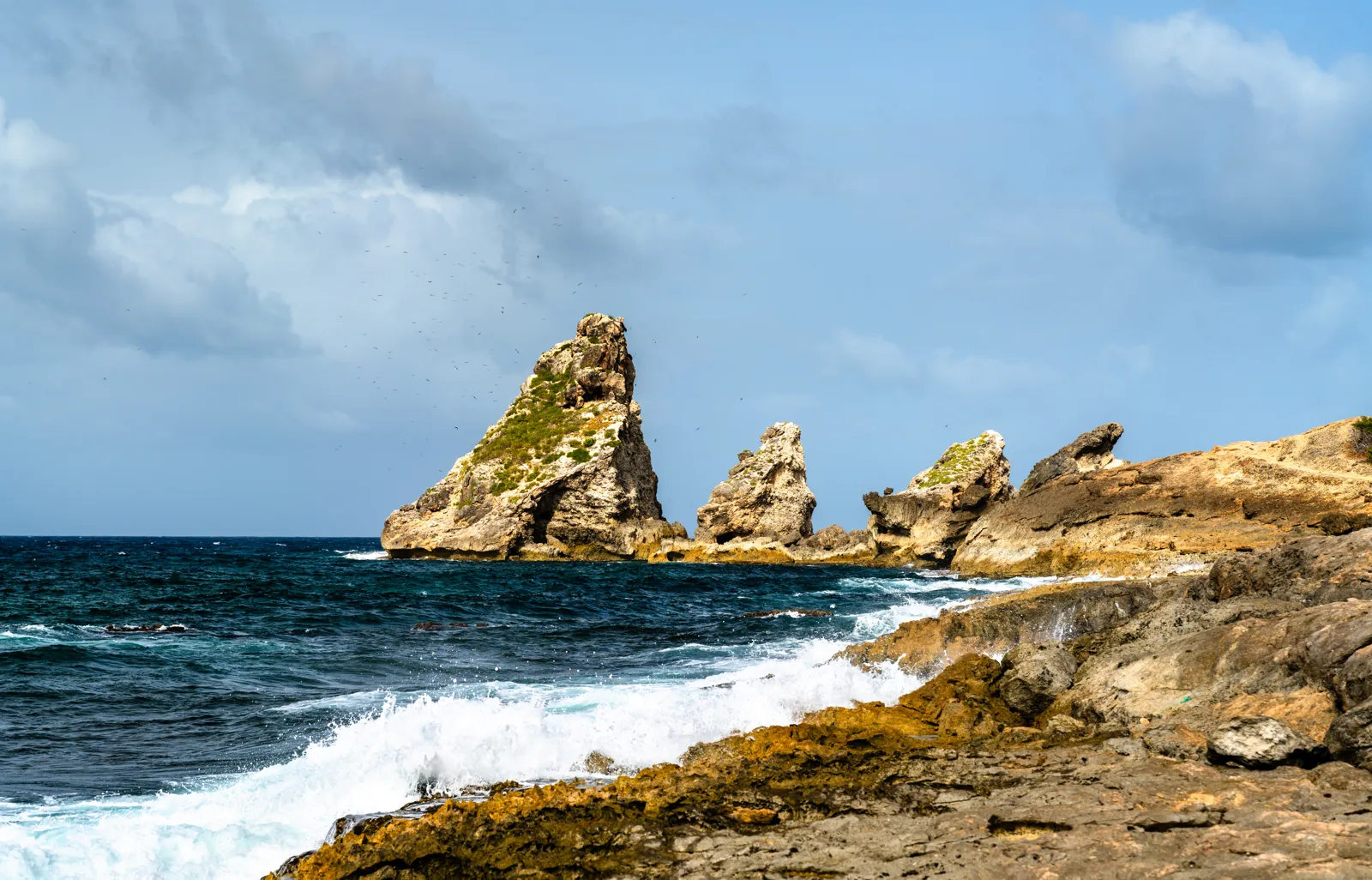
Cattle country, home of the « broussards » (bush ranchers), the west coast is drier. Near Bourail, La Roche Percee beach, Turtle Bay and the « Bonhomme » rock are classic stops, and Poe beach suits swimming and kitesurfing. Further north, the Heart of Voh, a heart-shaped mangrove, is seen from the air.
The east coast: Hienghene
On the other side of the central mountain range, the east coast is greener and more mountainous, with waterfalls and valleys. At Hienghene, the black rocks of Linderalique and the « Brooding Hen » rock dominate the bay. The road across the range is winding: allow a long day to get there from Noumea.
The lagoon
The lagoons of New Caledonia have been on the UNESCO World Heritage List since 2008. Diving and snorkeling are possible all year round: turtles, rays, reef fish and corals. According to the UK FCDO (GOV.UK, updated 10 December 2025), dive schools do not always observe safety standards: check the operator’s credentials, that oxygen is on board and how divers would be transferred to a hyperbaric chamber. Respect protected areas.
Itinerary ideas for New Caledonia
7 to 10 days: Noumea and the islands
Days 1 to 3: Noumea, Tjibaou Cultural Centre, a day on an islet
Days 4 to 6: Isle of Pines (Oro Bay, Kuto, Kanumera)
Days 7 and 8: Lifou or Ouvea
Days 9 and 10: back to Noumea, a day in the Deep South
2 weeks: Grande Terre and the islands
Days 1 to 3: Noumea and its islets
Day 4: the Deep South (Riviere Bleue)
Days 5 and 6: drive to Bourail and La Roche Percee
Days 7 and 8: across the range to Hienghene and the east coast (depending on road conditions)
New Caledonia is an expensive destination: much of what is sold is imported. Indicative amounts per person per day, excluding international flights (converted from our euro estimates at roughly €1 = US$1.12, ECB rate of 23 October 2026):
Item
Budget
Comfort
Accommodation (based on a shared double room)
roughly US$45–80
roughly US$110–225
Meals
roughly US$28–45
roughly US$55–100
Transport (shared car rental, shuttles)
roughly US$17–28
roughly US$34–56
Activities
roughly US$11–22
roughly US$34–90
Total per day
roughly US$100–155
roughly US$225–390
Indicative estimates, excluding domestic flights and boat crossings to the islands, which weigh on the budget.
To cut costs: shop in Noumea’s supermarkets, choose gîtes and tribal homestays on the islands, and book domestic flights and crossings early.
Getting around New Caledonia
Car: essential for exploring Grande Terre. UK drivers need the 1968 International Driving Permit plus their UK licence, and must get the IDP in the UK before travel; drink-driving is a serious offence (UK FCDO, GOV.UK, updated 10 December 2025). According to the U.S. Department of State (travel.state.gov, last updated October 22, 2026), roads are generally well maintained except in remote areas, animals and pedestrians make night driving on unlit secondary roads hazardous, and seat belts are compulsory. Check for possible roadblocks before setting off.
Plane: domestic flights link Noumea (Magenta airport) with the Isle of Pines, the Loyalty Islands and some towns on Grande Terre. The international airport is La Tontouta, about 50 km (31 mi) from Noumea.
Boat: ferries serve the Isle of Pines and the Loyalty Islands; they may be cancelled in bad weather. Shuttles run to the islets near Noumea.
Bus: a bus network serves Noumea and intercity lines link the main towns, with limited frequencies. Taxis and buses are available in Noumea and some larger towns; watch your belongings to avoid pickpocketing (U.S. Department of State).
Where to stay in New Caledonia
In Noumea, the Anse Vata and Baie des Citrons districts have most of the hotels, close to the beaches and restaurants. On Grande Terre, the choice is gîtes, campsites, guesthouses and a few hotels, notably in Bourail, Kone and Hienghene. On the islands, you will find a few hotels and many gîtes or tribal homestays, a simple way to meet local people. Further northeast, Vanuatu, a Melanesian archipelago, can be reached by air from Noumea.
Since 2024, some establishments have closed or scaled back: check that your accommodation is open and confirm your booking shortly before you leave.
Entry requirements, health and safety
Entry requirements for New Caledonia. New Caledonia is a French overseas territory, and its own authorities set and enforce entry rules (GOV.UK).
US citizens: according to the U.S. Department of State (travel.state.gov, last updated October 22, 2026), no visa is needed on a regular tourist passport for stays of no more than 90 days in any six months. Your passport must be valid for six months beyond your stay, your return ticket will be checked, and some travelers may be asked to show proof of medical insurance. Longer stays require a long-term visa from a French embassy or consulate.
UK citizens: according to the UK FCDO (GOV.UK foreign travel advice, updated 10 December 2025), you can visit without a visa for up to 90 days for tourism or business. Your passport must have an expiry date at least 3 months after the date you plan to leave and at least 2 blank pages. A yellow fever vaccination certificate is required if you are coming from a country listed as a transmission risk.
Connections: the journey usually involves a stopover in another country: check that country’s transit rules with your airline. Entry requirements checked on 24 October 2026; check them again before you travel.
Health: health risks include Zika, dengue and chikungunya (UK FCDO, GOV.UK, updated 10 December 2025; U.S. Department of State): use repellent and cover up. The U.S. Department of State advises being up to date on routine vaccines and considering typhoid and hepatitis A. General healthcare is good for uncomplicated treatment, but serious cases may need evacuation to Australia or France, and the EHIC and GHIC do not provide cover in New Caledonia (GOV.UK). Doctors and hospitals often expect immediate cash payment (travel.state.gov). Take out travel insurance covering medical costs and evacuation.
Safety: crime levels are low, but petty theft and street crime do happen; avoid isolated areas, including beaches, after dark (GOV.UK). Fights sometimes break out outside bars and nightclubs at closing time (travel.state.gov). Since the 2024 unrest, protests can take place with little warning, notably on some roads (RT1 south of Noumea past Saint-Louis, RT1 north of Kone, RPN2 east of Kone, RT3 east of Bourail, RP5 east of Fonwhary, RP4 east of Boulouparis), according to GOV.UK. Avoid gatherings and follow the authorities’ instructions.
Cyclones: the official cyclone season runs from November to April (U.S. Department of State); the UK FCDO notes the risk is highest from mid-December to mid-March.
Emergencies: ambulance 15, police 17, fire 18 (GOV.UK).
Practical tips for New Caledonia
Money: do not carry large amounts of cash and be careful when changing money or withdrawing it from ATMs (GOV.UK). Estimate your spending with our currency converter.
Internet: check roaming charges with your mobile provider before you leave, or buy a local SIM card or an eSIM.
Custom (la coutume): on Kanak land, access to some places (beaches, caves, sacred sites) requires « making the custom », that is asking permission from the clan concerned, often through your accommodation. Respect signs and do not enter a tribe’s village without being invited.
Shops: many shops close early and on Sunday afternoons, especially outside Noumea.
Customs: there are strict rules on goods you can bring in, and you must declare anything that may be prohibited or taxed (GOV.UK); check your home country’s allowances for the return (e.g. CBP in the US, HMRC in the UK).
Who is New Caledonia for?
Diving and snorkeling: yes: World Heritage lagoons, turtles, rays and reef fish all year round, islets reachable by shuttle from Noumea.
Beaches: yes: Isle of Pines (Oro Bay, Kuto, Kanumera), Ouvea’s beach of about 25 km (16 mi), Poe on the west coast.
Hiking and nature: yes, especially from May to August: Riviere Bleue park, the valleys and waterfalls of the east coast, whales in Prony Bay in season.
Culture: yes: Tjibaou Cultural Centre, tribal homestays on the islands, respecting the custom.
Budget travelers: no: an expensive destination, roughly US$100–155 per person per day on a budget, excluding domestic flights and crossings.
Short stays: not recommended: the journey is long, with at least one connection; plan at least two weeks on the ground.
Read more
To choose between the dry season and the cool season, see the best time to visit New Caledonia, with Météo-France climate normals. To plan your first days after a long journey, also check the time difference with New Caledonia (UTC+11): 11 hours ahead of London in winter and 16 hours ahead of New York in winter.
Frequently asked questions
Can you travel to New Caledonia right now?
Yes, the territory welcomes visitors, but the situation has remained sensitive since the 2024 unrest. According to the UK FCDO (GOV.UK, updated 10 December 2025), tensions have decreased but protests can take place with little or no warning, and restrictions or curfews may be imposed at short notice. Follow announcements from the French High Commission and local media, and take out insurance that covers cancellation.
Do I need a visa for New Caledonia?
Not for a short stay if you are a US or British citizen: US citizens can stay up to 90 days in any six months without a visa, with a passport valid six months beyond the stay (travel.state.gov), and British citizens up to 90 days, with a passport valid at least 3 months after departure (GOV.UK). Checked on 24 October 2026; check the latest rules before you leave.
Are there direct flights to Noumea?
International flights land at La Tontouta, about 50 km (31 mi) from Noumea. From North America or Europe, the journey involves at least one connection, usually via Asia or Australia: check current routes with the airlines and plan at least two weeks on the ground.
How much does a trip to New Caledonia cost?
Excluding international flights, allow roughly US$100–155 per person per day on a budget and US$225–390 in comfort. Domestic flights to the islands and car rental are major costs.
What is the best time to visit New Caledonia?
September to November, the driest period. The cool season (May to August) also works, especially for whales, generally from mid-July to mid-September. If possible, avoid February and March, at the heart of the hot and cyclone season.
How many days do you need in New Caledonia?
Given the length of the journey, plan at least two weeks on the ground: 7 to 10 days are enough for Noumea, the Isle of Pines and one Loyalty Island, and two weeks let you add Grande Terre (Deep South, Bourail, east coast).
How much do two weeks in New Caledonia cost?
Excluding flights, allow roughly US$100–155 per person per day on a budget, or roughly US$1,400–2,200 for 14 days, and US$225–390 per day in comfort (roughly US$3,100–5,500). Domestic flights to the islands come on top.
Transparency: this page contains affiliate links, labelled as such. If you book through them we may earn a commission at no extra cost to you; it does not influence our content or recommendations. How we fund the site.