For a trip to Madagascar, allow at least ten days for one region, two to three weeks for the RN7 down to the southwest lagoon, and roughly US$45–80 per person per day on a budget (excluding flights). This Madagascar travel guide covers a large Indian Ocean island known for its lemurs, baobabs, forests and rice-terrace landscapes. Travel here takes preparation: slow roads, limited infrastructure and security risks across the country. This guide brings together the essentials for planning your trip.
Crime across the country: according to the UK FCDO (GOV.UK, updated 9 September 2026), robberies and thefts are commonplace throughout Madagascar and foreigners are targets for pickpockets and muggers. The U.S. Department of State (travel.state.gov, last updated December 12, 2025) advises visiting remote sites only in large groups guided by reputable tour operators.
The south: the UK FCDO describes the security situation in the triangle between Ihosy, Toliara (Tuléar) and Fort Dauphin as tense, with greater risks at night: use a recognized tour operator there, and fly to Fort Dauphin. Attacks have taken place around Betroka and in the commune of Ilakakabe, near Isalo National Park.
Roads: the UK FCDO reports frequent armed robberies on main roads, particularly at night and outside major towns, and attacks on vehicles in convoy on the RN7. Do not travel by road after dark.
Cities: do not walk alone in city centers after dark; use pre-booked taxis or hotel transport (UK FCDO). Skilled pickpockets are very active in downtown Antananarivo (U.S. Department of State).
The situation can change: check the latest advice on travel.state.gov and GOV.UK before booking and during your trip.
When to go to Madagascar
The best period is May to October, during the dry season: little rain on the Highlands, in the west and in the south, passable tracks and no cyclones. April and November are good shoulder months. From December to March, the rainy season cuts off many tracks, and cyclones can occur until April. The east coast stays rainy all year. All the details, month by month and with official climate normals, are in our article best time to visit Madagascar.
Where to go in Madagascar: the highlights
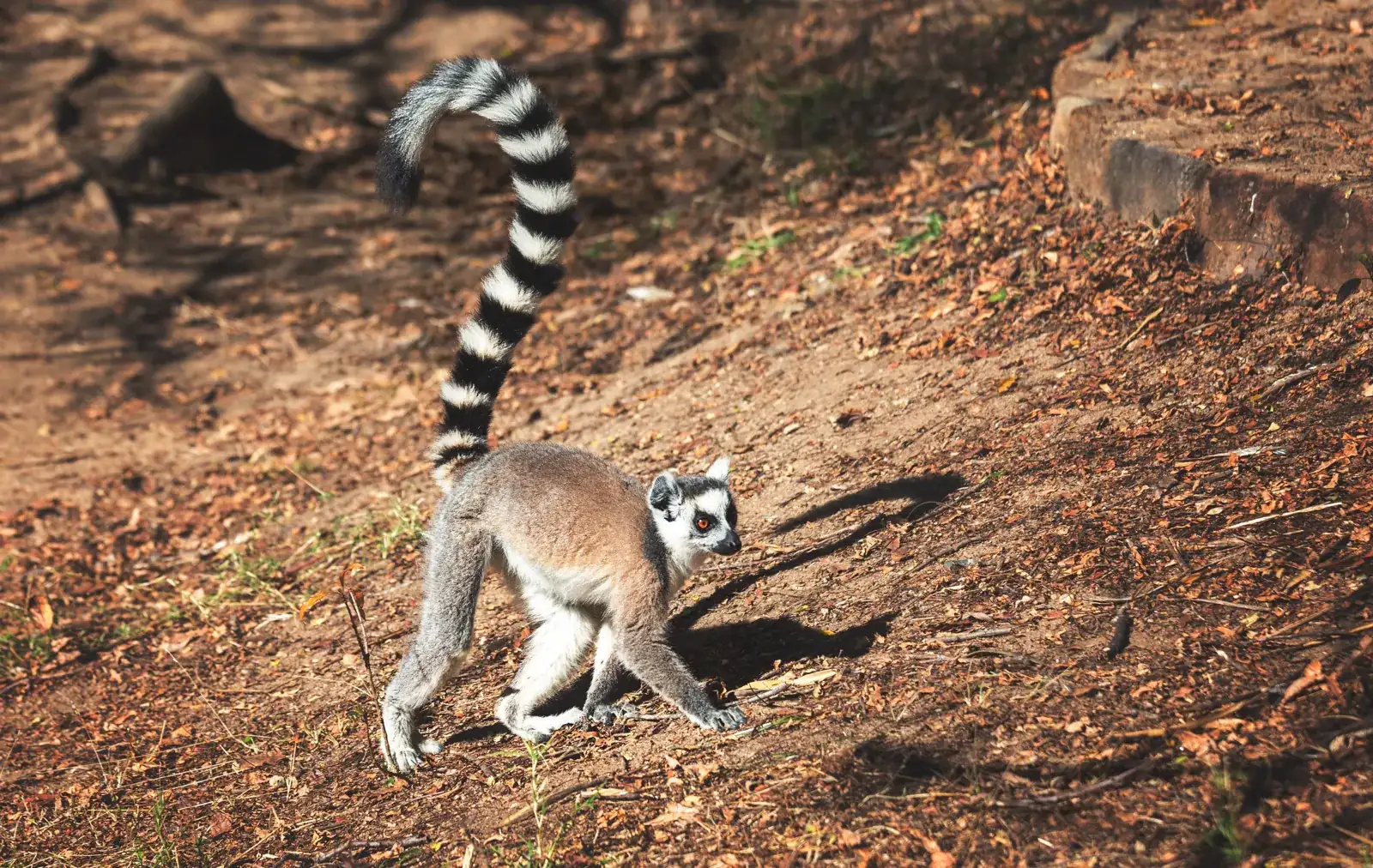
Ring-tailed lemur in its natural habitat in Madagascar
Antananarivo
The capital is spread over hills in the Highlands. Visit the Rova, the former royal palace overlooking the city, and Analakely market. The UNESCO-listed Royal Hill of Ambohimanga is about twenty kilometers (12 mi) away. According to the U.S. Department of State (travel.state.gov, last updated December 12, 2025), skilled pickpockets are very active downtown and violent incidents have occurred near government buildings, the national stadium and historical monuments; the UK FCDO advises against walking alone in city centers after dark.
Andasibe
A few hours’ drive east of the capital, Andasibe-Mantadia National Park is home to the indri, the largest of the lemurs, whose call carries far through the forest. It is often the first stop on a tour, combined with the road to the east coast. Visits are made with a guide.
Antsirabe and the RN7
National Route 7, from Antananarivo to Toliara (Tuléar), is the classic route for a first trip. It passes through Antsirabe, a spa town known for its rickshaws (pousse-pousse), then Ambositra and its woodcarvers, and Fianarantsoa. Allow several days: distances are long and driving at night should be avoided.
Ranomafana
This rainforest national park, on the eastern slopes of the Highlands, is home to several lemur species, including bamboo lemurs. It is part of the Rainforests of the Atsinanana World Heritage Site. It rains often: bring waterproof clothing.
Isalo
The Isalo massif, south of the RN7, offers canyons, natural pools and sandstone landscapes. Hikes are done with a guide. The U.S. Department of State lists Isalo among the areas where violent crime such as armed robbery is common, and the UK FCDO reports attacks in the nearby commune of Ilakakabe: go with a recognized tour operator.
Morondava and the Avenue of the Baobabs
On the west coast, Morondava is the base for the Avenue of the Baobabs, much photographed at sunset. Further north, the Tsingy de Bemaraha, a UNESCO-listed reserve, form a forest of limestone pinnacles crossed by walkways. Access by track is long and only possible in the dry season, by 4×4 with a driver.
Nosy Be
In the northwest, Nosy Be is the country’s busiest beach island, with an international airport. People come for the beaches, diving and trips to the neighboring islets (Nosy Komba, Nosy Tanikely). The UK FCDO (GOV.UK, updated 9 September 2026) reports violent robberies and assaults, even in daytime, on isolated beaches, including on Nosy Be: get local advice or use an experienced travel operator. Beaches, diving and nearby islets: our page on planning a trip to Nosy Be covers the logistics and local precautions.
The southwest: Ifaty and Anakao
Near Toliara (Tuléar), these Vezo fishing villages line a vast lagoon protected by a coral reef. It is the driest region of the country, and a good end to a trip along the RN7. The UK FCDO mentions beaches to the south and north of Toliara among the places where attacks have occurred, and the U.S. Department of State lists Batterie Beach, north of Toliara, among areas where violent crime is common.
Île Sainte-Marie
Off the east coast, Sainte-Marie (Nosy Boraha) is known for its old pirate cemetery and for humpback whale watching during the southern winter. The climate is humid for much of the year, and the region is exposed to cyclones from January to April.
Things to do in Madagascar: 8 experiences
Listen to the call of the indri in Andasibe-Mantadia National Park
Visit the Rova in Antananarivo and the Royal Hill of Ambohimanga
Travel down the RN7 via Antsirabe, Ambositra and Fianarantsoa
Look for lemurs in the Ranomafana rainforest
Hike the Isalo canyons with a guide
See the Avenue of the Baobabs at sunset near Morondava
Watch humpback whales off Sainte-Marie during the southern winter
End on a lagoon in Ifaty, Anakao or Nosy Be
Itinerary ideas for Madagascar
You cannot « do » Madagascar in one trip: choose a region or a route, and leave some slack, as journeys are slow.
10 days: the Highlands and lemurs
Days 1 and 2: Antananarivo and Ambohimanga
Days 3 and 4: Andasibe (indris, day and night walks)
Days 5 and 6: back toward Antsirabe
Days 7 and 8: Ambositra then Ranomafana
Days 9 and 10: return to Antananarivo, or fly to Nosy Be to extend your stay
2 weeks: the RN7 to the lagoon
Days 1 and 2: Antananarivo
Days 3 to 5: Antsirabe, Ambositra
Days 6 and 7: Ranomafana
Days 8 and 9: Fianarantsoa then Isalo
Days 10 to 13: Toliara (Tuléar) then Ifaty or Anakao (beach, lagoon)
Day 14: flight back to Antananarivo
Western variant (dry season only): fly to Morondava, see the Avenue of the Baobabs, then allow 4 to 5 days for the round trip to the Tsingy de Bemaraha.
Budget for a trip to Madagascar
The cost of living is low, but « logistics » weigh heavily: vehicle hire with a driver, domestic flights and park entry with a guide. Indicative amounts per person per day, excluding international flights (converted from our euro estimates at the ECB rate of 23 October 2026, €1 = US$1.12):
Item
Budget
Comfort
Accommodation (based on a shared double room)
roughly US$11–30
roughly US$55–135
Meals
roughly US$9–17
roughly US$20–45
Transport (taxi-brousse or share of a car with driver)
roughly US$11–20
roughly US$45–80
Parks, guides and activities
roughly US$11–17
roughly US$20–45
Total per day
roughly US$45–80
roughly US$135–280
Indicative estimates, varying by region and season. Domestic flights, often expensive, come on top.
Getting around Madagascar
Car with driver: the most common way to tour the country. The UK FCDO (GOV.UK, updated 9 September 2026) advises using a recognized tour operator or asking your hotel to arrange transport, and driving in convoy where possible. A 4×4 is essential outside towns; in the rainy season (December to April), many secondary roads are impassable except by four-wheel drive.
Plane: domestic flights reach Morondava, Toliara, Nosy Be, Diego-Suarez or Sainte-Marie in a few hours instead of several days by road. According to the U.S. Department of State (travel.state.gov, last updated December 12, 2025), the state-owned domestic airline Tsaradia is known for last-minute cancellations and rescheduling, and reconfirming tickets before the flight day is recommended.
Taxi-brousse: cheap shared minibuses. The UK FCDO advises avoiding them because of the risk of robbery and frequent road deaths; U.S. Embassy personnel are instructed not to use them.
At night: avoid driving after dark: vehicles often have no lights, few roads are lit and armed robberies are more frequent at night (UK FCDO).
In towns: use pre-booked taxis or hotel transport rather than walking after dark. Keep car doors locked and windows closed, particularly in Antananarivo (UK FCDO).
Boat: for Nosy Be and its islets or Sainte-Marie. The UK FCDO advises getting local advice on ferries (accidents due to overcrowding and poor maintenance) and reports that armed criminals have robbed passengers on boats on the Tsiribihina River.
Driving yourself: UK licence holders need the correct International Driving Permit plus their UK licence, obtained in the UK before travel (UK FCDO). Seatbelts are mandatory and using a phone while driving, even hands-free, is illegal (U.S. Department of State).
Where to stay in Madagascar
In Antananarivo, stay near the center or in a guarded hotel near the airport for a first or last night. Along the RN7, each stop has hotels and lodges, often run by Malagasy families or expatriates. Near the parks (Andasibe, Ranomafana, Isalo), lodges are few and fill up quickly in high season. On Nosy Be and in the southwest, options range from simple bungalows to resorts.
The U.S. Department of State notes that home invasions and armed robberies are common in Madagascar: choose guarded accommodation and keep valuables out of sight.
Mistakes to avoid in Madagascar
Underestimating travel times: slow roads and difficult tracks; plan short stages or domestic flights.
Driving at night: the UK FCDO reports frequent armed robberies on main roads, particularly at night and in the south.
Touring in January or February: rain and cyclone risk, with western tracks often impassable.
Forgetting malaria prevention: malaria is listed among the health risks by both the UK FCDO and the U.S. Department of State; see a doctor before you leave.
Bringing food: according to the UK FCDO, taking any food into Madagascar, including fruit, is illegal.
Entry requirements for Madagascar
US citizens
According to the U.S. Department of State (travel.state.gov, last updated December 12, 2025), you need a passport valid for six months from your date of entry with three blank pages, and a visa, obtained before traveling or purchased at the port of entry for stays of less than three months. Visas can be paid in US dollars, euros or Malagasy ariary, but credit cards are not accepted. You must also show evidence of onward or return travel and proof of sufficient funds, plus a yellow fever vaccination card if you have been in a yellow fever endemic area within six months of arrival.
UK citizens
According to the UK FCDO (GOV.UK foreign travel advice, updated 9 September 2026), you can visit for up to 15 days without a visa, paying a 10-euro administration fee on arrival and showing your onward or return tickets. For longer stays, you can buy a 30- or 60-day single-entry tourist visa on arrival at the airport (in US dollars, euros or ariary) or apply in advance to the Embassy of Madagascar in London; either can be extended to a maximum total stay of 90 days. Your passport must be valid for at least 6 months after arrival, with at least 2 blank pages. A yellow fever certificate is required if you arrive from a country with a risk of transmission, and a polio vaccine certificate in some circumstances.
The two sources differ on short stays: travel.state.gov does not mention a visa-free period for US citizens. In case of doubt, check with the Embassy of Madagascar. Because of the Ebola outbreak, travelers who have been in or transited through an affected country in the last 21 days may be refused entry, and all travelers must complete a health declaration and undergo screening on arrival (UK FCDO). Entry requirements checked on 24 October 2026.
Health and safety
Health: according to the UK FCDO (GOV.UK, updated 9 September 2026), check vaccine recommendations at least 8 weeks before your trip (TravelHealthPro); health risks include malaria, dengue, schistosomiasis and mpox. The U.S. Department of State also lists chikungunya, rabies and plague, which is endemic on the island, and advises consulting the CDC website for Madagascar. See a doctor or travel health clinic about malaria prevention.
Water: tap water is unsafe: drink only boiled or bottled water and avoid ice in drinks (UK FCDO).
Medical care: hospitals in Antananarivo can only handle routine operations, and patients needing complex surgery are flown to Mauritius, South Africa or Réunion (UK FCDO). Insurance covering medical treatment and evacuation is essential.
Safety: robberies are commonplace; avoid isolated places alone, do not walk at night in towns, do not travel by road after dark, and use a recognized tour operator in the south (UK FCDO). Avoid political gatherings and demonstrations, which can turn violent.
Cyclones: the season normally runs from November to April according to the UK FCDO (December to April according to the U.S. Department of State). Follow Meteo Madagascar, World Meteorological Organization warnings and official instructions.
Emergencies: ambulance or police, 117 from a mobile or 17 from a landline (UK FCDO).
Practical tips for Madagascar
Money: according to the U.S. Department of State (travel.state.gov, last updated December 12, 2025), Madagascar is primarily a cash economy: some high-end establishments accept credit cards (usually Visa only), but most shops and restaurants are cash only. ATMs, generally Visa-only, are found in large cities. US dollars are not widely accepted and $100 bills are often refused. You can bring up to 400,000 ariary into the country (UK FCDO). Our currency converter helps you estimate your spending.
Internet: a local SIM card or an eSIM is useful in towns; let someone know your plans before heading to remote areas.
Fady: according to the UK FCDO, many aspects of daily life are governed by local taboos (fady) that vary from region to region, from forbidden foods to clothing restrictions. Ask your guide or tour operator for advice and respect them.
Photos: ask before photographing people, and do not photograph tombs without permission. The UK FCDO advises against photographing security personnel.
ID: police make random ID checks. The UK FCDO advises carrying your passport, as copies are not always accepted; the U.S. Department of State advises carrying a color photocopy of your passport and visa and keeping the originals secure, while noting that the original may be requested.
Souvenirs: collecting, buying or exporting protected species or products made from them, including rosewood items, is illegal (UK FCDO). Precious gems need a certificate of authenticity and an export certificate (U.S. Department of State).
Tipping: customary for park guides and drivers; ask your agency or accommodation about usual amounts.
Packing: warm clothes for the Highlands in June to August, a headlamp, insect repellent and a basic first-aid kit.
Madagascar combines well with the other Indian Ocean islands: see our guides to Réunion, Mauritius and the Seychelles. Before leaving, read our guide to travel insurance.
Who is Madagascar for?
Our verdicts by traveler profile, based on the information in this guide:
Profile
Our verdict
Nature and wildlife
Ideal: the indris of Andasibe, the lemurs of Ranomafana, the Avenue of the Baobabs, the Tsingy de Bemaraha.
Adventure
Ideal, with an agency: slow roads, 4×4 tracks in the west, guided hikes in Isalo; official advice recommends recognized tour operators in several regions.
Beach
Yes: Nosy Be, Ifaty and Anakao at the end of a tour.
Families
Possible: long journeys, malaria and strict safety advice call for careful preparation.
Budget travelers
Possible: roughly US$45–80 per person per day, but a vehicle with driver, domestic flights and guides add up.
Short trip
Not well suited: allow at least ten days for a single region.
US citizens need a visa, bought before travel or at the port of entry for stays under three months (travel.state.gov, last updated December 12, 2025). British citizens can stay up to 15 days without a visa, paying a 10-euro fee on arrival, and can buy a 30- or 60-day visa on arrival for longer stays (GOV.UK, updated 9 September 2026). Your passport must be valid for six months after arrival. Checked on 24 October 2026; check the latest rules before you leave.
Is Madagascar safe for tourists?
Robberies and thefts are commonplace and armed robberies occur on main roads, particularly at night and in the south (UK FCDO, GOV.UK, updated 9 September 2026). Traveling by day, with a driver or a recognized tour operator, and following official advice, the main tourist routes can be visited.
What is the best time to visit Madagascar?
May to October, during the dry season. Avoid January and February, the wettest months and the most exposed to cyclones.
How many days do you need in Madagascar?
Allow at least 10 days for one region (Highlands and lemurs, or Nosy Be), and 2 to 3 weeks for the RN7 down to the southwest lagoon or to combine two regions with domestic flights.
Do I need malaria tablets for Madagascar?
Malaria is listed among the health risks in Madagascar by both the UK FCDO and the U.S. Department of State. Check the recommendations with your doctor or a travel health clinic at least 8 weeks before your trip, and protect yourself against mosquito bites.
What should I see on a first trip to Madagascar?
Antananarivo, Andasibe park and its indris, then the RN7 via Antsirabe, Ranomafana and Isalo to the lagoon at Ifaty or Anakao. With more time, add the Avenue of the Baobabs at Morondava, or Nosy Be.
How much does a trip to Madagascar cost?
Excluding international flights, roughly US$45–80 per person per day on a budget, and US$135–280 in comfort with a driver.
Transparency: this page contains affiliate links, labelled as such. If you book through them we may earn a commission at no extra cost to you; it does not influence our content or recommendations. How we fund the site.