The United Arab Emirates is a federation of seven emirates on the Persian Gulf: Abu Dhabi, Dubai, Sharjah, Ajman, Umm al-Quwain, Ras al-Khaimah and Fujairah. It offers very modern cities, sand-dune deserts, arid mountains and two coastlines. This UAE travel guide helps you choose what to see beyond Dubai, your stops and your itinerary, while taking strict local laws into account. For entry rules, see our page Dubai visa.
Regional tensions: according to the UK FCDO (GOV.UK, updated 24 July 2026), the situation in the Middle East remains unpredictable, with strikes and retaliatory attacks across the region since 8 July and a risk of further escalation. Be prepared for flight cancellations and periodic airspace closures, and follow local authorities’ instructions.
Terrorism: GOV.UK states that terrorists are likely to try to carry out attacks in the UAE; the U.S. Department of State advises a high level of security awareness.
Disputed islands: the waters around Abu Musa and the Tunbs are highly sensitive, and vessels entering them have been detained (GOV.UK); fishing or sailing there may lead to seizure of the boat and detention in Iran (U.S. Department of State, travel.state.gov, last updated September 17, 2026). Keep well clear on boat trips and fishing outings.
Check the latest advice just before you leave and sign up for alerts (FCDO email alerts, or the State Department’s STEP program).
When to go to the United Arab Emirates
The best period is November to March. According to the 1991–2020 normals for Dubai airport, highs are then between 24 and 31 °C (75 and 88 °F), compared with nearly 42 °C (108 °F) in August. In summer, from May to September, the heat is extreme across the country, even slightly more so in Abu Dhabi and Ras al-Khaimah. It rains only a few days a year, mostly in winter. Also bear Ramadan in mind; its dates move earlier each year. All the details, month by month, are in our article best time to visit Dubai.
What to see in the UAE: the highlights
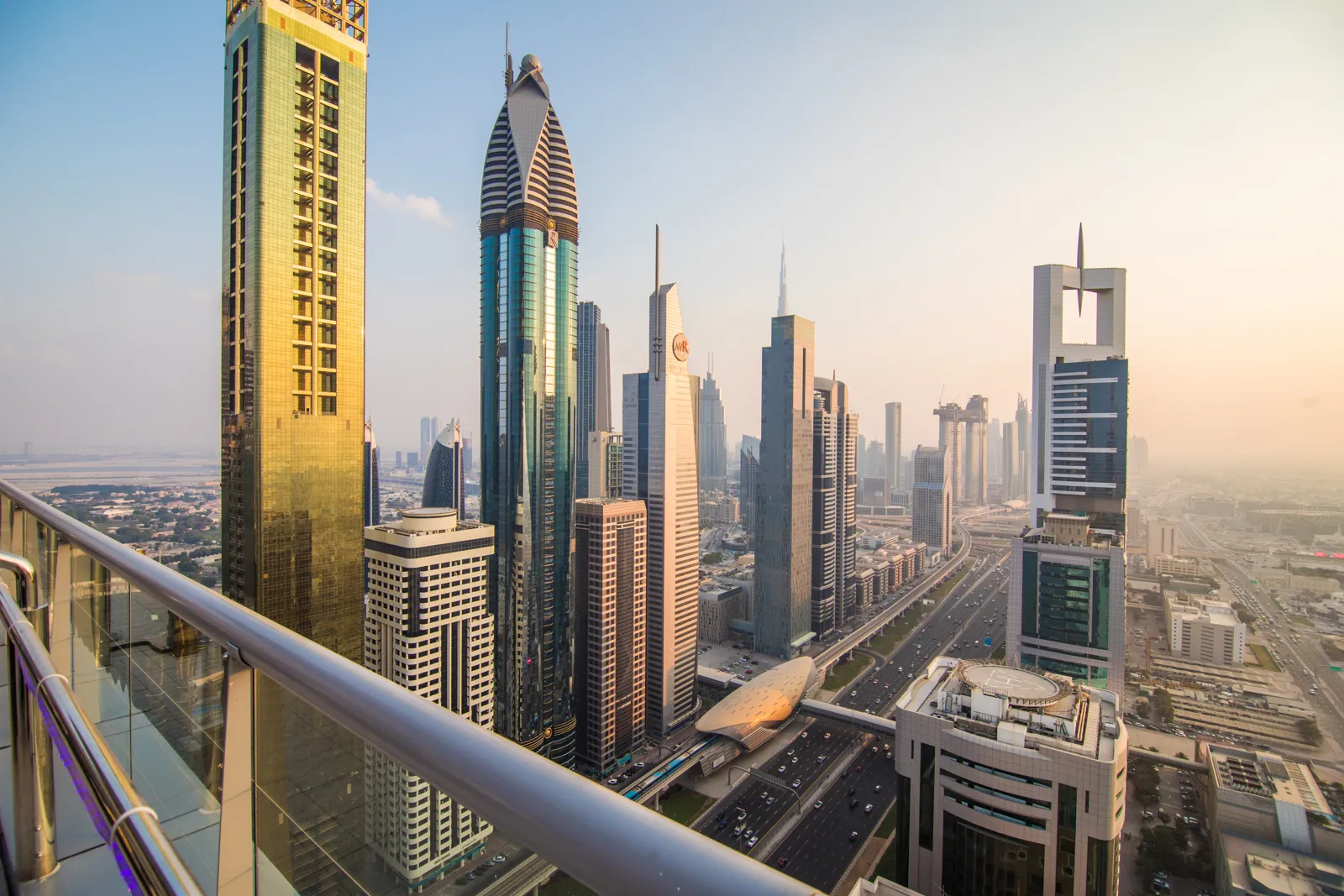
Aerial view of downtown Dubai and its skyscrapers
Dubai
The most visited city in the country: Burj Khalifa and Downtown, the old Al Fahidi district and the abra crossing of the Creek, the Deira souks, the beaches of Jumeirah, Dubai Marina and Palm Jumeirah, and the Museum of the Future. The desert starts less than an hour’s drive away. Our Dubai guide covers each district.
Abu Dhabi
The capital is airier and calmer than Dubai. Sheikh Zayed Grand Mosque, in white marble, is visited by reservation (AED 10 for foreign visitors since September 2026) in covering clothes (arms, legs and, for women, hair). On Saadiyat Island, Louvre Abu Dhabi displays art from around the world under a vast perforated dome. Yas Island has the Formula 1 circuit and several theme parks, handy for families. Qasr Al Hosn, the city’s oldest building, tells its history.
Al Ain
In the east of Abu Dhabi emirate, near the Omani border, the oasis city of Al Ain is a UNESCO World Heritage Site for its cultural sites: palm groves irrigated by traditional channels (falaj), mud-brick forts and Bronze Age tombs. Jebel Hafeet mountain overlooks the city. It is the most traditional stop in the country, about 1 h 30 by road from Abu Dhabi or Dubai.
Sharjah
Right next to Dubai, Sharjah focuses on culture: the Museum of Islamic Civilization, a restored heritage district and art galleries. It is more conservative than Dubai: drinking or possessing alcohol is illegal there (GOV.UK) and modest dress is expected. Traffic jams between Sharjah and Dubai are frequent at rush hour.
Ras al-Khaimah and Jebel Jais
The northernmost emirate combines beaches, mangroves and the Hajar Mountains. Jebel Jais, the country’s highest peak, is reached by a mountain road and offers viewpoints, trails and long zip lines. It is much cooler than the coast, which makes it a popular winter outing.
Fujairah and the east coast
On the Gulf of Oman coast, Fujairah offers a different setting: mountains plunging into the sea, quieter beaches, diving and snorkeling around Snoopy Island near Dibba. Al Badiyah Mosque, a small stone and mud mosque, is often described as the oldest in the country. Take care on boat trips: tourist boats may not meet UK safety standards, so make sure life jackets are available for everyone (GOV.UK).
Hatta and the Liwa desert
Hatta, a Dubai enclave in the mountains, is good for kayaking, hiking and mountain biking. In the south of Abu Dhabi emirate, the Liwa oasis opens onto the Rub al-Khali, one of the largest sand deserts in the world, with huge dunes such as Moreeb. Liwa is more than two hours’ drive from Abu Dhabi: plan at least one night there.
Itinerary ideas for the UAE (7 days to 2 weeks)
7 days: Dubai and Abu Dhabi
Days 1 to 3: Dubai (Downtown, old Dubai, beach)
Day 4: desert trip from Dubai
Days 5 and 6: Abu Dhabi (Grand Mosque, Louvre Abu Dhabi, Qasr Al Hosn)
Day 7: day trip to Al Ain, or back to Dubai for your flight
10 days to 2 weeks: a tour of the emirates
Days 1 to 4: Dubai and an outing to Hatta
Day 5: Sharjah and its museums
Days 6 and 7: Ras al-Khaimah and Jebel Jais
Days 8 and 9: Fujairah and the east coast (beach, snorkeling)
Days 10 to 12: Al Ain, then Abu Dhabi
Days 13 and 14: a night in the Liwa desert, back to Abu Dhabi for your flight
Distances are short, but public transport between emirates is limited: a rental car or a driver makes a tour much easier. For a first trip, two bases (Dubai and Abu Dhabi) are enough. For the second base on this route, our Abu Dhabi travel guide covers sights, neighborhoods and practical tips.
Budget for a trip to the UAE
The UAE is an expensive destination, especially in high season and in Dubai. In summer, hotel prices drop sharply. Indicative amounts per person per day, excluding international flights (converted from our euro estimates at the ECB rate of 23 October 2026, roughly €1 = US$1.12):
Item
Budget
Comfort
Accommodation (based on a shared double room)
roughly US$35–65
roughly US$110–280
Meals
roughly US$17–34
roughly US$55–110
Local transport
roughly US$6–17
roughly US$22–55
Activities and entrance fees
roughly US$11–45
roughly US$55–170
Total per day
roughly US$65–160
roughly US$250–620
Indicative estimates, varying by season. Add car rental for a tour (fuel is cheap).
To keep costs down: travel in November or March outside holiday periods, stay in Deira or Bur Dubai, eat in small Indian, Pakistani or Lebanese restaurants, and favor free or cheap sights (public beaches, souks, Sheikh Zayed Grand Mosque). For a cheaper winter-sun trip, compare with Jordan or Egypt.
Getting around the UAE
In Dubai: metro (Red and Green lines), tram, buses and boats, paid with the Nol card; taxis and ride-hailing apps. GOV.UK advises using only licensed taxis or recognized apps such as Careem, Uber and Abu Dhabi Taxi.
Between emirates: intercity buses link Dubai with Abu Dhabi, Sharjah, Ras al-Khaimah and Fujairah. Allow about 1 h 30 by road between Dubai and Abu Dhabi.
Rental car: the most flexible option for a tour. UK visitors can drive with a UK photocard licence (paper licences may need an IDP) (UK FCDO, GOV.UK, updated 24 July 2026); US visitors who are not residents can drive with a valid state license, though an international driving permit may be required in some emirates (U.S. Department of State, travel.state.gov, last updated September 17, 2026). Driving is on the right.
On the road: there is a high rate of accidents and speeding is common (GOV.UK). There is zero tolerance for drinking and driving, offensive gestures and bad language toward other drivers can lead to jail, and you must stay at the scene of an accident until the police arrive. Traffic fines must be paid before leaving the country (travel.state.gov).
Desert: excursions can be dangerous unless you are in a properly equipped 4×4; always travel with other cars, water and a mobile phone (GOV.UK). Otherwise, book a reputable operator and check that your insurance covers it.
Where to stay in the UAE
There is a very wide range of accommodation, from simple neighborhood hotels to large beach resorts. In Dubai, Downtown and Business Bay are convenient for sightseeing, Jumeirah, Dubai Marina and Palm Jumeirah for the beach, and Deira and Bur Dubai for tighter budgets (details in our Dubai guide). In Abu Dhabi, stay on the Corniche for the city, or on Saadiyat and Yas islands for the beach and theme parks. Ras al-Khaimah and Fujairah mainly offer seaside resort hotels, and the Liwa desert a few hotels and camps. A per-night tourism fee is often added to the bill: check whether it is included.
Entry requirements for the UAE
US citizens
According to the U.S. Department of State (travel.state.gov, last updated September 17, 2026), US citizens with a regular passport can obtain a free visitor visa on arrival for personal travel of 30 days or less; extensions are at the discretion of immigration officials.
Your passport must be valid for at least six months beyond the date of entry. The UAE does not accept 12-page emergency passports, nor passports with an « X » gender marker: travelers with these passports are denied boarding or entry.
Travelers with pending legal or financial cases, including unpaid bills or late credit card payments, can be barred from leaving the country. Leaving by land costs a departure fee of AED 35.
UK citizens
According to the UK FCDO (GOV.UK foreign travel advice, updated 24 July 2026), you get a free visitor visa on arrival, with no need to apply in advance. It is valid for up to 90 days over a 180-day period from your first entry, in one or several visits. Overstays are fined for each extra day.
Your passport must have an expiry date at least 6 months after the date you arrive.
A yellow fever certificate is required if you come from a country with a risk of transmission.
Entry requirements checked on 24 October 2026; check them again before you travel.
Health and safety
Medication: according to GOV.UK (GOV.UK, updated 24 July 2026), some UK prescription and over-the-counter medicines are controlled in the UAE: you need prior approval from the UAE Ministry of Health, applied for online (normally processed within 5 working days), and visitors can bring up to 3 months’ supply (one month for medicines requiring approval). The U.S. Department of State adds that possession of prohibited medication without approval is treated like possession of illegal narcotics.
Drugs and CBD: there is zero tolerance: even residual amounts, including drugs in the bloodstream from use before the trip, count as possession; products containing CBD, including some e-cigarette refills and skincare, are illegal (GOV.UK, travel.state.gov). The U.S. Department of State also lists e-cigarettes and poppy seeds among prohibited imports.
Health: check vaccine recommendations at least 8 weeks before your trip (TravelHealthPro). Air pollution is a significant problem (travel.state.gov).
Medical costs: healthcare facilities are similar to the UK’s, but you may be refused treatment without insurance or the means to pay, and you may be prevented from leaving if you cannot pay your medical bill (GOV.UK). Take insurance covering medical costs and repatriation.
Beaches: rip currents can occur at any beach; swim only on approved beaches with lifeguards (GOV.UK).
Emergency numbers: police 999, ambulance 998, fire 997 (GOV.UK).
Practical tips for the UAE
Money: cards are accepted almost everywhere; ATMs are found in malls and metro stations. Our currency converter helps you convert prices into dirhams. Non-payment of bills, including hotel bills, is a criminal offense (GOV.UK).
Internet: the mobile network is excellent in cities. A local SIM card or an eSIM is useful for maps, ride-hailing and bookings. Some online calling services may be restricted.
Dress and behavior: dress modestly in public areas such as malls (women should cover shoulders and knees), and wear swimwear only on beaches and at pools (GOV.UK, GOV.UK, updated 24 July 2026). Showing affection in public is frowned upon and you can be arrested for kissing in public; swearing and rude gestures, including online, are illegal. Same-sex sexual activity is illegal.
Alcohol: the legal age is 21 and drinking is allowed only in licensed venues; being drunk or under the influence in a public place is illegal everywhere, and alcohol is banned in Sharjah (GOV.UK).
Ramadan: avoid eating, drinking, smoking or chewing gum in public during the day, including in your car (GOV.UK). Many restaurants remain open in Dubai and Abu Dhabi for non-fasting guests.
Photos and drones: do not photograph government buildings, military sites or people without their permission (GOV.UK); flying a drone requires prior approval (travel.state.gov).
Who is the UAE for?
Our verdicts by traveler profile, based on the information in this guide (places, budget, seasons).
Profile
Our verdict
Why
Couples
Very well suited
Beach resorts, a night in the Liwa desert, views from Burj Khalifa.
Families
Suited
Beaches and theme parks on Yas Island; avoid summer, with nearly 42 °C (108 °F) in the afternoon.
Budget travelers
With reservations
Roughly US$65–160 a day staying in Deira or Bur Dubai and eating in small restaurants.
Culture
Suited
Sheikh Zayed Grand Mosque, Louvre Abu Dhabi, Sharjah’s museums, Al Ain.
Nature and adventure
Suited
Jebel Jais, kayaking and mountain biking in Hatta, the desert, snorkeling in Fujairah.
Frequently asked questions
Do I need a visa for the UAE?
Not in advance for a tourist stay. British citizens get a free visa on arrival valid for up to 90 days over 180 days (GOV.UK), and US citizens a free visitor visa on arrival for 30 days or less (travel.state.gov). Your passport must be valid for at least 6 months from entry. Checked on 24 October 2026; check the latest rules before you leave.
What is the best time to visit the UAE?
November to March, when highs are around 24 to 31 °C (75 to 88 °F). From May to September, afternoon temperatures often exceed 40 °C (104 °F).
How long do you need to visit the UAE?
A week lets you see Dubai, the desert and Abu Dhabi. With 10 days to 2 weeks, you can add Al Ain, Ras al-Khaimah, the east coast and the Liwa desert.
How much does a trip to the UAE cost?
Excluding international flights, allow roughly US$65–160 per person per day on a budget, and US$250–620 in comfort. Hotel prices vary widely between summer and the year-end holidays.
Is the UAE safe?
Violent crime and property crime are rare (travel.state.gov), but the UK FCDO warns of an unpredictable regional situation and a terrorism risk, and the waters around Abu Musa and the Tunbs are sensitive. The main risks for travelers are the roads, motorized activities and breaking very strict laws, especially on drugs and medication.
What is there to do in Abu Dhabi?
Visit Sheikh Zayed Grand Mosque, Louvre Abu Dhabi and Qasr Al Hosn, swim on Saadiyat Island, spend a day in the Yas Island parks, then head to the Al Ain oasis or spend a night in the Liwa desert. Two days cover the city’s essentials (see our itineraries above).
European Central Bank: euro reference rates of 23 October 2026 (budget conversion)
Climate normals: 1991–2020 normals for Dubai International Airport (WMO station 41194), Abu Dhabi Zayed International Airport and Ras al-Khaimah International Airport (WMO station 41184), published by the World Meteorological Organization (NOAA archive)
Transparency: this page contains affiliate links, labelled as such. If you book through them we may earn a commission at no extra cost to you; it does not influence our content or recommendations. How we fund the site.