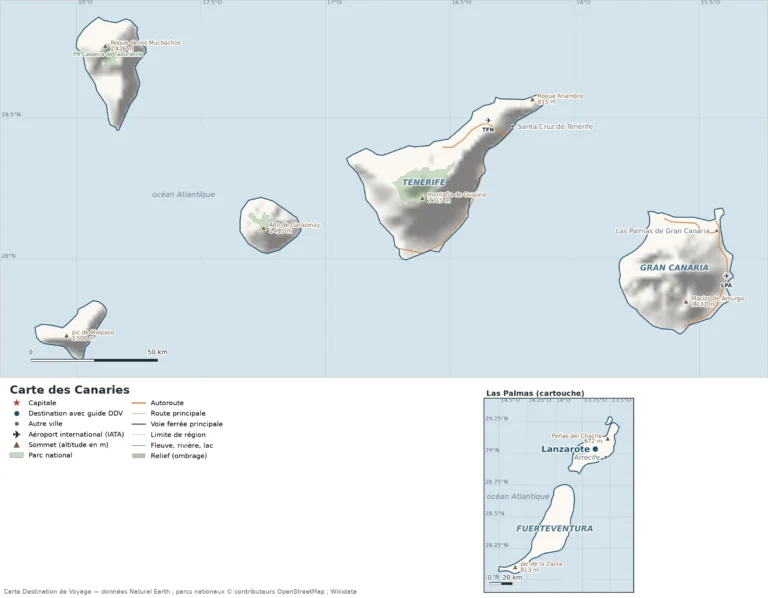
Looking for things to do in Lanzarote? The easternmost of the Canary Islands is above all about volcanic landscapes: the lava fields of Timanfaya National Park, the vines planted in the ash of La Geria and the lava caves of the north. It is also shaped by the work of artist César Manrique, who designed several of its sites, and by sheltered beaches in the south. This Lanzarote travel guide helps you choose what to see, where to stay and what budget to plan.
Our travel deals for Lanzarote
Affiliate links: we earn a commission, at no extra cost to you.
FlightsKiwi.comCompare flights and airline combinations to Lanzarote.
✅ Best months: January, February, March, April, may, June, September, October, November, December
Lanzarote can be visited all year: according to AEMET normals, highs range from 21 °C (70 °F) in January to 29.5 °C (85 °F) in August, and barely 100 mm (3.9 in) of rain falls a year. April-May and September-October offer the best balance of warmth, prices and crowds; winter attracts those escaping the cold. All the month-by-month figures are on our page on the best time to visit Lanzarote. Neighboring Fuerteventura has other strengths: our comparison to choose between Lanzarote and Fuerteventura sets these seasons and landscapes side by side.
Things to do in Lanzarote: the highlights
Timanfaya National Park
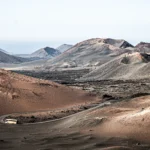
The eruptions of 1730 to 1736, then that of 1824, covered a large part of the island’s southwest in lava and ash. The national park protects this landscape of red and black craters. Visits are mainly by coach, along the Route of the Volcanoes from the Islote de Hilario visitor area, where demonstrations show the heat below the ground. Walking freely is tightly restricted: check guided hikes and access conditions before you come, and arrive early in high season.
La Geria and its vineyards
Between Timanfaya and the center of the island, growers plant each vine at the bottom of a hollow dug into the volcanic ash, sheltered from the wind by a semicircular stone wall. The result is one of the most unusual farming landscapes in Europe. Several wineries (bodegas) offer tastings, especially of Malvasía.
El Golfo, Los Hervideros and the Janubio salt flats
On the west coast, Charco de los Clicos is a green lagoon set in an old crater open to the sea, near the village of El Golfo and its fish restaurants. A little further south, Los Hervideros are lava caves and arches where the swell crashes in. The Janubio salt flats, still in use, form colorful pools by the ocean.
César Manrique’s sites
A painter, sculptor and architect born in Arrecife, César Manrique championed development that respected the island’s landscapes. His main creations can be visited: Jameos del Agua, built into a collapsed lava tube with an underground lake and an auditorium; Mirador del Río, a lookout carved into the cliff facing La Graciosa; the Jardín de Cactus, near Guatiza; and his house in Tahíche, built over lava bubbles, now the headquarters of the César Manrique Foundation. Combined tickets are available for several of the island’s tourist centers.
Cueva de los Verdes
Next to Jameos del Agua, this cave is part of the same lava tube, formed by an eruption of the Corona volcano. The guided tour covers part of the galleries, with carefully designed lighting and a final surprise the guides keep secret. Wear good shoes: the floor is uneven and some passages are low.
Teguise, Haría and the north
Teguise, the island’s former capital, has cobbled streets, churches and old mansions; its Sunday morning market is the best known on Lanzarote and draws big crowds. Further north, Haría lies in a palm-filled valley, where César Manrique’s last home can also be visited. The road to Mirador del Río offers fine views of the Risco de Famara cliffs.
Famara and La Graciosa
Famara beach stretches for several kilometers at the foot of cliffs, facing the open sea. It is a renowned surf spot, but currents make swimming dangerous. From the port of Órzola, ferries make the short crossing to La Graciosa island, with sandy tracks and no paved roads, pale beaches and the small village of Caleta de Sebo. It makes a good day trip, on foot or by bike.
Papagayo beaches and Playa Blanca
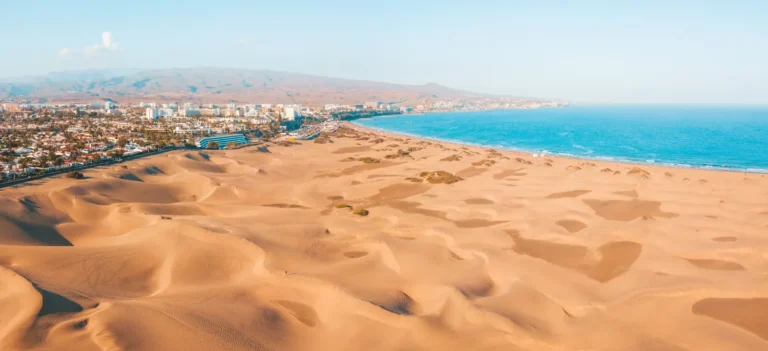
In the south, the Papagayo coves, in the Los Ajaches natural monument, line up golden sand and clear water, sheltered from the wind most of the time. Access is by a dirt track (a fee is charged for cars), or on foot from Playa Blanca, the southernmost resort, which is also the departure point for ferries to Fuerteventura. Off Playa Blanca, the Museo Atlántico is an underwater sculpture museum that can be visited by diving.
Itinerary suggestions for Lanzarote
7 days: the island’s highlights
Day 1: arrival, settle in Puerto del Carmen, Costa Teguise or Playa Blanca
Day 2: Timanfaya National Park (arrive early) and La Geria
Day 3: El Golfo, Los Hervideros, the Janubio salt flats
Day 4: Jameos del Agua, Cueva de los Verdes, Mirador del Río
Day 5: day trip to La Graciosa from Órzola
Day 6: Teguise (Sunday market), Haría, the César Manrique Foundation, the Jardín de Cactus
Day 7: Papagayo beaches, departure
10 days to 2 weeks: Lanzarote and Fuerteventura
Days 1-7: the itinerary above, with half a day in Famara
Days 8-9: beach and water sports (diving, Museo Atlántico, surf lessons)
Days 10-14: ferry from Playa Blanca to Corralejo, then Fuerteventura (dunes, Lobos, Betancuria, Jandía)
Indicative amounts per person per day, excluding flights:
Item
Budget
Comfort
Accommodation (sharing a double room)
about €25 to 45
about €60 to 140
Meals
about €20 to 30
about €40 to 70
Transport (shared rental car, fuel, bus)
about €10 to 20
about €20 to 40
Activities (Timanfaya, Manrique sites, ferry to La Graciosa)
about €10 to 20
about €20 to 50
Total per day
roughly €65 to 115
roughly €140 to 300
Indicative estimates, varying with the season: prices peak at Christmas, in February and in August.
Admission fees add up quickly: if you plan to visit several sites, look at combined tickets. All-inclusive packages in the big resorts can be worthwhile outside school holidays.
Getting around Lanzarote
Car: the easiest option; the island can be crossed in about an hour and the roads are good. Leave nothing visible in the vehicle: thieves target hire cars (GOV.UK). US drivers must obtain an International Driving Permit before arriving and need one to rent a car (U.S. Department of State); UK photocard licences can be used in Spain (GOV.UK).
Bus: the network links the airport, Arrecife and the resorts, but serves the inland and northern sites poorly.
Organized tours: an alternative for Timanfaya and the Manrique sites without a car.
Ferry: Playa Blanca-Corralejo (Fuerteventura) and Órzola-La Graciosa.
Bike: very popular, but the wind and the hills call for good fitness.
Where to stay in Lanzarote
Base
Best for
Good to know
Puerto del Carmen
First visit, nightlife, beach
The largest resort, close to the airport
Costa Teguise
Families, wind sports
Quieter, fairly windy
Playa Blanca
Papagayo beaches, ferry to Fuerteventura
Far from the north of the island
Arrecife
Budget, a Spanish town
Well served by bus
Famara
Surfing, nature
Village feel, very windy
Rural houses (Haría, Teguise, La Geria)
Quiet, hiking
Car essential
For a week, a central base (Puerto del Carmen, Costa Teguise) limits driving; Playa Blanca suits you if the beach comes before sightseeing.
Entry requirements, health and safety
US citizens: the Canary Islands are part of Spain. According to the U.S. Department of State (travel.state.gov, last updated August 11, 2025), your passport should be valid for at least 3 months beyond your stay (6 months recommended); you need sufficient proof of funds and a return ticket.
UK citizens: according to the UK FCDO (GOV.UK, updated 12 August 2026), you can travel to the Schengen area, including Spain, without a visa for up to 90 days in any 180-day period. Your passport must have been issued less than 10 years before you arrive and be valid for at least 3 months after you leave. You may be asked for proof of travel insurance, funds, a return ticket and accommodation, and may have to register under the EU Entry/Exit System (EES).
Health: UK travelers need a GHIC or EHIC for medically necessary state healthcare, which is not an alternative to travel insurance (GOV.UK). The sun is strong all year, even when the wind cools the air.
Safety: thieves use distraction techniques, especially at airports and when collecting a hire car (GOV.UK). In some areas, walking in the street in swimwear or bare-chested, or drinking alcohol in the street, can bring a fine (GOV.UK).
Sea: some beaches, especially around the islands, have strong undercurrents (GOV.UK); currents and swell are dangerous at Famara and on the west coast. Swim on supervised beaches.
Money: cards are accepted almost everywhere; you may be asked for ID when paying by card (GOV.UK). Keep some cash for markets and small bars.
Internet: check your provider’s roaming rates for Spain before you leave; an eSIM can be a cheaper option.
Shoes: bring closed shoes for the caves and the trails over sharp lava.
Nature: do not take volcanic stones, and stay on marked paths in protected areas.
Food: try papas arrugadas with mojo, grilled fish in El Golfo and La Geria’s white wine.
Who is Lanzarote for?
Volcanic landscape lovers: yes, it is the main draw: Timanfaya, La Geria’s vineyards, the lava caves of Cueva de los Verdes.
Culture and architecture: yes: César Manrique’s sites (Jameos del Agua, Mirador del Río, Jardín de Cactus, his house in Tahíche) and the old town of Teguise.
Beach: yes: the Papagayo coves, in the south, are sheltered from the wind most of the time. Avoid swimming at Famara, which is dangerous.
Surfers: yes: Famara is a renowned surf spot, with currents to respect.
Budget travelers: average: roughly €65 to 115 per person per day; admission fees add up, hence the value of combined tickets.
Car-free travel: possible but limited: buses link the resorts but serve the interior and north poorly; use organized tours instead.
A week is enough to see Timanfaya, La Geria, the west coast, César Manrique’s sites, La Graciosa and the southern beaches. With ten days to two weeks, add rest or an extension to Fuerteventura.
Do you need a car in Lanzarote?
It is strongly recommended: buses link the resorts, but many northern and inland sites are poorly served. Otherwise, use organized tours. US drivers need an International Driving Permit (travel.state.gov).
What is the best beach in Lanzarote?
The Papagayo coves, in the south, are the most sheltered and the clearest. Famara is more spectacular but best left to surfers: swimming there is dangerous.
Lanzarote or Fuerteventura: which island should you choose?
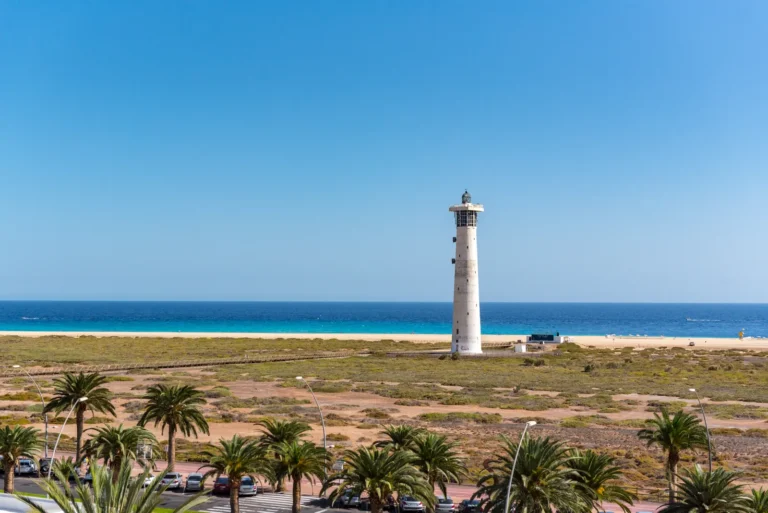
Lanzarote for volcanoes, caves and César Manrique’s work; Fuerteventura for big beaches and dunes. A short ferry crossing separates them.
How do you get to Lanzarote?
By air to Lanzarote Airport (ACE), between Arrecife and Puerto del Carmen; check current routes with the airlines. Ferries also link Playa Blanca with Corralejo on Fuerteventura.
Our sources
U.S. Department of State, Spain country information (travel.state.gov, last updated August 11, 2025), read on 26 October 2026


 FlightsKiwi.comCompare flights and airline combinations to Lanzarote.Compare flights