Things to do in Córdoba? Visit the Mosque-Cathedral (Mezquita), get lost in the lanes of the Judería, cross the Roman bridge to the Calahorra tower, stroll through the gardens of the Alcázar of the Christian Monarchs, step into flower-filled patios and head out to Medina Azahara, the caliphal city. Allow 1 to 2 days to visit Córdoba, and choose your season carefully: from June to September, it is one of the hottest cities in Spain.
Former capital of the Umayyad caliphate of al-Andalus, Córdoba lies on the Guadalquivir, between Seville and Madrid. Its historic center is a UNESCO World Heritage Site, as is Medina Azahara, and its patios festival is on the Intangible Heritage list. This guide covers the sights, itineraries, a budget, where to stay and the month-by-month climate based on AEMET, with our own calculation of the number of very hot days. For the whole region, see our Andalusia guide.
Our travel deals for Córdoba
Affiliate links: we earn a commission, at no extra cost to you.
FlightsKiwi.comCompare flights and airline combinations to Córdoba.
LocationAndalusia, on the GuadalquivirAbout 140 km (87 mi) north-east of Seville
LanguageSpanish; currency: the euro
Time zoneUTC+1, UTC+2 in summer: 1 hour ahead of London, 6 hours ahead of New York · detailsLocal time now: –:–
AirportsSeville or Málaga, then the train · details
TrainCórdoba station is on the Madrid – Seville high-speed line
Ideal length1 day for the essentials2 days with Medina Azahara and the patios
EntrySchengen area: no visa for UK citizens for up to 90 days in any 180-day period; US citizens need a passport valid 3 months beyond their stay · travel.state.gov · GOV.UK
Electricitycheck voltage and plug types before you go · plugs
This is the city’s major monument and one of the most memorable visits in Spain. Begun in the late 8th century by Emir Abd al-Rahman I and enlarged over two centuries, the great mosque lines up a forest of columns topped by red-and-white two-tone arches. After Ferdinand III took the city in 1236, it became a cathedral; in the 16th century, a Renaissance nave was built at its center. Don’t miss the mihrab and its mosaics, or the Courtyard of the Orange Trees. Allow 1.5 to 2 hours; check the official site for access to the bell tower, which is limited.
The Judería and the synagogue
Around the Mezquita, the former Jewish quarter forms a maze of whitewashed lanes. Here you can visit one of the few medieval synagogues preserved in Spain, the small Plaza de Maimónides and its statue, and the Calleja de las Flores, a flower-lined alley that frames the cathedral bell tower. The quarter is very busy in the middle of the day: come early in the morning or in the late afternoon.
The Alcázar of the Christian Monarchs
A former royal residence of the monarchs of Castile, the Alcázar is best known for its terraced gardens, with pools, fountains, cypresses and orange trees. The towers offer views over the city and the river. In summer, visit at opening time: the gardens have little shade during the hottest hours.
The Roman bridge and the Calahorra tower
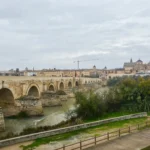
The Roman bridge over the Guadalquivir.
The Roman bridge, rebuilt many times, crosses the Guadalquivir opposite the Mezquita. At the far end, the fortified Calahorra tower houses a museum on the coexistence of cultures in al-Andalus. At sunset, the view from the south bank over the bridge and the city is one of the finest in Córdoba.
The patios and the Viana Palace
The flower-filled patio, its walls often covered in hanging pots of geraniums, is the emblem of the city. All year round, the Viana Palace lets you discover a dozen of them, in different styles, around an aristocratic mansion. In May, during the patios festival, residents open their courtyards to the public free of charge, especially in the San Basilio and Santa Marina quarters.
Medina Azahara
About ten kilometers (6 mi) west of the city, the ruins of the palace city built in the 10th century by Caliph Abd al-Rahman III are terraced at the foot of the Sierra Morena. An interpretation center introduces the site before your visit. Listed as a World Heritage Site in 2018, Medina Azahara can be reached by car, on an organized excursion or by the tourist shuttle offered in some periods. Allow half a day.
The center and Plaza de la Corredera
Further north-east, the modern city has some fine quarters: Plaza de la Corredera, a large arcaded square, the so-called Fernandine churches, built after the Reconquest, the remains of the Roman temple and Plaza de las Tendillas, the shopping heart of the city. This is where the people of Córdoba live, away from the crowds of the Judería.
The Caliphal baths and museums
The baths of the caliphal palace, near the Alcázar, show how a medieval hammam was organized. The archaeological museum, built over the remains of the Roman theater, traces the city’s history from Antiquity to the caliphate. These are good visits for the hottest hours of the day.
Itinerary: how many days in Córdoba?
Córdoba in 1 day
Opening time: the Mosque-Cathedral
Late morning: the Judería, the synagogue, the Calleja de las Flores
Midday: lunch, then an indoor visit out of the sun (Caliphal baths, museum)
Late afternoon: the Alcázar gardens
Sunset: the Roman bridge and the Calahorra tower
Córdoba in 2 days
Day 1: as above
Day 2: Medina Azahara in the morning, the Viana Palace and the San Basilio quarter in the afternoon, evening on Plaza de la Corredera
Córdoba combines very well with Seville (under an hour by high-speed train) and Granada on a one-week Andalusian tour, or with Málaga and the coast. From Madrid, a day trip is possible by high-speed train.
Checklist: visiting Córdoba without mistakes
Mistakes to avoid in Córdoba
Arriving at the Mezquita in the middle of the day: aim for opening time, when the light is better and it is quieter
Forgetting to check bell tower access, which is limited
Scheduling Medina Azahara for a summer afternoon: the site is very exposed, go in the morning
Thinking the patios festival lasts all month: it usually runs for about ten days in May, and the dates change every year
Walking around between 2 pm and 6 pm in July-August: according to our calculation, the city exceeds 35 °C (95 °F) on about 23 days out of 31 (see below)
Driving into the historic center: traffic is restricted, so park on the outskirts
When to go to Córdoba
The best times to visit Córdoba are April-May and October: 23 to 28 °C (73 to 83 °F) in the afternoon, the patios are in bloom in spring and the heat eases in autumn. March and November are mild but less predictable. From June to September, the city bakes: the average high reaches 37.1 °C (99 °F) in July. Winter mornings are chilly (below 5 °C / 41 °F in January) but often sunny.
When to go to Córdoba: the essentials
Best months: April, May and October
Patios festival: in May (dates announced each year by the city)
Hottest month: July, average high 37.1 °C (99 °F)
Wettest month: December, about 91 mm (3.6 in)
Driest month: July, under 1 mm
Sunshine: 372 hours in July, 161 hours in December
Month
High °C (°F)
Low °C (°F)
Rain mm (in)
Crowds
Prices
Verdict
January
15.2 (59)
3.7 (39)
58 (2.3)
Low
Low
⚠️ Cold mornings, quiet
February
17.4 (63)
4.7 (40)
53 (2.1)
Low
Low
⚠️ Mild, short days
March
21.1 (70)
7.3 (45)
63 (2.5)
Medium
Medium
✅ Spring, orange trees in blossom
April
23.6 (74)
9.7 (49)
54 (2.1)
High (Easter)
High
✅ Very pleasant, Holy Week in some years
May
28.1 (83)
12.9 (55)
42 (1.7)
Very high
Very high
✅ Patios month, rising heat
June
33.4 (92)
16.8 (62)
11 (0.4)
Medium
Medium
⚠️ Already very hot in the afternoon
July
37.1 (99)
19.1 (66)
0.5 (0.0)
Low
Low to medium
❌ Frequent heatwaves
August
37.0 (99)
19.6 (67)
7 (0.3)
Low
Low to medium
❌ Frequent heatwaves, city slows down
September
31.8 (89)
17.0 (63)
37 (1.5)
Medium
Medium
⚠️ Hot early in the month
October
25.8 (78)
13.1 (56)
79 (3.1)
High
Medium to high
✅ Mild, rain returns
November
19.1 (66)
7.9 (46)
79 (3.1)
Medium
Medium
✅ Mild, few visitors
December
15.8 (60)
5.1 (41)
91 (3.6)
Medium (holidays)
Medium
⚠️ Cool, wettest month
Temperatures and precipitation: AEMET (Agencia Estatal de Meteorología) 1991-2020 normals, Córdoba airport station. Crowds and prices: estimate based on festivals and tourist seasons.
How many days above 35 °C in Córdoba?
Normals give an average, but the useful question in summer is: how many truly scorching days should you expect? Here is our exclusive data. Destination de Voyage calculation based on 1991-2020 daily observations from the Córdoba airport station (Meteostat series, about 98% of days available): average number of days per month with a high above 35 °C (95 °F), then reaching 40 °C (104 °F). Check: the average highs recalculated from this series match AEMET normals to within a tenth of a degree. This calculation is not official AEMET data.
Month
Average high °C (°F), AEMET
Days > 35 °C (95 °F)
Days ≥ 40 °C (104 °F)
Sunshine (h, AEMET)
May
28.1 (83)
2.3
0.1
298
June
33.4 (92)
11.6
1.8
336
July
37.1 (99)
22.7
7.3
372
August
37.0 (99)
22.7
6.2
344
September
31.8 (89)
6.7
0.5
255
October
25.8 (78)
0.4
0
220
Very hot days: Destination de Voyage calculation (1991-2020 average). Highs and sunshine: AEMET (Agencia Estatal de Meteorología) 1991-2020 normals, Córdoba airport station. From November to April, no days above 35 °C (95 °F) on average.
July and August: about 23 days out of 31 above 35 °C (95 °F), and 6 to 7 days at 40 °C (104 °F) or more. Sightsee from 8 am to 1 pm, then again in the evening.
June: about one day in three above 35 °C (95 °F), already 2 days at 40 °C (104 °F) on average.
September: still 7 hot days on average, mostly early in the month.
May and October: fewer than 3 days above 35 °C (95 °F): the best compromise between mild weather and long days.
Flower-decked crosses in squares and neighborhoods, popular festivities
May, about 10 days
Patios festival
Private patios open free of charge, queues in the evening and at weekends; on UNESCO’s Intangible Heritage list
Late May
Córdoba Feria
Funfair and casetas (marquees) on the fairground
March or April
Holy Week
Processions in the center, around the Mezquita
Dates change every year: check them on the city’s official website before booking.
Budget for visiting Córdoba
Item (per person per day)
Budget
Comfort
Accommodation (shared double room)
roughly €30 to €50 (hostel, guesthouse)
roughly €80 to €150 (hotel in a palace or with a patio)
Meals
roughly €20 to €30 (tapas, menu of the day)
roughly €40 to €70
Sights
roughly €15 to €25
roughly €25 to €40 (guided tours)
Transport
roughly €0 to €5 (center on foot)
roughly €10 to €30 (taxi, Medina Azahara excursion)
Total
roughly €70 to €100
roughly €150 to €250
Indicative estimates, excluding travel to Córdoba. Hotels can double their prices during the patios festival and Holy Week.
Getting to Córdoba and getting around
By air: the simplest option is to fly into Seville or Málaga, then take the train. Madrid is another gateway.
By train: Córdoba is on the Madrid – Seville high-speed line: under an hour from Seville, a little more from Málaga, about 2 hours from Madrid depending on the train. See our tips for cheap train travel.
By bus: services link Córdoba with the other Andalusian cities, useful for Granada.
Getting around: the historic center is best explored on foot; the station is about a 20-minute walk from the Mezquita. For Medina Azahara, use a car, a taxi, an excursion or the tourist shuttle.
Where to stay in Córdoba
Area
Best for
Good to know
Judería
First visit, sightseeing on foot
At the foot of the Mezquita, quiet lanes in the evening, higher prices
San Basilio and Alcázar Viejo
Patio lovers
Residential quarter, at the heart of the patios festival
Santa Marina and San Andrés
Local atmosphere
Fernandine churches, patios, taverns
Center (Tendillas, Corredera)
Budget travelers, shopping
10-15 minutes’ walk from the Mezquita
Near the station
Short stops by train
Practical, less charm
In summer, check that your accommodation has air conditioning, and for the patios festival book several months ahead. Many central hotels occupy old mansions built around a patio.
Entry requirements, health and safety
US citizens (travel.state.gov, last updated August 11, 2025): Schengen rules apply. Your passport should be valid for at least 3 months beyond your stay, and you need sufficient proof of funds and a return ticket.
UK citizens (GOV.UK, updated 12 August 2026): no visa for up to 90 days in any 180-day period as a tourist. Your passport must have been issued less than 10 years before the day you arrive and be valid for at least 3 months after the day you plan to leave the Schengen area. The EU Entry/Exit System (EES) means fingerprints and a photo may be taken at your first entry, free of charge.
Lost passport: according to GOV.UK, you cannot use a police report to leave Spain: you need a new passport or an emergency travel document.
Health: UK travellers can use a GHIC or EHIC for medically necessary state healthcare, which does not replace travel insurance; whatever your nationality, take out insurance covering medical costs. Emergency number: 112.
Safety: the U.S. Department of State notes that pickpocketing and theft are very common at tourist spots, airports, train stations and beach destinations. GOV.UK warns of extreme heat in summer, wildfires and flash floods (follow AEMET warnings), and of strong undercurrents on some beaches: never swim when the red flag is flying.
Check what your travel insurance covers, including repatriation and private clinics.
Practical tips for Córdoba
Meal times: lunch is around 2 pm and dinner rarely before 9 pm. Many shops close in the afternoon in summer.
Dress: the Mezquita is also a working cathedral: covered shoulders and knees are recommended.
Local specialties: salmorejo (cold tomato soup), flamenquín, rabo de toro (oxtail stew) and Montilla-Moriles wines.
Money: cards are accepted almost everywhere; GOV.UK notes you may be asked for photo ID when paying by card.
Mobile data: check your roaming charges before you go, or use a travel eSIM.
Frequently asked questions
What to do in Córdoba in one day?
Visit the Mosque-Cathedral at opening time, then the Judería and the synagogue, the Alcázar gardens in the late afternoon and the Roman bridge at sunset. Keep the hottest hours for a museum or the Caliphal baths.
How many days do you need to visit Córdoba?
One day covers the essentials. Two days let you add Medina Azahara, the Viana Palace and the patio quarters.
What is the best time to visit Córdoba?
April, May and October, with 23 to 28 °C (73 to 83 °F) in the afternoon according to AEMET 1991-2020 normals. May is the month of the patios festival, but also the busiest and most expensive.
Is Córdoba too hot in summer?
According to our calculation based on 1991-2020 daily observations, the high exceeds 35 °C (95 °F) on about 23 days out of 31 in July and August, with 6 to 7 days at 40 °C (104 °F) or more. Sightseeing is still possible early in the morning and in the evening.
When is the Córdoba patios festival?
Every year in May, for about ten days. The exact dates are published by the city: check them before booking your accommodation.
How do you get from Seville to Córdoba?
By high-speed train, in under an hour, with many departures a day. Buses also link the two cities.
Our sources
AEMET: AEMET (Agencia Estatal de Meteorología) 1991-2020 normals, Córdoba airport station (as reproduced in the Wikipedia article “Córdoba, Spain”, source AEMET OpenData)
Daily observations 1991-2020 from the Córdoba airport station (WMO 08410), Meteostat series: days above 35 °C and 40 °C calculated by Destination de Voyage
Entry requirements, health and safety read on 26 October 2026: U.S. Department of State, Spain country information (travel.state.gov, last updated August 11, 2025), and UK FCDO, foreign travel advice for Spain (GOV.UK, updated 12 August 2026)


 FlightsKiwi.comCompare flights and airline combinations to Córdoba.Compare flights