To visit Seville is to discover the capital of Andalusia on foot: the Alcázar and the cathedral at the heart of the old town, the lanes of the Santa Cruz quarter, Plaza de España and, across the Guadalquivir, the Triana district. The city is compact, flat and very hot in summer. This guide helps you choose what to see, where to stay, how many days to plan and above all when to go, based on official AEMET normals.
Our travel deals for Seville
Affiliate links: we earn a commission, at no extra cost to you.
FlightsKiwi.comCompare flights and airline combinations to Seville.
AirportSan Pablo, about 10 km (6 mi) from the centerLinked by a city bus
Ideal length3 days for the city, 4 to 5 with Córdoba or Cádiz
Best timeMarch to May and October
Time zoneUTC+1, UTC+2 in summer: 1 hour ahead of London, 6 hours ahead of New York · detailsLocal time now: –:–
EntrySchengen area: no visa for UK citizens for up to 90 days in any 180-day period; US citizens need a passport valid 3 months beyond their stay · travel.state.gov · GOV.UK
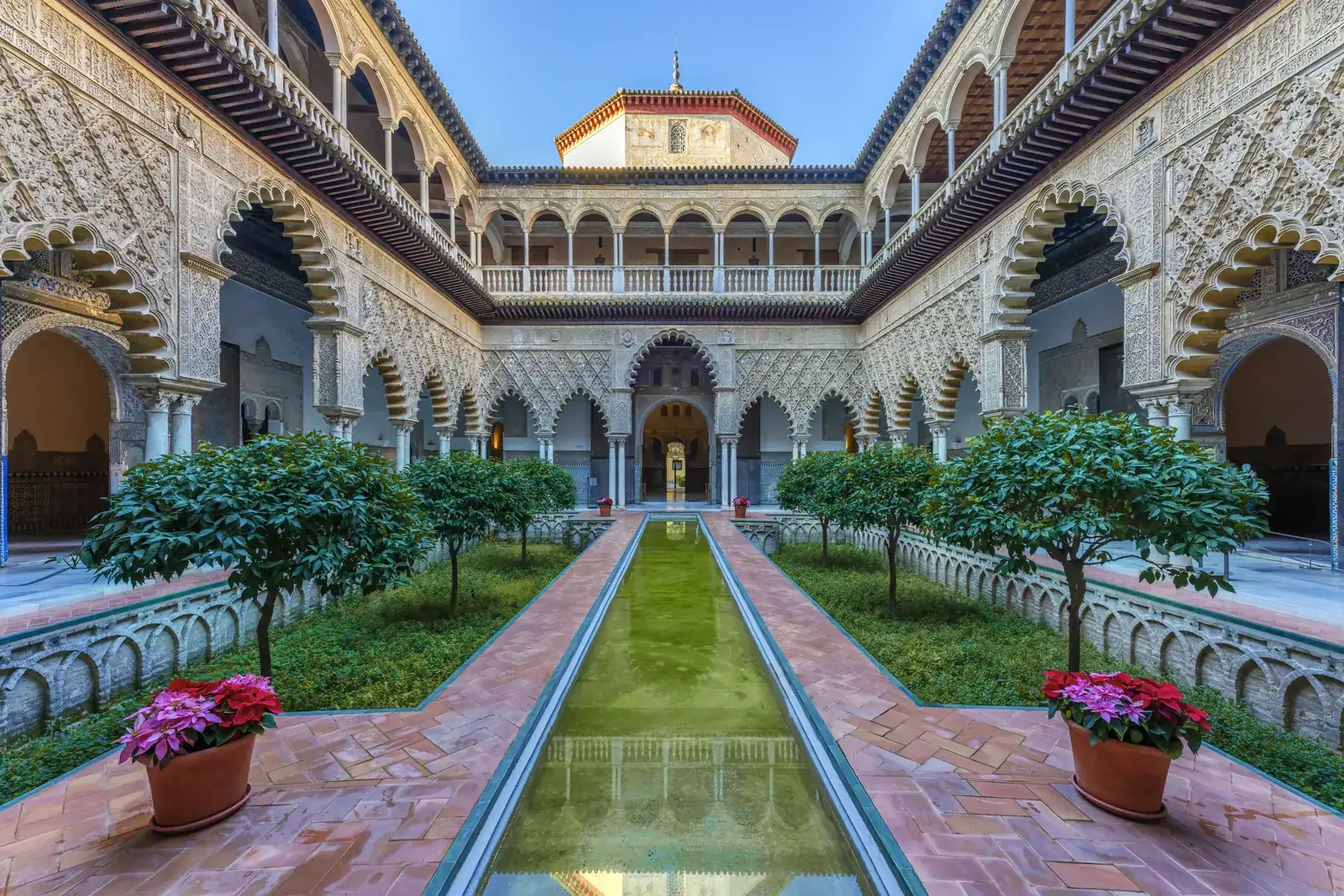
This royal palace, still used by the royal family, blends Mudéjar, Gothic and Renaissance architecture. The Palace of Peter I, with the Courtyard of the Maidens, is its heart; the vast gardens deserve at least an hour. The Alcázar is a UNESCO World Heritage Site together with the cathedral and the Archivo de Indias. It is the most sought-after sight in the city: book a time slot online, ideally at opening time.
The cathedral and the Giralda
Built on the site of the great mosque, Seville cathedral is one of the largest Gothic churches in the world. It contains the tomb attributed to Christopher Columbus and a monumental altarpiece. The Giralda, its bell tower, is the former Almohad minaret: you climb a series of ramps, with no steps, to a view over the city’s rooftops. Next door, the Archivo de Indias holds the archives of the Spanish empire in the Americas.
The Santa Cruz quarter
The former Jewish quarter lies at the foot of the Alcázar: narrow lanes, shady little squares (Plaza de Doña Elvira, Plaza de Santa Cruz), flower-filled patios and the Murillo gardens. It is the most visited quarter, and the most pleasant early in the morning. The Hospital de los Venerables, a former Baroque almshouse, is open to visitors.
Plaza de España and María Luisa Park
Built for the 1929 Ibero-American Exposition, Plaza de España forms a vast semicircle lined with a canal and tiled (azulejo) benches dedicated to the Spanish provinces. The neighboring María Luisa Park offers shade, fountains and pavilions from the same exhibition. As at all busy tourist spots, keep an eye on your belongings.
Triana, across the river
Linked to the center by the Isabel II Bridge, Triana is the historic quarter of potters, sailors and flamenco artists. Visit the Triana market, built over the remains of San Jorge castle (seat of the Inquisition, presented in a small interpretation center), the ceramics workshops and shops, and Calle Betis, lined with bars facing the Torre del Oro.
Las Setas (Metropol Parasol)
This huge wooden structure, opened in 2011 on Plaza de la Encarnación, houses a market, Roman remains in the basement and a panoramic walkway on top. It is especially pleasant at sunset.
The Torre del Oro, the Maestranza and the riverside
Along the Guadalquivir, the Torre del Oro, a 13th-century Almohad tower, houses a small naval museum. A little further on, the Maestranza bullring can be visited along with its bullfighting museum. The riverside walk is a good way to link the center with Triana and María Luisa Park.
Palaces and museums
The Casa de Pilatos and the Palacio de las Dueñas are fine aristocratic mansions with patios mixing Mudéjar and Renaissance styles. The Museum of Fine Arts, in a former convent, gathers Sevillian Golden Age painting (Murillo, Zurbarán, Valdés Leal). For flamenco, several tablaos and a museum devoted to the art put on shows every evening.
Day trips from Seville
Itálica: ruins of a Roman town at Santiponce, a few kilometers north, with a large amphitheater and mosaics.
Córdoba: the Mosque-Cathedral and the Jewish quarter, about 45 minutes away by high-speed train.
Cádiz and Jerez de la Frontera: the old town of Cádiz by the ocean, the bodegas and the equestrian school of Jerez, reachable by train.
Carmona: a small hilltop town, under an hour by bus.
Ronda and the white villages: further away, easier by car or on an organized excursion.
Granada: possible in a day, but the Alhambra really deserves a night there.
Day 1: cathedral and Giralda at opening time, Archivo de Indias, Santa Cruz quarter; in the evening, a flamenco show
Day 2: Real Alcázar and its gardens in the morning, Plaza de España and María Luisa Park late in the day
Day 3: Triana and its market, Torre del Oro, Maestranza, then Las Setas at sunset
Day 4: Casa de Pilatos, Museum of Fine Arts, Palacio de las Dueñas, or a trip to Itálica
Day 5: day trip by train to Córdoba or Cádiz
With only two days, keep the cathedral, the Alcázar, Santa Cruz, Plaza de España and an evening in Triana. Book the Alcázar and the cathedral before you go.
Seville airport transfer: EA bus, flat-rate taxi and private transfer
Seville-San Pablo airport has no train or metro link: the choice is between the EA bus run by the municipal company Tussam and taxis, which charge a flat fare to the city. Fares and timetables change: check them on the official Aena (Seville airport) and Tussam websites before you travel.
EA bus (Tussam)
The EA line links the airport with the city center, stopping at Santa Justa station. Check the current fare, payment options and first and last departures on the operator’s website.
Taxi: the airport flat rate
Seville city taxis apply a flat fare between the airport and the city, with a different rate at night, at weekends and on public holidays. Outside the city, interurban rates apply. Ask for a receipt in case you need to make a complaint.
Booking a transfer in Seville
A private transfer booked in advance (a driver waiting on arrival, price fixed at booking) makes most sense for a late arrival, bulky luggage, a family trip with young children or a group sharing the cost. It also makes sense if you are heading straight to Córdoba, Cádiz or the coast. Before booking, check what the price includes (tolls, luggage, waiting time if your flight is late), the exact meeting point in the terminal, the cancellation terms and the name of the company that actually operates the trip.
Where to stay in Seville
Santa Cruz and the cathedral area: as close as possible to the monuments, charming but very touristy and more expensive
El Arenal: between the cathedral and the river, central and practical
Centro (around Calle Sierpes and Las Setas): shopping streets, lively, well placed for doing everything on foot
Alameda de Hércules: more local, bars and restaurants, a little further from the monuments
Triana: neighborhood atmosphere, a few minutes’ walk from the center across the bridge
Near Santa Justa station: practical for train day trips, less charm
Many places to stay occupy old houses built around a patio. In summer, air conditioning is essential; a pool or rooftop terrace is a real plus. For Holy Week and the April Fair, book several months ahead: prices rise sharply.
Getting around Seville
On foot: the old town is flat and most sights are less than a 20-minute walk from each other.
From the airport: a city bus links the airport with the center and Santa Justa station; taxis also make the trip.
Tram and metro: a short tram line crosses the center; the single metro line mainly serves outlying districts.
Bike: the city has many cycle lanes and a bike-sharing service.
Train: Santa Justa station links Seville with Córdoba and Madrid by high-speed train, as well as with Cádiz and Jerez.
Car: unnecessary in town (restricted center, difficult parking); useful for the white villages.
When to go to Seville: month-by-month climate
The best time to visit Seville is from March to May and from October to early November: 21 to 28 °C (70 to 83 °F) in the afternoon, with cool nights. From June to September, the heat is overwhelming: July and August exceed an average high of 36 °C (97 °F), making Seville one of the hottest big cities in Europe. Winter is mild and sunny, but the rain is concentrated between October and April.
The table uses the 1991-2020 normals for the Seville airport station published by AEMET. The city center, with more stone and less greenery, can be slightly hotter than these values.
Month
High °C (°F)
Low °C (°F)
Rain mm (in)
Crowds
Prices
Verdict
January
16.3 (61)
6.0 (43)
56 (2.2)
Low
Low
⚠️ Mild days, cold nights, few visitors
February
18.3 (65)
7.0 (45)
46 (1.8)
Low
Low
⚠️ Pleasant, orange blossom late in the month
March
21.6 (71)
9.5 (49)
47 (1.9)
Medium
Medium
✅ Mild, ideal for walking; Holy Week in some years
April
24.0 (75)
11.6 (53)
52 (2.0)
Very high (Holy Week, Feria)
Very high
✅ Excellent weather, but festivals and prices at their peak
May
28.2 (83)
14.9 (59)
34 (1.3)
High
High
✅ Hot and dry, courtyards in bloom
June
32.9 (91)
18.5 (65)
6 (0.2)
Medium
Medium
⚠️ Already very hot in the afternoon
July
36.3 (97)
20.7 (69)
1 (0.0)
Low to medium
Medium
❌ Extreme heat, early-morning sightseeing only
August
36.2 (97)
20.9 (70)
3 (0.1)
Low to medium
Medium
❌ Extreme heat, city slows down
September
31.6 (89)
18.4 (65)
33 (1.3)
Medium
Medium
⚠️ Still very hot early in the month
October
26.3 (79)
14.9 (59)
75 (3.0)
High
High
✅ Mild again, showers return
November
20.3 (69)
10.1 (50)
73 (2.9)
Medium
Medium
⚠️ Mild but wetter
December
16.9 (62)
7.4 (45)
77 (3.0)
Medium (holidays)
Medium
⚠️ Wettest month, Christmas lights
Temperatures and precipitation: 1991-2020 normals for the Seville airport station, Spanish State Meteorological Agency (AEMET). Crowds and prices: estimate based on tourist seasons.
According to the same normals, it rains on average 6 days a month from December to April, against less than one day in July and August. Sunshine exceeds 360 hours in July and stays around 175 to 200 hours a month in winter.
When to go to Seville: the essentials
Best periods: March to May, October and early November
Hottest month: July, with an average high of 36.3 °C (97 °F) (August 36.2 °C / 97 °F)
Driest month: July, with under 1 mm of rain
Wettest month: December (77 mm / 3.0 in), followed by October and November
Major festivals: Holy Week then the April Fair, in spring
Cheapest period: July-August (because of the heat) and winter outside the holidays
Spring (March to May): the best season
Temperatures rise from 22 °C (72 °F) in March to 28 °C (83 °F) in May, orange blossom scents the city and the patios are in bloom. It is also the season of Seville’s two great festivals: Holy Week and the Feria. During these periods, the city is packed, some central streets are closed by processions and accommodation costs much more.
Pros: ideal walking weather, long days, festive atmosphere
Cons: prices and crowds at their peak during the festivals, some showers in March-April
Our advice: if you are not coming for the festivals, choose a week in March, April or May outside their dates
Summer (June to September): the heat
It hardly rains any more, but heat becomes the main obstacle: average highs above 36 °C (97 °F) in July and August, and heatwaves that go well beyond. Locals live early in the morning and late in the evening; many shops and family restaurants close for part of August.
Pros: prices often lower, fewer visitors, lively evenings on terraces
Cons: heat hard to bear in the afternoon, risk of heatwaves
Who for? Travelers who cope well with heat and plan their visits for the morning and evening
Autumn (October to November): the second good season
October brings back afternoons of 26 °C (79 °F) and big crowds. Rain returns (75 mm / 3.0 in in October) as showers, sometimes stormy. November stays mild (20 °C / 68 °F) and quieter.
Pros: pleasant temperatures, soft light
Cons: more frequent showers, shorter days
Our advice: the second half of October, once the heat has eased
Winter (December to February): mild and quiet
Afternoons stay mild (16 to 18 °C / 61 to 65 °F) and often sunny, but nights are cool (6 to 7 °C / 43 to 45 °F) and many old buildings are poorly heated. It is the ideal time to visit the monuments without queues.
Pros: few visitors, moderate prices, mild weather that is rare in Europe at this time of year
Cons: cold nights, short days, possible rain
Seville month by month
January: Mild in the afternoon (16 °C / 61 °F), cold at night (6 °C / 43 °F). Few visitors: a good month for the Alcázar and the cathedral.
February: 18 °C (64 °F) in the afternoon, often dry. The orange trees begin to blossom.
March: Mild (22 °C / 72 °F). Depending on the date of Easter, Holy Week may fall in late March: check before booking.
April: 24 °C (75 °F), but the most sought-after month: Holy Week or the Feria, sometimes both. Book very early.
May: 28 °C (83 °F), clear skies. May Crosses (Cruces de Mayo) in some neighborhoods early in the month.
June: average high of 33 °C (91 °F): sightseeing in the morning, siesta in the afternoon.
July: The hottest (36.3 °C / 97 °F) and driest month. Only for those who can handle the heat.
August: Just as hot (36.2 °C / 97 °F). The city slows down, and some places close.
September: Still 32 °C (90 °F) on average, cooling toward the end of the month. In even-numbered years, the Flamenco Biennial livens up the city.
October: 26 °C (79 °F), showers return. One of the best months to visit.
November: 20 °C (68 °F), more rain but few visitors. Prices fall.
December: 17 °C (63 °F), the wettest month. Nativity scenes and Christmas lights in the center.
Seville’s major festivals
Period
Event
Good to know
March or April (dates vary)
Holy Week (Semana Santa)
Processions of brotherhoods day and night; center very congested
April or May, usually after Holy Week
April Fair (Feria de Abril)
Casetas (marquees) in Los Remedios, horses, flamenca dresses; many casetas are private
Early May
Cruces de Mayo
Flower-decked crosses in some neighborhoods
September, in even-numbered years
Flamenco Biennial
Shows all over the city
December
Christmas
Lights, nativity scene markets
The dates of Holy Week and the Feria change every year: check them before booking.
For Holy Week and the Feria, book 4 to 6 months ahead: central accommodation is snapped up. For the rest of spring and for October, 2 to 3 months is usually enough; in summer and winter, a few weeks. Seville airport has international flights from several European hubs; check current routes from your departure airport. The high-speed train from Madrid is an alternative if you combine the two cities, in which case it helps to know the best time to visit Madrid, whose summers are very hot.
Budget for a stay in Seville
Seville stays affordable for meals, thanks to tapas. Accommodation varies greatly by season. Indicative amounts per person per day, excluding flights:
Item
Budget
Comfort
Accommodation (shared double room)
roughly €30 to €50
roughly €80 to €150
Meals
roughly €25 to €35
roughly €45 to €70
Transport (bus, tram)
roughly €3 to €6
roughly €10 to €20
Sights and shows
roughly €10 to €20
roughly €20 to €30
Total per day
roughly €70 to €110
roughly €150 to €260
Indicative estimates. Accommodation prices can double during Holy Week and the Feria.
To cut costs: have a menu of the day at lunchtime, order tapas at the bar rather than at a table, and look into the free visiting slots offered by some monuments, often bookable in advance.
Who is Seville for?
Our verdicts by profile, based on the places, conditions and budget ranges in this guide:
Culture and heritage: ideal: Real Alcázar, cathedral and Archivo de Indias on the UNESCO list, Casa de Pilatos, Museum of Fine Arts and flamenco every evening.
Couples: a very good choice: accommodation around a patio, rooftop terraces, sunset on Las Setas and evenings in Triana.
Festivals: yes, in spring: Holy Week then the April Fair. Book 4 to 6 months ahead and expect much higher prices.
Families: yes, outside summer: the city is flat and compact, and Plaza de España and María Luisa Park offer space and shade. In July-August, the average high exceeds 36 °C (97 °F).
Budget travel: yes: roughly €70 to €110 per day, thanks to set lunch menus and tapas at the bar. Avoid Holy Week and Feria weeks.
Day trips: very convenient: Córdoba about 45 minutes away by train, Cádiz and Jerez by train, Itálica and Carmona nearby.
Beach: no: Seville is inland; Cádiz, on the ocean, can be reached by train.
Entry requirements, health and safety
US citizens (travel.state.gov, last updated August 11, 2025): Schengen rules apply. Your passport should be valid for at least 3 months beyond your stay, and you need sufficient proof of funds and a return ticket.
UK citizens (GOV.UK, updated 12 August 2026): no visa for up to 90 days in any 180-day period as a tourist. Your passport must have been issued less than 10 years before the day you arrive and be valid for at least 3 months after the day you plan to leave the Schengen area. The EU Entry/Exit System (EES) means fingerprints and a photo may be taken at your first entry, free of charge.
Lost passport: according to GOV.UK, you cannot use a police report to leave Spain: you need a new passport or an emergency travel document.
Health: UK travellers can use a GHIC or EHIC for medically necessary state healthcare, which does not replace travel insurance; whatever your nationality, take out insurance covering medical costs. Emergency number: 112.
Safety: the U.S. Department of State notes that pickpocketing and theft are very common at tourist spots, airports, train stations and beach destinations. GOV.UK warns of extreme heat in summer, wildfires and flash floods (follow AEMET warnings), and of strong undercurrents on some beaches: never swim when the red flag is flying.
Alerts: GOV.UK mentions the Spanish police AlertCops app, which lets you contact the police discreetly.
Meal times: lunch is around 2 pm and dinner rarely before 9 pm; many restaurants close between the two services.
Bookings: the Alcázar, the cathedral and flamenco shows can be booked online, which is advisable in spring.
Heat: from June to September, visit at opening time, carry a bottle of water and plan an afternoon break.
Dress: covered shoulders and knees are expected in churches.
Money: cards are accepted almost everywhere; keep some cash for small bars.
Mobile data: check your roaming charges before you go, or use a travel eSIM.
Further reading
Seville is one of the hottest big cities in Europe: compare the seasons with when to go to Andalusia and the best time to visit Spain before choosing your dates. For a tour of the region, our Andalusia travel guide covers Córdoba, Granada and the white villages. And if you can’t decide on the month, our selection where to go in April compares Seville with other spring destinations.
Seville pass: do you need a tourist card?
Unlike Madrid or Barcelona, Seville has no Go City pass (the Go City Seville page did not exist when we checked on 24 October 2026). In Seville, the “pass” therefore comes down to buying tickets for the two main monuments on their official websites.
Cathedral and Giralda: official prices
Ticket
Online
At the ticket office
General (cathedral, Giralda and El Salvador)
€13
€14
Reduced (over-65s, students up to 25, etc.)
€7
€8
Guided tour “Footprint of the Sacred” (roofs, crypt, dressing room)
€20
—
Prices in force from 1 January 2026 on catedraldesevilla.es, checked 26 October 2026.
Free: children up to 13 accompanied by an adult, with official proof.
Opening hours: Monday to Thursday 10:15 am to 6 pm (ticket office closes 5:30 pm), Friday and Saturday 10:15 am to 5 pm (ticket office closes 4:30 pm), Sunday 2:30 pm to 7:30 pm (ticket office closes 7 pm). They can change for worship or cultural events.
Bonus: the joint ticket includes entry to the Church of El Salvador.
Real Alcázar
The Real Alcázar sells timed tickets on its official website (alcazarsevilla.org). Check the current price when you book, and beware of sites that resell entry at a mark-up without saying so.
Method: add up the tickets for the sights that interest you (Alcázar, cathedral, Metropol Parasol, Casa de Pilatos…) at the official price. Example (Destination de Voyage calculation based on the cathedral price list): for a couple, booking the cathedral online rather than at the ticket office saves €2 and avoids the ticket queue. A “combined” guided tour sold by a reseller is only worthwhile if the guide adds something: compare its price with the total of the official tickets.
Buying tickets in Seville
Official site or reseller: check the time slot, what is included (guide, audio guide, access to upper levels), the meeting point and the cancellation terms.
Frequently asked questions
How many days do you need to visit Seville?
Three days cover the essentials: the cathedral and the Giralda, the Alcázar, Santa Cruz, Plaza de España and Triana. Add one or two days for Córdoba, Cádiz or Itálica.
What is the best month to visit Seville?
May and October, as well as March and April outside the festivals: 21 to 28 °C (70 to 83 °F) in the afternoon according to AEMET 1991-2020 normals. Avoid July and August if you don’t cope well with heat.
Is Seville too hot in summer?
July and August have average highs above 36 °C (97 °F), and heatwaves go well beyond that. Sightsee early in the morning and in the evening, and choose air-conditioned accommodation.
Do you need to book the Alcázar in Seville?
Yes, it is strongly recommended: time slots sell out fast, especially in spring. Book on the monument’s official website and arrive at opening time.
Can you visit Seville on foot?
Yes. The historic center is flat and compact; most sights are less than a 20-minute walk from each other. The tram and buses help for longer trips.
Is Seville a safe city?
Generally yes, but the U.S. Department of State notes that pickpocketing and theft are very common at tourist spots, airports, stations and beaches (travel.state.gov, last updated August 11, 2025). Watch your belongings in crowds.
Our sources
Spanish State Meteorological Agency (AEMET): 1991-2020 normals for the Seville airport station
Entry requirements, health and safety read on 26 October 2026: U.S. Department of State, Spain country information (travel.state.gov, last updated August 11, 2025), and UK FCDO, foreign travel advice for Spain (GOV.UK, updated 12 August 2026)
Catedral de Sevilla, “Schedules and rates” (catedraldesevilla.es), checked 26 October 2026


 FlightsKiwi.comCompare flights and airline combinations to Seville.Compare flights