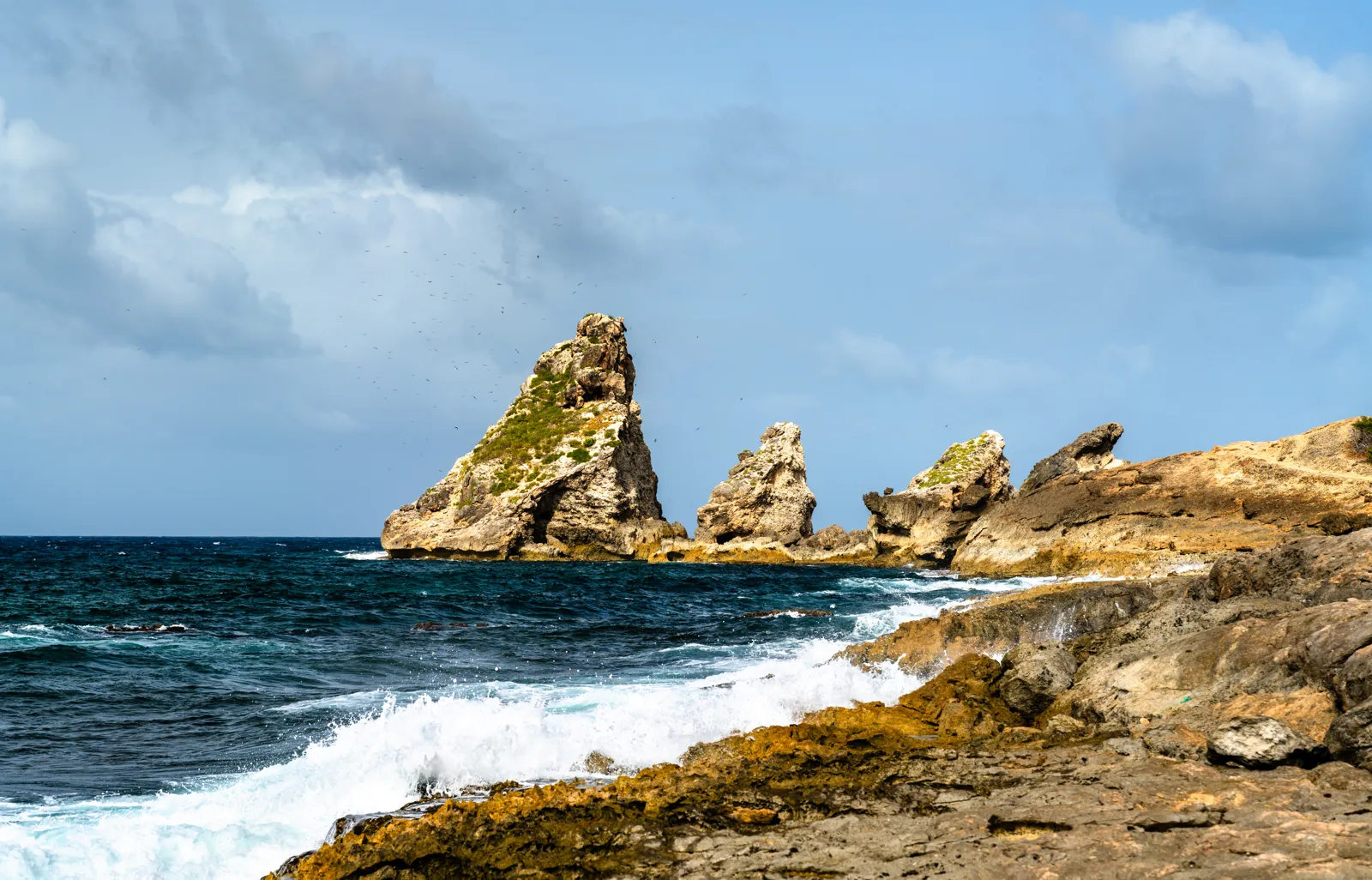
The only French territory in South America, French Guiana is more than 90% covered by Amazon rainforest. People come for the nature: rivers explored by dugout canoe, marshes, sea turtle nesting beaches and the Salvation Islands with their former penal colony. It is also home to the Guiana Space Centre in Kourou. The currency is the euro, and there is one health requirement not to forget: the yellow fever vaccination. This French Guiana travel guide brings together what to see, itineraries, budget and entry requirements.
To locate towns, regions, terrain, national parks and airports, see our map of French Guiana.
Time zoneUTC−3, no daylight saving · details3 h behind London and 2 h ahead of New York in winter
AirportsCayenne Félix Eboué (CAY)Check current routes with the airlines
EntryUS and UK: visa-free up to 90 days; yellow fever vaccination certificate required · travel.state.gov · GOV.UK
Electricitycheck voltage and plug types before you leave · plugs
Budgetroughly €80–120 per person per day on a budget · details
When to go to French Guiana
The best period is the dry season, from August to November: in Cayenne, September and October get only about 55 to 65 mm (2.2 to 2.6 in) of rain, compared with 600 mm (23.6 in) in May. From December to July, rain is heavy, with a possible lull in February–March (the « little summer of March »). The rainy season has its advantages: carnival from January to February or March, and turtle nesting from April to July. According to the UK FCDO (GOV.UK, updated 10 December 2025), there is a risk of tropical storms during the rainy season from December to July. Details, Météo-France normals and month-by-month advice are in our article best time to visit French Guiana.
What to see in French Guiana: the highlights
Cayenne
The capital can be explored on foot in a day: Place des Palmistes, Place Victor-Schoelcher, colorful Creole houses, Fort Cépérou and its view over the estuary, and the covered market, where you can try Vietnamese soup or local fruit juices. The Alexandre-Franconie departmental museum covers the territory’s history and wildlife. In the evening the town empties quickly: get around by car or taxi.
Rémire-Montjoly and Cayenne Island
Just east of Cayenne, Rémire-Montjoly has most of the beaches on Cayenne Island and several marked forest trails, such as Mahury, Rorota and Montagne Bourda. The sea is brown, loaded with Amazon sediment: it is better for walks than for swimming. The beaches host nesting turtles in season.
Kourou and the Guiana Space Centre
Kourou is known for the Guiana Space Centre (CSG), the launch site for European rockets. Guided tours of the site and a space museum are offered at certain times, and some launches can be watched from viewing sites, with registration. Check conditions and dates on the CNES and launch operator websites before your trip.
The Salvation Islands
About 15 km (9 mi) off Kourou, Île Royale, Île Saint-Joseph and Devil’s Island housed the penal colony until the mid-20th century. You can visit the prison buildings, overgrown with vegetation, among monkeys, agoutis and macaws. Boats and catamarans leave Kourou for the day, and you can also stay overnight on Île Royale. Devil’s Island cannot be visited.
Saint-Laurent-du-Maroni
The territory’s second town, on the Maroni River that marks the border with Suriname, Saint-Laurent has kept the Camp de la Transportation, where convicts arrived, open for guided tours. It is also the starting point for dugout canoe trips on the river and to the villages of the west.
Awala-Yalimapo and Mana
At the western end of the coast, the beaches of Awala-Yalimapo and Mana are among the world’s main nesting sites for leatherback turtles. The Amana nature reserve manages viewing, mainly from April to July. Follow the instructions of rangers and local associations: no white light, no flash, keep your distance from the animals.
The Kaw marshes
Southeast of Cayenne, the Kaw-Roura marshes nature reserve is a vast wetland with black caimans, hoatzins and many other birds. It is explored by dugout canoe, often with a night on a floating carbet (open-sided shelter). Trips leave from Cayenne or Roura with local operators.
Cacao and Saül
Cacao, a village founded by Hmong refugees in the 1970s, is known for its Sunday morning market, its fruit stalls and its Asian food. Further away, Saül, in the heart of the Guiana Amazonian Park and reached mainly by plane, is the starting point for hiking trails through primary forest.
Itinerary ideas for French Guiana
7 to 10 days: the coast
Days 1 and 2: Cayenne on foot, Fort Cépérou, the market, the Rémire-Montjoly trails
Day 3: Cacao market (Sundays) and back via Roura
Days 4 and 5: the Kaw marshes by dugout canoe, with a night in a carbet
Days 6 and 7: Kourou, the Space Centre, a day or a night on the Salvation Islands
Days 8 to 10: west to Mana, Awala-Yalimapo (turtles in season), Saint-Laurent-du-Maroni and the Camp de la Transportation
2 weeks: coast and forest
Days 1 to 3: Cayenne, Rémire-Montjoly, Cacao
Days 4 and 5: the Kaw marshes
Days 6 to 8: Kourou and the Salvation Islands
Days 9 to 11: Saint-Laurent-du-Maroni, a two- or three-day dugout canoe trip on the Maroni with a guide
Days 12 to 14: a stay in Saül, by plane from Cayenne, to hike in the forest, or Mana and Awala-Yalimapo
Distances are long: allow about 3 hours by road between Cayenne and Saint-Laurent-du-Maroni. The interior is not connected to the coast by road: you reach it by plane or dugout canoe.
Who is French Guiana for?
Our verdicts by traveler profile, based on the information in this guide:
Profile
Our verdict
Why
Nature and adventure
✅ Ideal
Amazon rainforest, the Kaw marshes by dugout canoe with a night in a carbet, the trails of Saül in the Amazonian Park.
History
✅ Yes
The Salvation Islands and the Camp de la Transportation in Saint-Laurent-du-Maroni tell the story of the penal colony.
Space enthusiasts
✅ Yes
Guiana Space Centre in Kourou: tours and viewing of some launches with registration, depending on the period.
Families
⚠️ Possible
Salvation Islands, leatherback turtles at Awala-Yalimapo, the Space Centre: good outings, but proof of yellow fever vaccination is required to enter.
Budget travelers
⚠️ Possible
High cost of living: roughly €80–120 per person per day, excluding flights and forest expeditions.
Beach
❌ Not ideal
Brown sea, loaded with Amazon sediment: the beaches are for walking more than swimming.
Budget for a trip to French Guiana
Item (per day)
Budget
Comfort
Accommodation (double room, guesthouse or carbet)
roughly €50–90
roughly €110–200
Meals (per person)
roughly €20–35
roughly €45–70
Car rental
roughly €35–50
roughly €50–80
Activities (boat, dugout canoe, tours)
roughly €0–40
roughly €50–150
Indicative ranges excluding flights. Multi-day forest expeditions and domestic flights to Saül or Maripasoula come on top.
Overall, allow roughly €80–120 per person per day on a budget and €160–260 in comfort, excluding flights and forest expeditions. The cost of living is high, especially for imported goods. Markets, snack bars and the food of the different communities (Creole, Hmong, Chinese, Brazilian) let you eat at a reasonable price. Guided dugout canoe trips and nights in a carbet are often the biggest cost after the flight.
Getting around French Guiana
A rental car is essential on the coast: one main road links Saint-Laurent-du-Maroni to Saint-Georges-de-l’Oyapock via Kourou and Cayenne. Intercity public transport exists but is not well suited to visitors. According to the U.S. Department of State (travel.state.gov, last updated July 30, 2026), primary roads are paved and well maintained, but you should avoid driving at night (unlit roads and vehicles, stray livestock), and there are few or no service stations between towns.
Driving licence: according to the UK FCDO (GOV.UK, updated 10 December 2025), you can drive with a UK photocard licence; holders of a paper licence may need a photocard or the correct International Driving Permit, and rental companies may require an IDP anyway. According to travel.state.gov, US drivers need a valid licence and an International Driving Permit. The legal blood alcohol limit is 0.05% (both sources), and French driving laws apply (GOV.UK).
The interior is reached by plane (to Saül, Maripasoula or Grand-Santi) or by dugout canoe on the rivers. Always go with an established operator: the U.S. Department of State also recommends a well-established tour company for trips into the interior.
Where to stay in French Guiana
Cayenne and Rémire-Montjoly: the widest choice of hotels and rentals, practical for a first stay
Kourou: hotels and apartment residences, a base for the Space Centre and the Salvation Islands
Salvation Islands: accommodation on Île Royale, in a room or a hammock; limited capacity
Saint-Laurent-du-Maroni and the west: small hotels, guesthouses and carbets in Mana and Awala-Yalimapo
Carbets: traditional open-sided shelters with hammocks, typical of forest and marsh trips
Entry requirements for French Guiana
US citizens
According to the U.S. Department of State (travel.state.gov, last updated July 30, 2026), you can enter French Guiana for up to 90 days for tourism or business without a visa. The page notes that French Guiana is an overseas department of France but not part of the Schengen area, and that immigration officers may ask for evidence of travel or health insurance. Proof of yellow fever vaccination (or a doctor’s written statement that it is not medically recommended) is required. The same page still states that non-citizens aged 12 and over must be fully vaccinated against COVID-19; the UK FCDO page does not mention this requirement, so check with the French embassy before you travel.
UK citizens
According to the UK FCDO (GOV.UK foreign travel advice, updated 10 December 2025), French Guiana is an overseas department of France and part of the EU. You can visit without a visa for up to 90 days for tourism or business. Your passport must have an expiry date at least 3 months after the date you plan to leave. You must have a certificate proving yellow fever vaccination, and you may need it for onward travel to some other countries. You cannot bring meat, milk or products containing them into EU countries, with some exceptions such as powdered baby milk.
Entry requirements checked on 24 October 2026; check them again before you travel. If you plan to cross into Suriname or Brazil, check those countries’ rules too.
Health and safety
Yellow fever: vaccination is required to enter (GOV.UK; travel.state.gov). The regional health agency (ARS Guyane) states that it is compulsory from 12 months of age. Get it at a yellow fever vaccination center well before departure.
Mosquito-borne diseases: the UK FCDO (GOV.UK, updated 10 December 2025) lists Zika, dengue and yellow fever among health risks and advises checking vaccine recommendations at least 8 weeks before your trip. The U.S. Department of State lists dengue, malaria, yellow fever and Zika, recommends CDC-approved repellents and insecticide-treated nets, and says malaria chemoprophylaxis is recommended for all travelers, even for short stays. See a doctor or travel clinic before you go.
Medical care: GOV.UK describes general health facilities as very good, equivalent to mainland France, and says UK travelers need a GHIC or EHIC for medically necessary state healthcare (it is not a substitute for travel insurance). The U.S. Department of State says medical care is limited outside urban areas, with intensive care and trauma units only at the Centre Hospitalier Andrée Rosemon in Cayenne, and strongly recommends medical evacuation insurance.
Safety: according to GOV.UK, crime levels are low, but there is a risk of robbery in some areas of Cayenne, especially after dark: avoid isolated areas and secluded beaches at night and take a licensed taxi after using an ATM. The U.S. Department of State notes petty street crime in the major towns and advises driving with windows closed and doors locked. Do not head into the forest alone: go with a guide. Wear a life jacket at sea and on rivers.
Emergencies: 112 (general), 15 (ambulance), 17 (police), 18 (fire), according to GOV.UK and travel.state.gov.
Practical tips for French Guiana
Money: the euro. Bring cash for the interior and markets. Estimate your spending with our currency converter.
Phone and internet: check your provider’s roaming terms before you leave, and do not count on a signal in the forest.
Etiquette: always ask before photographing people, especially in Amerindian and Maroon villages.
Food: try bouillon d’awara (a traditional Easter dish), colombo, accras, smoked fish and local fruit juices (açaí, passion fruit).
What to pack: repellent, light long clothing, rain gear, closed shoes, a red-light headlamp for turtle watching, and a hammock and mosquito net for nights in a carbet if the operator does not provide them.
Customs: check your home country’s customs allowances for the return (e.g. CBP in the US, HMRC in the UK).
Not for a short stay if you are a US or British citizen: both can visit for up to 90 days without a visa (travel.state.gov, last updated July 30, 2026; GOV.UK, updated 10 December 2025). British passports must be valid for at least 3 months after the date you leave. Checked on 24 October 2026; check the latest rules before you travel.
Is the yellow fever vaccine required for French Guiana?
Yes. Both GOV.UK and travel.state.gov say proof of yellow fever vaccination is required to enter, and the regional health agency (ARS Guyane) sets the requirement from 12 months of age.
How many days do you need in French Guiana?
A week to ten days covers the coast, from Cayenne to Saint-Laurent-du-Maroni, with the Salvation Islands and the Kaw marshes. Allow two weeks to add a dugout canoe trip or a stay in Saül.
Can you swim in French Guiana?
Yes, but the sea along the coast is brown because of Amazon sediment. For clearer water, the Salvation Islands have a former penal colony pool and a few coves, and the freshwater creeks of the interior are popular.
What is the best time to visit French Guiana?
August to November, during the dry season. September and October are the driest and sunniest months.
How much does a trip to French Guiana cost?
Excluding flights, on a budget allow roughly €50–90 a night for a double room, guesthouse or carbet, €20–35 per person for meals and €35–50 a day for car rental; in comfort, roughly €110–200 a night and €45–70 for meals. Dugout canoe trips, nights in a carbet and flights to Saül add to the bill.
Do you need a car to visit French Guiana?
For the coast, yes: public transport is limited and sites are far apart (about 3 hours by road between Cayenne and Saint-Laurent-du-Maroni). The interior is reached by dugout canoe or plane, often with a guide.
Discover our other destinations in Latin America, such as neighboring Brazil or Costa Rica, another nature destination. For another French overseas department, see Guadeloupe.
Transparency: this page contains affiliate links, labelled as such. If you book through them we may earn a commission at no extra cost to you; it does not influence our content or recommendations. How we fund the site.