Colourful lanes and Spanish forts in Old San Juan, the El Yunque rainforest, the beaches of Flamenco, Luquillo and Crash Boat, bioluminescent bays: Puerto Rico packs a lot of scenery into an island 160 km (99 mi) long. A US territory with a Hispanic culture, it uses the US dollar and follows US entry rules. This Puerto Rico travel guide brings together the essentials: what to see, itineraries, budget and entry requirements.
To locate the towns, regions, relief, national parks and airports, see our map of Puerto Rico.
Puerto Rico at a glance
CapitalSan Juan
Statusunincorporated territory of the United StatesEstado Libre Asociado (Commonwealth)
LanguageSpanish and EnglishSpanish dominates in daily life; English is common in tourist areas
AirportsSan Juan Luis Muñoz Marín International (SJU) · details
EntryUS: domestic travel; UK: US rules apply, ESTA or visa required · GOV.UK
Electricitycheck voltage and plug type before you travel · plugs
Budgetroughly US$100–170 per person per day on a budget, US$225–450 for comfort · details
When to go to Puerto Rico
The best time is from December to April, ideally February and March, the driest months in San Juan. It is hot all year round (28 to 32 °C / 82 to 90 °F in the afternoon). The Atlantic hurricane season normally runs from June to November (GOV.UK, updated 18 August 2026), with the highest risk from mid-August to mid-October. The south coast, around Ponce, is the driest part of the island. All the details, with NOAA climate normals, are in our article on when to go to Puerto Rico.
What to see in Puerto Rico: the highlights
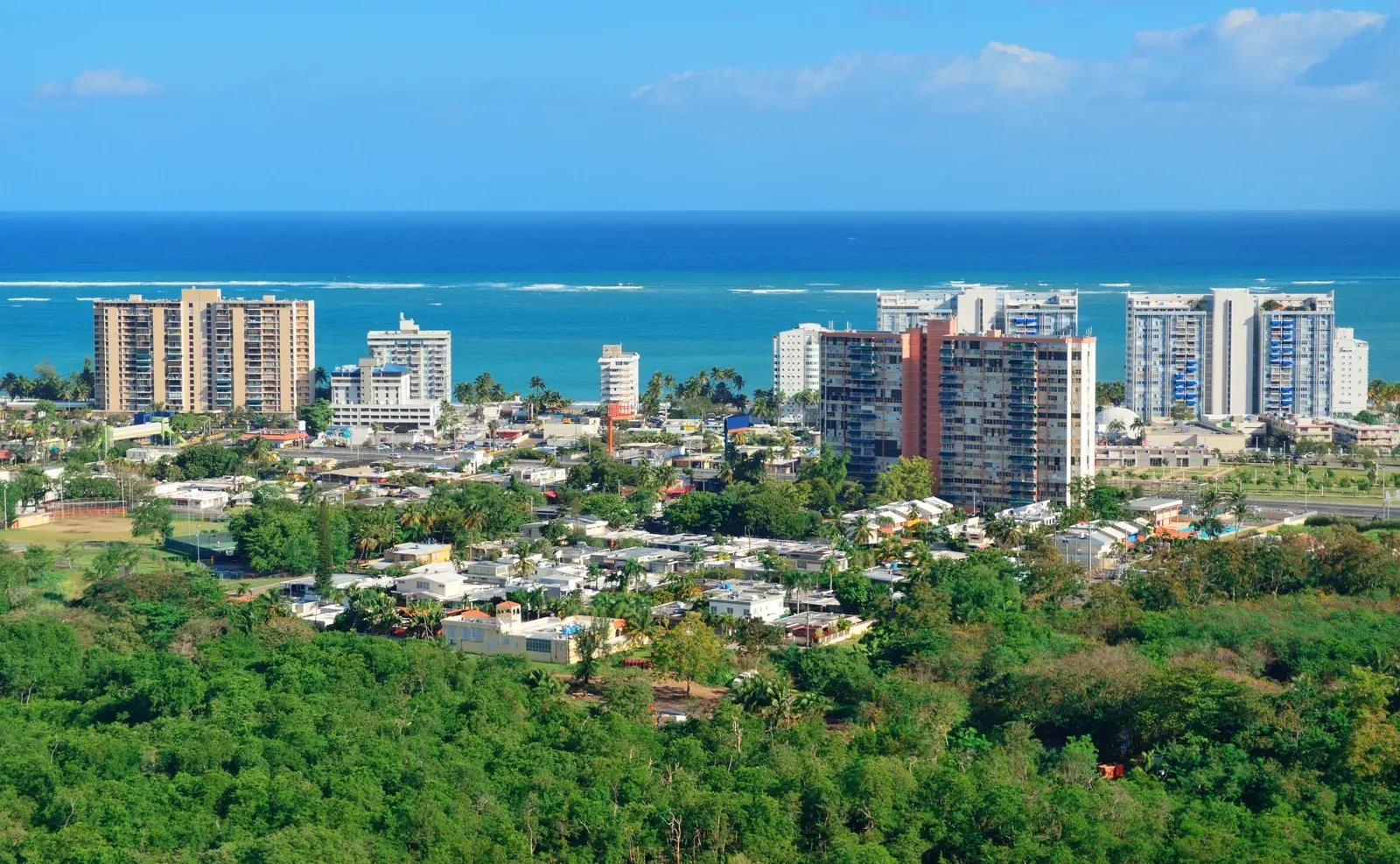
Aerial view of San Juan and the Caribbean Sea, Puerto Rico
Old San Juan
Founded in the early 16th century on an islet that closes off the bay, Old San Juan (Viejo San Juan) is explored on foot: streets paved with bluish stones, colonial houses with pastel façades, San Juan Bautista Cathedral, shady squares, the Paseo de la Princesa along the ramparts and La Fortaleza, the governor’s residence. The district is compact and hilly: wear good shoes and allow at least a day, two if you want to visit the forts without rushing. In the evening, its streets are full of restaurants and bars.
El Morro and San Cristóbal forts
San Juan’s Spanish fortifications are managed by the US National Park Service (San Juan National Historic Site) and are a UNESCO World Heritage Site together with La Fortaleza. Castillo San Felipe del Morro, at the tip of the islet, guards the entrance to the bay: six levels of batteries, a lighthouse and a vast lawn where families fly kites. Castillo San Cristóbal, east of the old town, protected San Juan from attacks by land; it is the largest fortification built by the Spanish in the New World, with tunnels and sentry boxes facing the Atlantic. A single ticket gives access to both forts for 24 hours: $10 per adult, free for those 15 and under, according to the National Park Service. Payment is by card only, no cash. Allow about 1.5 to 2 hours per fort and start early to avoid the heat.
El Yunque National Forest
About 45 minutes’ drive east of San Juan, El Yunque is the only tropical rainforest in the US National Forest System. The PR-191 corridor, on the Río Grande side, leads to the main sites: La Coca Falls, visible from the road, the Yokahú observation tower and several trails to waterfalls and viewpoints. According to the USDA Forest Service, access to this corridor is free and no longer requires a reservation, but the number of vehicles is capped each day (about 200, first come, first served, from 8 am) and it is open from 8 am to 5 pm. Works may close some trails: check the Forest Service’s access conditions page before you go. It rains almost every day in the forest: bring a rain jacket and shoes with good grip.
Luquillo beach
At the foot of El Yunque, the public beach at Luquillo (balneario) is a long curve of sand lined with coconut palms, protected by a reef that often calms the sea: it is one of the most popular with families. The balneario has showers, toilets and paid parking. By the road, the row of Luquillo kiosks serves inexpensive Puerto Rican food. El Yunque in the morning and Luquillo beach in the afternoon is a classic day trip from San Juan.
Culebra and Flamenco Beach
On the island of Culebra, east of the main island, Flamenco Beach is an arc of fine white sand and turquoise water, regularly cited among the most beautiful in the Caribbean. It has basic facilities (showers, toilets, kiosks) and a campsite. The old rusting military tanks left on the sand are a reminder that the US military used the island as a firing range until the 1970s. The neighbouring Tamarindo and Carlos Rosario beaches are good for snorkelling. Culebra is reached by ferry from the Ceiba terminal, on the east coast (fares for non-residents were raised in 2026), or by small plane from San Juan. Seats are limited: book ahead, especially at weekends and in high season.
Vieques and the bioluminescent bay
Larger than Culebra, Vieques combines wild beaches, free-roaming horses and a large nature reserve on former military land. At night, Mosquito Bay is famous for its bioluminescence: micro-organisms light up at the slightest movement of the water. Swimming is prohibited; you see it by kayak or electric boat with a licensed operator, ideally on a moonless night. Two other bioluminescent bays can be visited on the main island: Laguna Grande in Fajardo and La Parguera, in the south-west.
Río Camuy caves
In the north-west of the island, between Camuy, Hatillo and Lares, Río Camuy Cave Park is built around a vast cave network crossed by the Río Camuy, one of the largest underground rivers in the world. The main tour goes down into Cueva Clara, a chamber about 65 m (213 ft) high. The park has closed several times after hurricanes, most recently from September 2022 to February 2023 after Fiona, and limits the number of visitors per day: check that it is open and book before you go.
Ponce and the south coast
The island’s second city, Ponce has kept an elegant centre around Plaza Las Delicias, with its cathedral and the Parque de Bombas, a former fire station striped red and black. The Museo de Arte de Ponce is one of the most important art museums in the Caribbean. The south coast is the driest part of the island, with more arid landscapes, and a good starting point for La Parguera and the Guánica reserve.
Aguadilla, Crash Boat and Rincón
The north-west is the land of surfing and sunsets. In Aguadilla, Crash Boat beach owes its name to the rescue boats of the nearby former Ramey Air Force Base, which responded to plane crashes. It is known for its very clear water, the pier pillars young locals dive from and its local atmosphere at weekends. When the sea is calm, usually in summer, it is good for snorkelling; in winter, the swell draws surfers. Further south, Rincón is the island’s surf capital, with many surf schools. Allow about 2 hours’ drive from San Juan.
Itinerary ideas for Puerto Rico
7 to 10 days: San Juan, El Yunque and the islands
Days 1 to 3: Old San Juan, El Morro and San Cristóbal forts, Condado and Isla Verde beaches
Day 4: El Yunque in the morning, Luquillo beach and kiosks in the afternoon
Day 5: Fajardo, catamaran trip or an evening kayak in the bioluminescent bay
Days 6 to 8: Culebra (Flamenco) or Vieques (Mosquito Bay), by ferry from Ceiba
Days 9 and 10: back to San Juan, last visits before your flight
2 weeks: round the island
Days 1 to 3: San Juan and its forts
Days 4 and 5: El Yunque, Luquillo and Fajardo
Days 6 to 8: Culebra and/or Vieques
Days 9 and 10: Ponce, then La Parguera and the Guánica reserve
Days 11 and 12: Rincón, Aguadilla and Crash Boat beach
Days 13 and 14: back towards San Juan along the north coast (Arecibo), last night near the airport
A car is almost essential once you leave San Juan. Distances look short on the map, but traffic around the capital is heavy: allow plenty of time.
Budget for a trip to Puerto Rico
Puerto Rico’s price level is close to that of the mainland United States, especially for accommodation and car hire. Indicative amounts per person per day, excluding international flights:
roughly US$45–80 (car for one, taxis, ride-hailing)
Activities and excursions
roughly US$10–30
roughly US$45–110
Total per day
roughly US$100–170
roughly US$225–450
Indicative estimates, varying by season. Prices are higher in Condado, Isla Verde and on Culebra, and over the year-end holidays.
Add tips (around 15 to 20% in restaurants, as on the US mainland), taxes added to displayed prices, the ESTA fee for travellers who need one and, for the islands, the ferry or small plane. The San Juan forts cost $10, and many public beaches are free or charge only for parking.
Getting around Puerto Rico
Getting there: most international and mainland flights land at Luis Muñoz Marín International Airport, in Carolina, next to San Juan.
Car hire: the most practical option for El Yunque, the south coast and the west. Road signs are in Spanish, distances in kilometres but speeds in miles. Avoid leaving items on display in the car. According to GOV.UK (updated 18 August 2026), UK travellers can drive in the US on a UK photocard licence but may also need the 1949 international driving permit, which can only be bought in the UK; hire companies often have stricter requirements.
Taxis and ride-hailing: available in San Juan, with fixed fares from the airport to the tourist areas. Ride-hailing apps work in the metropolitan area.
Public transport: San Juan’s bus network and the Tren Urbano light rail serve part of the metropolitan area; they are poorly suited to visiting the rest of the island.
Ferries: to Culebra and Vieques from the Ceiba terminal. Timetables and fares change: check them before you go and arrive early.
Small planes: several regional airlines link San Juan with Culebra and Vieques in about thirty minutes, with strict baggage limits.
Where to stay in Puerto Rico
In San Juan, three areas stand out. Old San Juan lets you see everything on foot, with boutique hotels and apartments in colonial houses. Condado and Ocean Park offer city beaches, restaurants and large hotels a few minutes from the old town. Isla Verde, near the airport, is lined with beachfront hotels. Elsewhere, Fajardo and Río Grande have resorts close to El Yunque, while Culebra, Vieques, Rincón and the south coast mostly offer small properties, guesthouses and rentals.
In high season and over the holidays, book early, especially on Culebra and Vieques, where capacity is limited.
Entry requirements for Puerto Rico
US citizens: Puerto Rico is a US territory, so travel from the mainland is domestic travel. Check with your airline which ID it accepts for boarding.
UK citizens: the UK FCDO’s travel advice for the USA also covers Puerto Rico. According to GOV.UK (updated 18 August 2026), you need either an ESTA (Electronic System for Travel Authorisation, under the Visa Waiver Program) or a US visa, obtained before you travel, and your passport must be valid for the length of your planned stay. A valid ESTA or visa does not guarantee entry. You cannot normally get an ESTA if you have been arrested or have a criminal record, have previously overstayed, were in Iran, Iraq, Libya, North Korea, Somalia, Sudan, Syria or Yemen on or after March 2011, or were in Cuba on or after 12 January 2021; you would then need a visa. GOV.UK also notes that officials may ask to inspect your electronic devices.
Customs: GOV.UK states that there are strict rules on goods brought into or out of the US and that you must declare anything that may be prohibited or subject to tax or duty. For what you can bring home, check your home country’s customs allowances (e.g. HMRC in the UK).
Health and safety
Health: GOV.UK (updated 18 August 2026) lists Zika virus among health risks in the US and its territories, including Puerto Rico: use repellent and cover up. Medical treatment is expensive and some hospitals ask non-residents for a deposit; GOV.UK also notes that UK prescriptions are not valid in the US. Take out travel insurance with adequate medical cover.
Safety: as in any large city, keep an eye on your belongings in San Juan, avoid quiet areas at night and leave nothing in the car. Swim preferably at lifeguarded beaches: currents can be strong, especially on the north coast in winter.
Natural hazards: according to GOV.UK, the Atlantic hurricane season normally runs from June to November; follow the US National Hurricane Center and instructions from local authorities, including evacuation orders. GOV.UK also lists Puerto Rico among the areas at higher risk of earthquakes.
Emergency number: 911 for ambulance, fire and police (GOV.UK).
Practical tips for Puerto Rico
Money: the US dollar is the only currency; cards and contactless payment are accepted almost everywhere, but keep some cash for kiosks, car parks and small shops on the islands. Displayed prices usually exclude tax, added at the till. Our currency converter helps you estimate your spending.
Internet: mobile coverage is good in San Juan and along the coasts but can be weak in the mountains and in El Yunque. For travellers from outside the US, a US eSIM or a plan that includes the US is handy for navigation.
Language: Spanish is the language of daily life. A few words help outside tourist areas, although English is widely understood.
Tipping: customary, as on the US mainland: around 15 to 20% in restaurants; check whether service is already included.
Food: try mofongo (mashed fried plantain with garlic), arroz con gandules (rice with pigeon peas), alcapurrias and other fritters from the kiosks, and, at Christmas, coconut coquito.
Power cuts: outages can occur, especially after a storm: a head torch and a power bank are useful.
Puerto Rico: who is it for?
Our verdict by type of traveller, based on the information in this guide:
Beaches: yes: Flamenco on Culebra, Luquillo, Crash Boat, and the Condado and Isla Verde beaches in San Juan.
Couples: yes: Old San Juan in the evening, kayaking in the Vieques bioluminescent bay, small properties in Rincón or on Culebra.
Families: yes: the El Morro lawn, Luquillo beach protected by a reef, El Yunque; free entry to the forts for those 15 and under.
Budget travellers: difficult: roughly US$100–170 a day, with mainland-level prices for accommodation and car hire.
Nature and surfing: yes: El Yunque rainforest, the Río Camuy caves, surfing in Rincón and Aguadilla in winter.
Culture: yes: UNESCO-listed Spanish forts, Old San Juan, the Museo de Arte de Ponce.
Read also
The dry season, the wettest months and the hurricane calendar are detailed with NOAA normals on our page when to go to Puerto Rico. To compare with other islands, see our comparison Guadeloupe or Martinique, and for a trip on the mainland, our United States travel guide, whose entry rules Puerto Rico follows.
Frequently asked questions
Do I need a passport for Puerto Rico?
Puerto Rico is a US territory: for US citizens coming from the mainland it is domestic travel, so check with your airline which ID it accepts. UK citizens follow US entry rules: according to GOV.UK (updated 18 August 2026), they need a passport valid for the length of the stay and an ESTA or a US visa; a visa is needed, for example, if you were in Cuba on or after 12 January 2021.
When is the best time to visit Puerto Rico?
From December to April, ideally February and March, the driest months in San Juan. The hurricane season normally runs from June to November, peaking from mid-August to mid-October.
How much does a trip to Puerto Rico cost?
Excluding the flight, allow roughly US$100–170 per person per day on a budget and US$225–450 for comfort. Accommodation and car hire are the biggest expenses.
How do you get to Culebra and Vieques?
By ferry from the Ceiba terminal, on the east coast of the main island, or by small plane from San Juan. Seats are limited in high season and at weekends: book ahead and check timetables, which change regularly.
How many days do you need in Puerto Rico?
A week lets you see San Juan, El Yunque, Luquillo and one of the islands, Culebra or Vieques. Two weeks leave time to add Ponce, the south coast and the surf beaches of the west.
What can you do in Puerto Rico in a week?
Stay in the east: two or three days in Old San Juan and its forts, a day at El Yunque and Luquillo, then two or three days on Culebra or Vieques for Flamenco Beach or a bioluminescent bay. Keep Ponce, the Río Camuy caves and the west coast for a two-week trip.
Our sources
National Park Service, San Juan National Historic Site: entry fees for El Morro and San Cristóbal forts
USDA Forest Service and Puerto Rican press (News is my Business, Primera Hora): access conditions for El Yunque
Puerto Rican press (Metro Puerto Rico): Ceiba ferry terminal and ferry fares to Vieques and Culebra (2026)
NOAA, National Centers for Environmental Information: 1991-2020 climate normals
Wikipedia, article « Río Camuy Cave Park », consulted on 5 October 2026
Transparency: this page contains affiliate links, labelled as such. If you book through them we may earn a commission at no extra cost to you; it does not influence our content or recommendations. How we fund the site.