Visiting Granada starts with the Alhambra, the former palace city of the Nasrid rulers, but the city does not stop there: the white Albaicín quarter facing the palaces, the cave houses of the Sacromonte, the cathedral and the Royal Chapel where the Catholic Monarchs are buried, and a tradition of tapas served with your drink. Allow two to three days; the best times are April-May and late September-October.
Set at an altitude of about 700 m (2,297 ft), at the foot of the Sierra Nevada, Granada has a more contrasted climate than Seville or Córdoba: scorching summers but cooler nights, and winters that are cold after dark. This guide brings together the sights, an itinerary, the areas to stay in, the budget and the month-by-month climate based on the official AEMET normals, with a comparison of Granada, Seville and Córdoba that you will not find elsewhere.
Our travel deals for Granada
Affiliate links: we earn a commission, at no extra cost to you.
FlightsKiwi.comCompare flights and airline combinations to Granada.
AirportFederico García Lorca Granada-Jaén, about 15 km (9 mi) west of the cityLinked to the centre by bus; many international travellers fly into Málaga or Madrid instead
Ideal length2 to 3 days, 4 with the Alpujarras or the Sierra Nevada
Best timeApril-May, late September and October
Time zoneUTC+1, UTC+2 in summer: 1 hour ahead of London, 6 hours ahead of New York · detailsLocal time now: –:–
EntrySchengen area: UK citizens need no visa for up to 90 days in any 180-day period; US citizens need a passport valid 3 months beyond their stay · US: travel.state.gov · UK: GOV.UK
Electricity220 V, 50 Hz, round-pin sockets to the European standard (according to Spain’s official tourism site, spain.info); US and UK plugs need an adapter · plugs
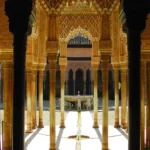
The Alhambra overlooks the city from the Sabika hill. The complex brings together the Nasrid palaces (Court of the Myrtles, Court of the Lions, Hall of the Two Sisters), the Alcazaba fortress, the Palace of Charles V and the gardens of the Generalife. It is a UNESCO World Heritage Site together with the Albaicín. Entry numbers are limited and the Nasrid palaces are visited at a set time slot: book on the monument’s official website several weeks ahead, longer in spring. We have a full page on visiting the Alhambra (tickets, route, opening times).
The old Moorish quarter climbs the hill opposite the Alhambra: cobbled lanes, white houses, cármenes (houses with walled gardens) and small squares. The Mirador San Nicolás offers the most famous view of the palaces, with the snow-capped Sierra Nevada behind them in winter and spring. It is packed at sunset; the higher Mirador de San Cristóbal is quieter. The Carrera del Darro and the Paseo de los Tristes, at the foot of the hill, follow the river beneath the walls.
The Sacromonte
Beyond the Albaicín, the Sacromonte is the district of houses dug into the hillside, long home to the Roma (Gitano) community. You can watch flamenco shows (zambra) in caves, and a small museum explains cave dwelling. Higher up, the Sacromonte Abbey is open to visitors.
The cathedral and the Royal Chapel
In the centre, the Renaissance cathedral stands next to the Royal Chapel, built to house the tombs of Isabella of Castile and Ferdinand of Aragon, who took Granada in 1492. Around them, the Alcaicería, the former silk market now full of shops, and Plaza Bib-Rambla form the shopping heart of the city.
The Realejo and the centre
The old Jewish quarter, below the south side of the Alhambra, is more residential, with tapas bars and street-art murals. The Corral del Carbón, a former merchants’ inn from the Nasrid period, and the Bañuelo, 11th-century Arab baths on the Carrera del Darro, are two small monuments not to miss.
The Charterhouse and Lorca’s house
To the north, the Charterhouse (Cartuja) surprises with its Baroque sacristy. Federico García Lorca, who was born in the area, had a summer house that is now a museum in the park named after him. The Science Park, to the south, is a good choice for families.
Tapas in Granada
In Granada, a tapa is traditionally served with every drink ordered at the bar: it is one of the few cities in Andalusia where the custom is still common. Calle Navas, Calle Elvira and the Realejo have the most bars. Also try the tea and pastries of the teterías on Calle Calderería, a legacy of North African influence.
Day trips from Granada
The Sierra Nevada: a ski resort from roughly December to April, hiking in summer; about 45 minutes by car or bus.
The Alpujarras: white villages clinging to the southern slopes of the mountains (Pampaneira, Bubión, Capileira), easiest to reach by car.
Córdoba and Seville: combine them on a tour; see our guides to Córdoba and Seville.
Málaga and the Costa del Sol: about 1 hour 30 minutes away, for the sea; see our guide to visiting Málaga.
Guadix: a town with many cave houses, about an hour away.
Day 1: the Alhambra and the Generalife (at least half a day), then down to the Carrera del Darro; sunset at the Mirador San Nicolás
Day 2: cathedral and Royal Chapel, Alcaicería, Corral del Carbón; afternoon in the Albaicín, flamenco evening in the Sacromonte
Day 3: the Realejo, the Bañuelo, the Charterhouse or Lorca’s house; tapas in the evening
Day 4 (optional): a trip to the Alpujarras or the Sierra Nevada
With only one day, you have to choose: the Alhambra in the morning, the Albaicín in the afternoon. If you could not get a ticket for the Nasrid palaces, the Albaicín and the Sacromonte still justify the trip.
When to go to Granada: the climate month by month
The best months to visit Granada are April, May, late September and October: 20 to 29 °C (68 to 84 °F) in the afternoon and still-cool nights. July and August exceed 34 °C (93 °F) as an average high, but nights drop to 15-16 °C (59-61 °F). Winter is sunny and mild in the afternoon (13 to 15 °C (55 to 59 °F)) but cold at night, often close to 0 °C (32 °F) in January.
Month
High °C (°F)
Low °C (°F)
Rain mm (in)
Crowds
Prices
Verdict
January
13.0 (55)
0.3 (33)
42 (1.7)
Low
Low
⚠️ Cold at night, often clear skies, few visitors
February
15.4 (60)
1.6 (35)
38 (1.5)
Low
Low
⚠️ Cool, snow on the Sierra Nevada
March
19.0 (66)
3.8 (39)
32 (1.3)
Medium
Medium
✅ Mild, almond blossom, Holy Week in some years
April
20.6 (69)
6.0 (43)
36 (1.4)
High
High
✅ Ideal for walking; a few showers
May
25.0 (77)
9.4 (49)
28 (1.1)
High
High
✅ The best month: warm and dry, patios in bloom
June
31.0 (88)
13.6 (56)
11 (0.4)
Medium
Medium
⚠️ Already hot in the afternoon, music and dance festival
July
34.8 (95)
15.7 (60)
2 (0.1)
Medium
Medium
❌ Intense daytime heat, cooler nights
August
34.2 (94)
15.5 (60)
4 (0.2)
Medium
Medium
❌ Intense heat, quieter city
September
29.4 (85)
12.8 (55)
19 (0.7)
High
High
✅ Heat easing by the end of the month
October
23.2 (74)
8.7 (48)
40 (1.6)
High
High
✅ Pleasant, soft light
November
17.0 (63)
4.2 (40)
54 (2.1)
Medium
Medium
⚠️ Wetter, few visitors
December
13.4 (56)
1.7 (35)
56 (2.2)
Medium (holidays)
Medium
⚠️ The wettest month, cold nights
Temperatures and rainfall: 1991-2020 normals for the Granada airport station (altitude 567 m (1,860 ft)), Spanish State Meteorological Agency (AEMET). Crowds and prices: estimate based on the tourist seasons.
When to go to Granada: key points
Best times: April-May, late September and October
Hottest month: July, average high of 34.8 °C (95 °F)
Coldest month: January, average low of 0.3 °C (33 °F)
Wettest month: December (56 mm (2.2 in), 7.4 rainy days)
Sunshine: 373 hours in July, still 149 to 172 hours a month in winter
For snow: the Sierra Nevada, from roughly December to April depending on snow cover
Granada, Seville or Córdoba: which copes best with summer?
The usual comparisons simply say that Granada is « cooler ». Here are the figures, month by month, from the AEMET 1991-2020 normals for the three airports, plus the day-night range in Granada (average high minus average low).
Month
Granada high °C (°F)
Seville high °C (°F)
Córdoba high °C (°F)
Granada-Seville gap °C (°F)
Granada day-night range °C (°F)
January
13.0 (55)
16.3 (61)
15.2 (59)
−3.3 (−6)
12.7 (23)
February
15.4 (60)
18.3 (65)
17.4 (63)
−2.9 (−5)
13.8 (25)
March
19.0 (66)
21.6 (71)
21.1 (70)
−2.6 (−5)
15.2 (27)
April
20.6 (69)
24.0 (75)
23.6 (74)
−3.4 (−6)
14.6 (26)
May
25.0 (77)
28.2 (83)
28.1 (83)
−3.2 (−6)
15.6 (28)
June
31.0 (88)
32.9 (91)
33.4 (92)
−1.9 (−3)
17.4 (31)
July
34.8 (95)
36.3 (97)
37.1 (99)
−1.5 (−3)
19.1 (34)
August
34.2 (94)
36.2 (97)
37.0 (99)
−2.0 (−4)
18.7 (34)
September
29.4 (85)
31.6 (89)
31.8 (89)
−2.2 (−4)
16.6 (30)
October
23.2 (74)
26.3 (79)
25.8 (78)
−3.1 (−6)
14.5 (26)
November
17.0 (63)
20.3 (69)
19.1 (66)
−3.3 (−6)
12.8 (23)
December
13.4 (56)
16.9 (62)
15.8 (60)
−3.5 (−6)
11.7 (21)
AEMET 1991-2020 normals (Granada, Seville and Córdoba airports). Gaps: Destination de Voyage calculation based on these normals.
From June to August, Granada is about 1.5 to 2 °C (3 to 4 °F) cooler in the afternoon than Seville and 2.3 to 2.8 °C (4 to 5 °F) cooler than Córdoba: the gap is modest, so the heat is very real.
The real difference is at night: the day-night range reaches 19.1 °C (34 °F) in July, which makes summer evenings more bearable than on the Guadalquivir plain.
In winter, it is the other way round: Granada is the coldest of the three, with lows close to 0 °C (32 °F) in January; pack a proper jacket and choose heated accommodation.
What it means for a tour: in July-August, end in Granada rather than Seville; in winter, do the opposite.
Sunset times in Granada, month by month
Sunset over the Alhambra, seen from the Mirador San Nicolás, is the city’s most sought-after moment. To arrive in time (and find a spot), here are sunrise and sunset times on the 15th of each month, in local time.
Month
Sunrise
Sunset
Day length
January
8:27
18:20
9 h 53 min
February
8:03
18:53
10 h 51 min
March
7:25
19:21
11 h 56 min
April
7:39
20:49
13 h 09 min
May
7:05
21:15
14 h 10 min
June
6:53
21:36
14 h 42 min
July
7:06
21:34
14 h 28 min
August
7:31
21:06
13 h 36 min
September
7:56
20:22
12 h 26 min
October
8:22
19:37
11 h 16 min
November
7:53
18:04
10 h 11 min
December
8:20
17:58
9 h 37 min
Destination de Voyage astronomical calculation (NOAA solar algorithm, coordinates of central Granada, Spanish legal time, 15th of the month). Actual times may vary by a few minutes depending on the terrain.
Plan to reach the mirador 30 to 45 minutes before sunset in summer. To compare with other cities, see our ranking of day length by destination.
Granada month by month
January: 13 °C (55 °F) in the afternoon but 0 °C (32 °F) at night. Often clear skies, snow on the Sierra Nevada, fewer people at the Alhambra.
February: cool (15 °C, 59 °F). A good month for the Alhambra without crowds and to combine with skiing.
March: 19 °C (66 °F), the first fine days. Depending on the date of Easter, Holy Week may fall in late March.
April: 21 °C (70 °F), a few showers (6 rainy days). Very popular: book the Alhambra early.
May: 25 °C (77 °F), dry weather. In early May, the Festival of the Crosses (Día de la Cruz) livens up the squares.
June: 31 °C (88 °F). The International Festival of Music and Dance is usually held between June and July, partly in venues at the Alhambra.
July: the hottest month (34.8 °C (95 °F)), almost no rain. Visit the Alhambra in the first morning slot.
August: 34 °C (93 °F), nights at 15 °C (59 °F). Fewer people than in spring.
September: 29 °C (84 °F), the heat eases by the end of the month.
October: 23 °C (73 °F), soft light: one of the best months.
November: 17 °C (63 °F), more rain (54 mm (2.1 in)). Quiet, with prices falling.
December: 13 °C (55 °F), the wettest month; Christmas markets and lights in the centre.
Everything on foot, buses to the Alhambra, plenty of tapas bars
Albaicín
Atmosphere and views
Steep streets, difficult car access; some places have a view of the Alhambra
Realejo
A more local stay
Walking distance from the Alhambra (steep climb), quiet in the evening
Alhambra hill
Early-morning visits
A few hotels right next to the monument, away from the bustle
Near the station
Arriving by train
Practical, less charm, 20 minutes’ walk from the centre
For Holy Week and Spanish long weekends, book early.
In winter, check that your accommodation is heated: nights are cold. In summer, air conditioning is essential.
Getting around Granada
On foot: the centre is easy to explore, but the Albaicín, the Sacromonte and the Alhambra are uphill: bring good shoes.
Minibuses: small bus lines serve the Albaicín, the Sacromonte and the Alhambra from Plaza Nueva and Plaza Isabel la Católica.
Light rail: one line crosses the city from north to south, mainly useful for the station and outlying districts.
From the airport: a bus links the airport with the centre; taxis also make the trip.
Train and bus: connections to Seville, Córdoba, Málaga and Madrid; the bus is often more direct for Andalusian cities.
Car: pointless in the city, where access to the historic centre is restricted; useful for the Alpujarras.
Budget for visiting Granada
Item (per person per day)
Budget
Comfort
Accommodation (sharing a double room)
roughly €30 to €45
roughly €75 to €140
Meals
roughly €20 to €30 (tapas served with drinks)
roughly €40 to €65
Transport
roughly €3 to €6
roughly €10 to €15
Sights and shows
roughly €10 to €20
roughly €20 to €30
Total
roughly €65 to €100
roughly €140 to €240
Rough estimates per person per day, excluding travel to Granada. Check current Alhambra prices on its official website.
Entry requirements, health and safety
US citizens: Spain is in the Schengen area. Your passport should be valid for at least 3 months beyond your period of stay (the State Department recommends 6 months), and you need sufficient proof of funds and a return ticket; students and athletes need a visa to take part in study or sports programmes (U.S. Department of State, travel.state.gov, last updated August 11, 2025).
UK citizens: no visa for up to 90 days in any 180-day period as a tourist. Your passport must have been issued less than 10 years before the day you arrive and be valid at least 3 months after the day you plan to leave the Schengen area. The EU Entry/Exit System (EES) is being implemented: fingerprints and a photo may be taken at the border, free of charge (UK FCDO, GOV.UK, updated 12 August 2026).
Health: UK travellers need a GHIC or EHIC for medically necessary state healthcare, which GOV.UK says is not a substitute for travel insurance; whatever your nationality, take out insurance that covers medical costs. Emergency number: 112 (GOV.UK and travel.state.gov).
Safety: the U.S. Department of State notes that street crime targets tourist spots, airports, train stations and beach destinations; keep valuables out of outer pockets and carry a copy of your passport’s bio page rather than the original when you can (you will need the passport to check in to hotels).
Heat and altitude: the U.S. Department of State warns that summer heatwaves can push temperatures above 104 °F (40 °C) in regions such as Andalusia, and GOV.UK notes that altitude sickness may be a risk in higher mountain ranges, including in the Granada region. Drink plenty and avoid the climb to the Alhambra in the hottest hours.
Alhambra ticket booked on the official website, with the right slot for the Nasrid palaces
Your booking confirmation and the passport you booked with
Walking shoes for the cobbled slopes of the Albaicín
A warm layer for the evenings, even in spring
Sunset time checked (table above) for the Mirador San Nicolás
Spanish meal times: lunch around 2 pm, dinner rarely before 9 pm.
Money: cards are accepted almost everywhere; GOV.UK notes you may be asked for photo ID when paying by card. Keep a few coins for the buses.
Mobile data: check your home carrier’s roaming charges before you go, or see our travel eSIM guide.
Respect the neighbourhoods: people live in the lanes of the Albaicín and the Sacromonte; keep the noise down in the evening.
Frequently asked questions
How many days do you need to visit Granada?
Two days are enough for the Alhambra, the Albaicín, the Sacromonte and the centre. Three days leave time for the Charterhouse, the Realejo and a flamenco evening; add a day for the Alpujarras.
What is the best time to visit Granada?
April, May, late September and October: 20 to 29 °C (68 to 84 °F) in the afternoon according to the AEMET 1991-2020 normals. Summer is very hot (34.8 °C (95 °F) in July) and winter nights are cold.
Is Granada cooler than Seville in summer?
A little: about 1.5 to 2 °C (3 to 4 °F) less in the afternoon from June to August according to our calculation based on AEMET normals, but nights are noticeably cooler thanks to the altitude.
Can you visit Granada without seeing the Alhambra?
Yes. The Albaicín, the Sacromonte, the cathedral, the Royal Chapel and the viewpoints easily fill a day. But the Alhambra remains the main reason for the trip: book it as soon as your dates are set.
How do you get to Granada?
Granada has its own airport (Federico García Lorca Granada-Jaén), with a limited choice of routes. Many travellers fly into Málaga, about 1 hour 30 minutes away by road, or Madrid, and continue by train or bus.
What time should you go to the Mirador San Nicolás?
The sun sets around 6 pm in winter and around 9:30 pm in June-July (local time); arrive 30 to 45 minutes before.
Our sources
Spanish State Meteorological Agency (AEMET): 1991-2020 normals for the Granada, Seville and Córdoba airports (via Wikipedia climate tables citing AEMET)


 FlightsKiwi.comCompare flights and airline combinations to Granada.Compare flights