
You can travel with a baby from the first few weeks, provided you talk to the pediatrician first, choose a nearby, easy destination and sort out the paperwork: even a newborn needs their own passport to travel abroad. Air France advises against traveling within 7 days of birth.
This guide covers documents, airline rules for babies, health precautions, a baby packing list and destination ideas, with official sources for US and UK travelers. For older children, see our family travel section.
Traveling with a baby: the essentials
- Passport: your baby needs their own passport. For UK citizens, GOV.UK says a child passport is valid for 5 years; US citizens should check the State Department’s passport rules for minors on travel.state.gov.
- Entry rules: check the entry requirements for your destination (UK FCDO or U.S. State Department). The UK ETA, for example, is required for each person, including babies and children.
- Health cover: UK travelers need their own GHIC or EHIC for each child in the EU, which does not replace travel insurance.
- On the plane: airlines treat a baby as a child under 2; they travel on an adult’s lap or in their own seat with an approved car seat.
- Liquids: at UK airports, containers of baby milk or baby food of up to 2 litres can go through security; US airports have their own rules, so check TSA.
How old should a baby be to travel?
There is no legal minimum age to travel. Airlines set their own limits: Air France advises against traveling within 7 days of birth, and other airlines accept babies from a minimum age set in their conditions (Vueling mentions babies « from 7 days to 2 years »). The pediatrician’s advice remains the reference, especially for a premature baby or a baby being followed for a health problem.
For a first trip, favor a short journey, little time difference and a destination whose health system reassures you.
Documents: your baby’s paperwork
UK citizens
According to GOV.UK (checked 12 November 2026), a child passport is for children under 16, costs £66.50 to apply online and £80 with a paper form from the Post Office, and is valid for 5 years. Someone with parental responsibility must apply, and you need to give both parents’ details. GOV.UK advises not to book travel until you have a valid passport. The UK FCDO’s foreign travel checklist (updated 5 June 2026) also says to check whether you need extra documentation if you are travelling with children.
US citizens
The U.S. State Department sets the passport rules for minors and the entry requirements for each destination on travel.state.gov. Read the « Entry, Exit and Visa Requirements » section of your destination’s country page, and apply early for the baby’s passport.
- Allow for passport processing time: apply as soon as you know your travel date.
- Some countries have their own requirements for minors, for example proof of parental consent when a child travels with one parent or another adult: look for this in the entry requirements of the destination’s travel advice, or contact the embassy.
- Each person needs their own electronic travel authorization where one applies: for the UK ETA (£20), GOV.UK says each person traveling needs one, including babies and children.
Health: preparing the trip with your pediatrician
- Check-up before you leave: the CDC advises seeing your child’s health care professional or a travel medicine specialist at least one month before you leave, and making sure routine vaccines are up to date. Infants 6 to 11 months old should get 1 dose of MMR vaccine before international travel (CDC, page last reviewed August 16, 2022).
- Health cover: UK travelers need a GHIC or EHIC for each family member in the EU, and the UK FCDO says it is not an alternative to travel insurance (medical repatriation, for example, is not covered). US travelers should check what their insurance covers abroad. Beyond Europe, check your travel insurance for medical costs and repatriation.
- Baby medicine kit: thermometer, saline drops, fever medicine suited to weight, rehydration solution, diaper cream, baby-safe sunscreen, on the advice of the pediatrician or pharmacist.
- Heat and sun: infants cope badly with heat; avoid the hot hours, hydrate and cover up.
- Mosquitoes: bed and stroller nets, covering clothing; ask the pediatrician which repellent is suitable at your child’s age. The CDC suggests covering strollers and baby carriers with mosquito netting.
- Water: where tap water is not safe, use bottled water suited to bottles. The CDC says that if you use formula and water quality is poor, you should use sterile water to prepare it and sterilize bottles, nipples, caps and rings.
- Diarrhea: the most common illness in children who travel. For infants, breastfeeding is the best way to keep them hydrated; seek medical attention if the child seems dehydrated, has a fever or bloody stools.
Flying with a baby
For airlines, a baby is a child under 2. The rules below were noted on 13 October 2026 from the airlines’ official sites; they vary by airline and fare.
| Point | Air France | Other airline noted |
|---|---|---|
| Seat | On an adult’s lap, or in an individual seat (child fare) with an approved car seat or harness | Ryanair: without a reserved seat, a child under 2 travels on an adult’s lap |
| Baby’s baggage (lap infant) | In the cabin: 1 carry-on bag (12 kg, 55 x 35 x 25 cm); in the hold: 1 bag of 10 kg, unless the ticket does not include a checked bag | Ryanair: a 5 kg baby bag in addition to the adult’s baggage |
| Stroller, car seat | Carriage of a stroller or rigid baby carrier and a car seat | According to each airline’s conditions |
| Bassinet | On long-haul flights, subject to availability; babies under 10 kg and 70 cm; only a Seat Option guarantees it | Depends on the airline and aircraft |
Tips for the flight
- Book suitable seats early (bassinet rows on long-haul flights).
- Nurse, give a bottle or a pacifier on takeoff and landing: swallowing helps balance the pressure in the ears.
- Keep enough in the cabin for twice the length of the flight: diapers, wipes, a complete change of clothes for the baby and for you, milk, baby food.
- At security, check the rules at your airport: the UK government says containers of up to 2 litres through security are allowed at all UK airports if they contain baby food or baby milk (GOV.UK, hand luggage restrictions, read 12 November 2026). For US airports, check the TSA’s guidance on baby formula, breast milk and baby food at tsa.gov.
- For a long-haul flight, choose a schedule that matches the baby’s sleep if you can.
Car and train with a baby
- By car: a car seat suited to age and weight, rear-facing for the smallest; regular breaks. The CDC advises researching car seat guidelines for the country you are going to, because a car seat from the United States may not be approved in another country. With a rental, reserve the car seat in advance or bring your own (see our road trip guide).
- By train: being able to stand and change the baby often makes it the most comfortable option in Europe; see our tips for traveling by train.
The baby packing list
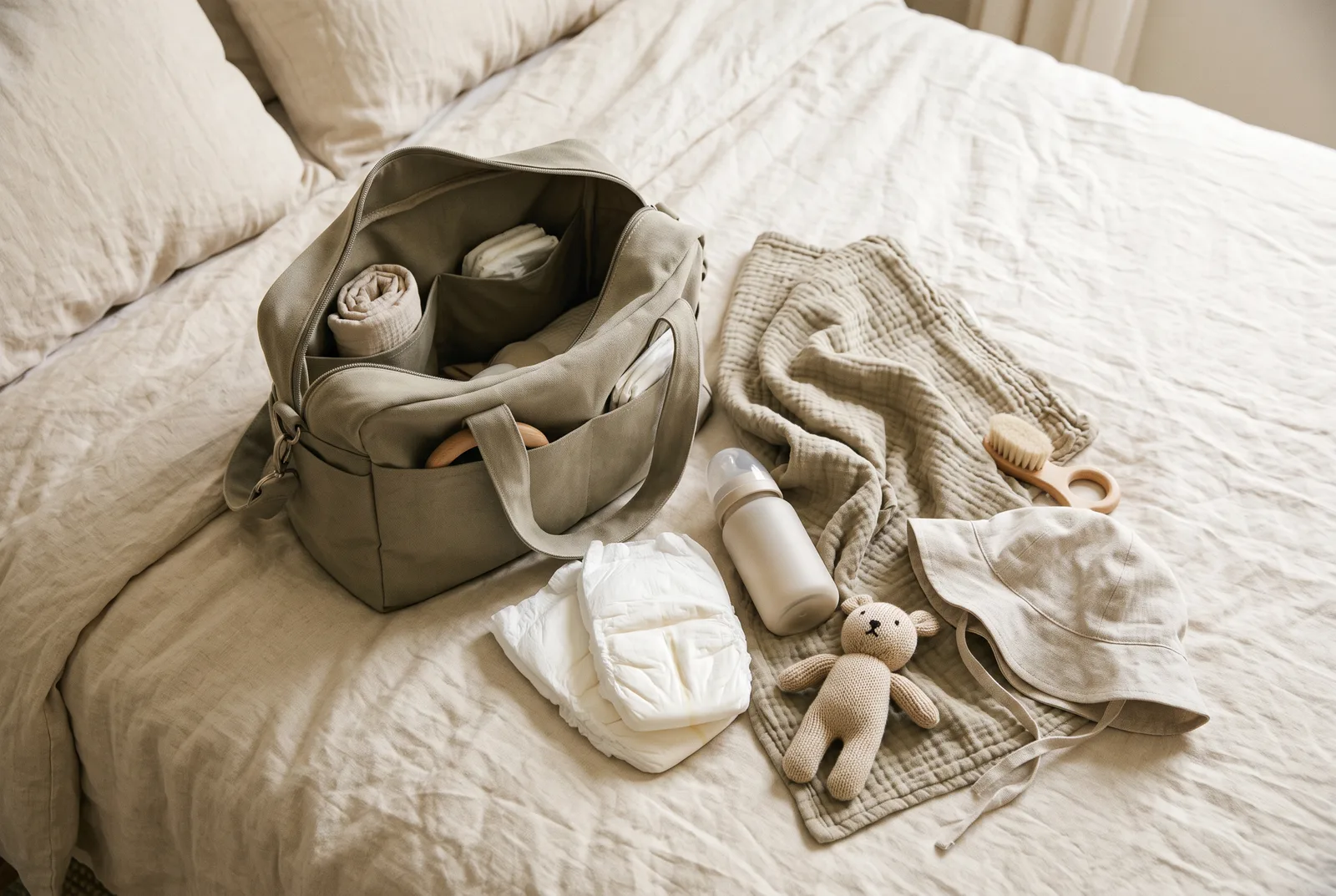
Baby packing checklist
Documents
Feeding
Diapering and washing
Sleep and transport
Health
Clothes
For the adults’ luggage, see our complete packing list.
Which destinations with a baby?
The criteria that matter: a short flight or train journey, little time difference, a temperate climate in the chosen season, accessible healthcare and equipped accommodation (cot, kitchen). A few destinations that tick these boxes, to check by season in each guide:
| Destination | Why with a baby | Watch out for |
|---|---|---|
| Portugal | Short flights from much of Europe, little time difference within Europe | Summer heat in the south |
| Spain and Balearic Islands | Short flights within Europe, many equipped rentals | Strong heat in summer |
| Canary Islands | Mild climate all year | Strong sun even in winter |
| Madeira | Mild climate, calm pace | Hilly terrain: bring a baby carrier rather than a stroller |
| Malta | Small island, short distances | Summer heat |
| Croatia and Greece | Calm sea, apartment stays | Heat and ferries in high season |
| France (Brittany, Corsica) | Easy trips by train or car | Heat in midsummer in the south |
| Guadeloupe, Martinique, Réunion | Beaches and warm weather | Long-haul flight, mosquitoes: medical advice recommended |
Distant destinations are not ruled out, but they need more preparation (vaccines, time difference, access to healthcare): talk to the pediatrician before you book.
Frequently asked questions
Does a baby need a passport?
Yes, to travel abroad a baby needs their own passport. For UK citizens, GOV.UK says a child passport is valid for 5 years. US families should check the State Department’s passport rules for minors.
Does a baby need a travel authorization such as the UK ETA?
Where an authorization applies, each person needs one. For the UK ETA, GOV.UK says each person traveling needs one, including babies and children.
How old must a baby be to fly?
There is no legal age: each airline sets its rules. Air France advises against traveling within 7 days of birth. Ask the pediatrician, especially for a newborn.
Can you take milk and baby food through airport security?
At UK airports, containers of baby milk or baby food of up to 2 litres can go through security (GOV.UK). For US airports, check the TSA’s guidance. Present them separately at security.
How do you protect a baby’s ears on a plane?
Nursing, giving a bottle or a pacifier on takeoff and descent helps balance the pressure. If your baby has a cold or ear infection, consult before the flight.
Does a baby get a baggage allowance?
With Air France, a lap infant gets a 12 kg carry-on bag in the cabin and a 10 kg bag in the hold (unless the ticket has no checked bag). With Ryanair, the adult may take a 5 kg baby bag in addition to their baggage. Check your airline’s rule.
Our sources
- GOV.UK, Get a passport for your child, read 12 November 2026
- UK FCDO, Foreign travel checklist (GOV.UK, last updated 5 June 2026), read 12 November 2026
- GOV.UK, Get an electronic travel authorisation (ETA) to visit the UK, read 12 November 2026
- GOV.UK, Hand luggage restrictions at UK airports: liquids, read 12 November 2026
- CDC Travelers’ Health, Traveling with Children (page last reviewed August 16, 2022), read 12 November 2026
- U.S. Department of State, travel.state.gov country information pages
- Air France, « Traveling by plane as a family with babies and children », consulted on 13 October 2026
- Ryanair, General Terms & Conditions of Carriage (article 3.1), and Vueling help center, consulted on 13 October 2026
- Our methodology
Updated November 2026.